I imagine it's because, when the year of the Linux desktop didn't arrive, developers everywhere decided they could make it happen if only they tried hard enough to put together the perfect UI, and so the kitchen-sink approach proliferated.
> Or back in the '90s/'00s, attempts towards recreating the Windows UI/UX?
I take exception to this one. In fact it was Microsoft with Windows 7 (released in 2007) which copied much of the UI of older Linux desktops like KDE and GNOME versions 1.0 (circa 1997). See:
https://linuxgazette.net/165/misc/laycock/gnome.png https://images.channelpartner.de/bdb/490847/1066x600.jpg
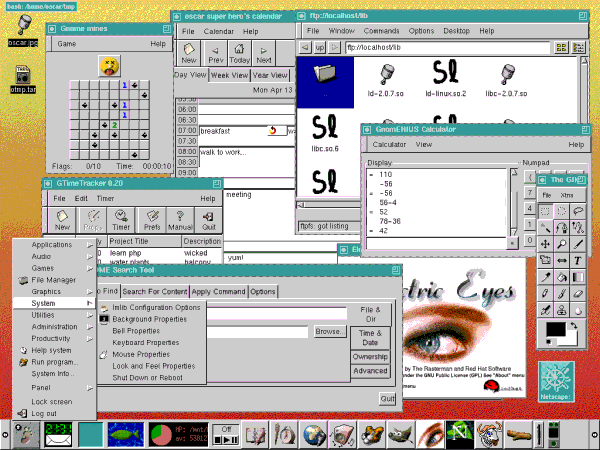

Linux desktop environments were better back then. XFce is the only tolerable one I can think of, today. Even there, I hate the defaults and preferred it in the XFce3 days when it was just an (improved) CDE clone. Fluxbox or bust!
There's also ReactOS, though admittedly it's a non-Linux open source OS.
Why the hell do you think those things are related? I can easily make my OS look macOS, windows, something weird inbetween or some pink vapourwave hell from the 90's or some minimalist tiling WM and that's the beauty of it. That's exactly one of the things I want.
I don't use Linux because of a particular DE with presets that let's me mimic windows. If that was all why wouldn't I just use windows.
> I don't think most people who buy a Linux phone actually want a Linux phone. They want an open-source phone. The Linux philosophy isn't important to them, they essentially want open-source iOS
Seems like the phenomenon of people choosing Linux, only to choose a windows manager that makes the entire thing look like a non-open OS, fits this same line of thinking. At the end of the day, most people don't care about the particulars of Linux, or its ideologies. They just want an open and customizable OS, and if there's a variant that looks like a more widely-used OS, so much as the better.
If there were more open OS's that were as far along as Linux, it would likely be less popular. The important thing is open-source phones or computers, not Linux ones.
Yes, KDE has copied Windows features.
But: they made it better (for people like me). I didn't get Windows, but something that happened to look similar but work better.
And the latest big Windows update copied a good deal of styling from KDE Plasma so they are clearly doing something interesting :-)
I personally use Elementary daily and I really don't like OSX, they only superficially look similar but it's a very different mindset and UX.
Maybe people also do just want general open-source computing, and Linux just happens to be the one that's furthest along, its philosophy and ideology be damned.
Personally, I'm hoping Haiku eventually gets further along to be usable as a Linux alternative, and it's fun to wonder what it would be like as a mobile OS.