When I say “heroic efforts”, that’s in contrast to “ordinary error recovery and failover”, which is the way you’d want to handle a DC fire, because DC fires happen often enough.
The thing is, while these big companies have a much larger base of expertise to draw on and simply more staff time to throw at problems, there are factors which incentivize these employees to *increase risk* rather than reduce it.
These big companies put pressure on all their engineers to figure out ways to drive down costs. So, while a big cloud provider won’t make a rookie mistake—they won’t forget to run disaster recovery drills, they won’t forget to make backups and run test restores—they *will* do a bunch of calculations to figure out how close to disaster they can run in order to save money. The real disaster will then reveal some false, hidden assumption in their error recovery models.
Or in other words, the big companies solve all the easy problems and then create new, hard problems.
What we call “progress” in humanity is just putting our best efforts into reducing or eliminating the problems we know how to solve without realizing the problems they may create further down the line. The only way to know for sure is to try it, see how it goes, and then re-evaluate later.
California had issues with many forest fires. They put out all fires. Turns out, that solution creates a bigger problem down the line with humongous uncontrollable fires which would not have happened if the smaller fires had not been put out so frequently. Oops.
Sure, the amount of expertise, redundancy and breadth of service offerings they provide is worth a markup, but they are also significantly more expensive than they need to be.
Thanks to being the leader in an oligopoly, and due to patterns like making network egress unjustifiably expensive to keep you (/your data) from leaving.
AWS may charge more for egress, but that’s not high enough for it to be a concern for most clients.
A bigger, independent concern is probably that there should be sufficient redundancy, backups and such that allows for business continuity. (Note again that I’m not saying that all companies make full use of these features, but those that care for such things do. Additionally, I’ve honestly never heard of an AWS DC burning down. Either it doesn’t happen frequently or it doesn’t have enough of an effect on regular customers, both of situations are equivalent for my case).
Most businesses choose to prioritize the second aspect. Even if they have to pay extra for egress sometimes, it’s just not big enough of a concern as compared to businesses continuity.
Put another way: one is guided towards making operational good choices rather than being left to discover them yourself. This is a value proposition of public clouds since it commoditises that specialist knowledge.
They don't automatically geo-replicate things. You still need a backup for the torched EC2 instance to be able to relaunch in another AZ/region.
"The whole site has been isolated, which impacts all our services on SBG1, SBG2, SBG3 and SBG4. "
Wonder if those SBGx were advertised as being the same as "Availability Zones" - when other cloud providers ensure zones are distanced enough from each other (~1km at least) to likely survive events such as fire.
SBG is for Strasbourg. That's not a region. It's a city. Obviously, SBG1 to 4 are in the radius of one fire. It's four different buildings on the same site.
https://cdn.baxtel.com/data-center/ovh-strasbourg-campus/pho...
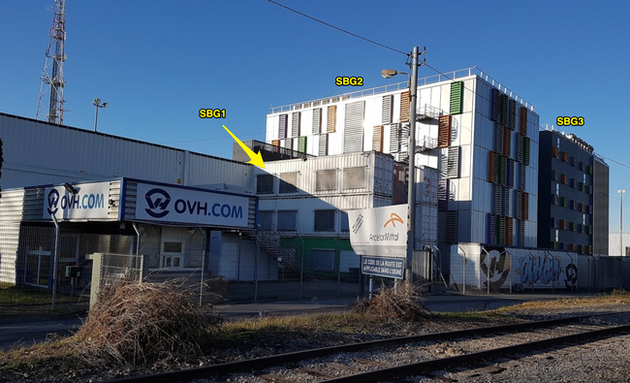
I use a single server at OVH, and I'm not in the affected DC, but if this DID happen to me I could get back up and running fairly quickly. All our data is mirrored on S3 and off site backups are made frequently enough it wouldn't be an issue.
Plus, you still need to plan for a scenario like this even with AWS or any other cloud provider. It is less likely to happen with those, given the redundancy, but there is still a chance you lose it all without a backup plan.
Personally I'll continue to use these third world cloud providers. But I like to live on the edge.
Their solar panels on the roof caught on fire. Presumably there was no actual disruption in service computing-wise.
> Google fire
2006, still a young company at that point. Also this was way before GCP where they were responsible for other people's services.
> AWS fire
Data center caught on fire while it was under construction. Drunk construction workers messed up, not AWS. Presumably no computers were even inside yet. This is completely different from OVH completely burning down while all their customers' data went up in flames.
If these are the best examples of Big Cloud messing up, this is quite the endorsement.
It's funny how the OVH CEO tells everyone to go activate their DRPs while the company didn't have enough foresight to install fire suppression systems.
Keep in mind I’m talking not of “downtime” but of actual data loss which might affect business continuity.
This is really tragic. I’m hoping they have some kind of multi regional backup/replication and not just multi zones (although from the twitters it appears that only one of the zones was destroyed however the others don’t seem to be operational atm).