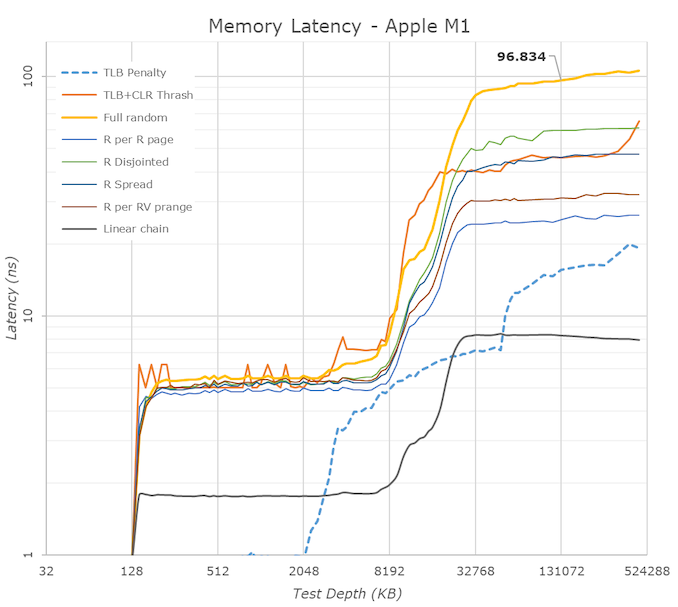
M1: https://images.anandtech.com/doci/16252/latency-m1_575px.png
Zen3: https://images.anandtech.com/doci/16214/lat-5950.png
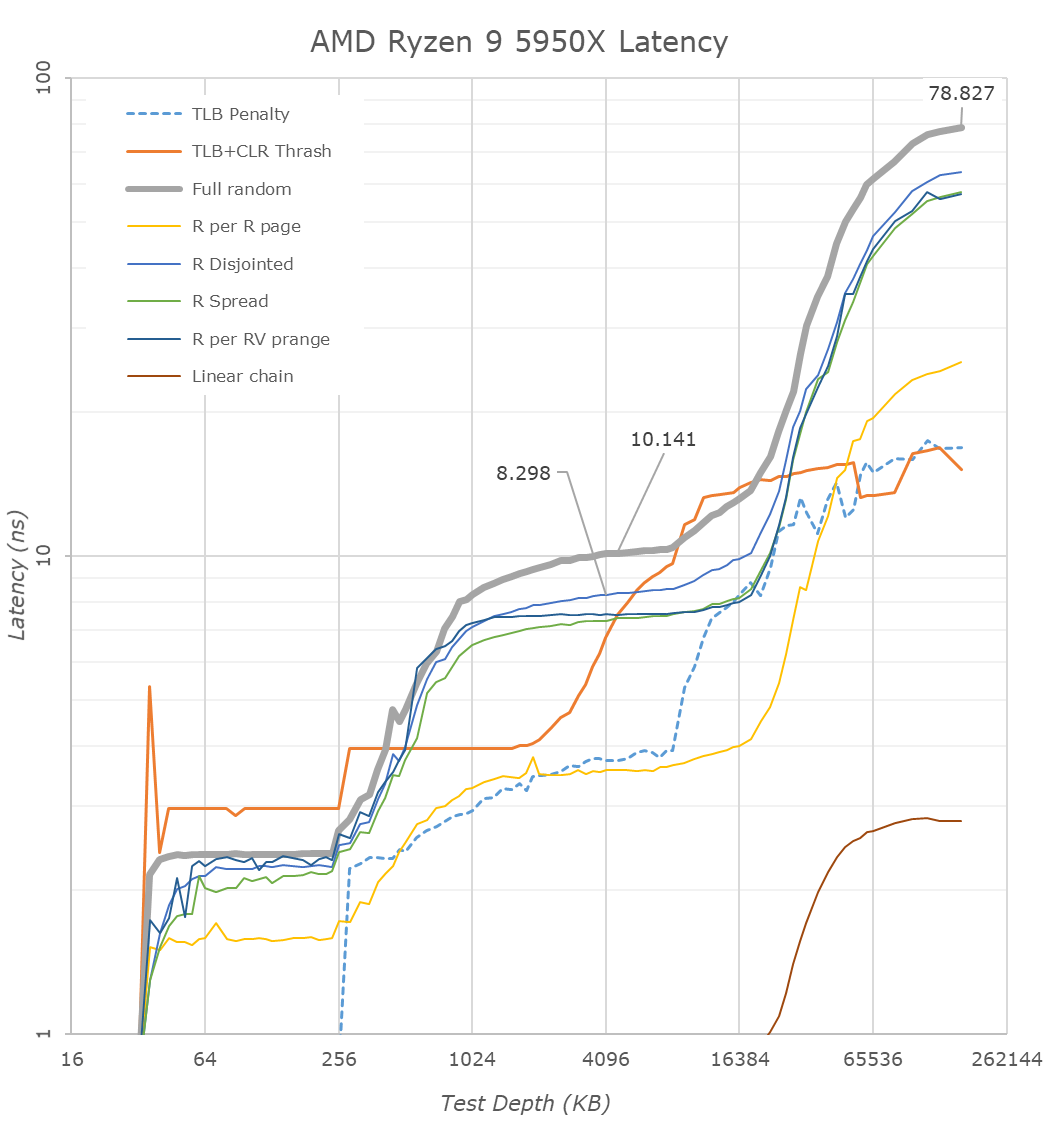
If anything the M1's ram has _higher_ latency than the Zen3.
(Can't reply to the sibling comment but Intel's numbers are even better: https://images.anandtech.com/doci/16214/lat-10900.png)

Is it random accesses you want to test? Or TLB thrashing?
The R per RV prange benchmark accesses memory randomly, but in a TLB friendly pattern (TLB thrashing real world workloads aren't particularly common). The M1 gets 30ns, the 5960X is 55ns and still climbing at the max array size.
The 5950X does better on "full" random, although that's unclear if that's a faster TLB, or the testing with a different page size. With Linux for TLB thrashing workloads you can always use HUGE pages, not sure if the M1 hardware supports that though.
Just noting Zen3 is not Intel.
Please stop this non-sense on HN. DRAM is DRAM. L2 Cache is L2 Cache. Doesn't matter how good its 8-Channel LPDDR4X Memory Architecture sitting next to the Die in the same package it is still just DRAM.
It takes my M1 a little while longer to stitch together 4K videos than my 2017 MPB 16". My 2017 MBP screams and throttles down the CPU down to 60%-75% as soon as editing starts.
Then buy something else, full stop.
Even if the RAM were as fast as L1 cache, it still wouldn't do a thing for the SSD bottleneck.
These things already don't act as if it's RAM as we're used to considering it. They could probably have shipped the first ones with 4G RAM and had 'em act relatively normal… with heavy stuff like 4K video editing. Not great, but normal. So they did 8G RAM to have 'em act more impressive… like doing said editing smoother with fewer dropped frames than far more powerful Intel machines with a lot more RAM.