The quote is explicitly only about "people who talk about “Nice Guys” – and the people who enable them, praise them, and link to them". (https://cdn.substack.com/image/fetch/f_auto,q_auto:good,fl_p...)
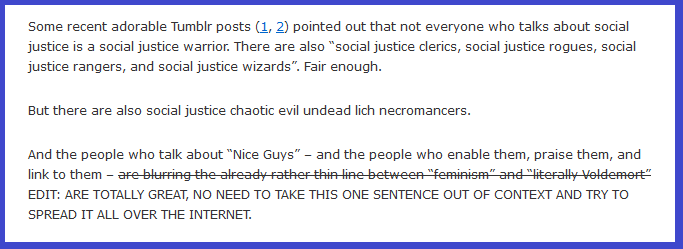
This leads to several keys questions: Are all feminist such people who talk about "nice guys" and who enable, praise and link to them?
The second question is, are all people who talk about "nice guys" and who enable, praise and link to them feminist?
The third question is if this definition of "nice guy" is the informal term or the sarcastic meaning, and how useful either are to describe a psychology profile or human male stereotype?
The fourth question is if a discussion around "nice guy" stereotype of either profile is of strategist benefit to goals of some feminist theory, and then which ones?
He refers to the "already rather thin line between 'feminism' and literally 'Voldermort'", so it's clear that he's talking about feminism more broadly. Elsewhere in his writings there are statements that are completely consistent with this. For example, here he is alluding in passing to the supposed fact that only 30% of feminists are "sane": https://slatestarcodex.com/2013/10/20/the-anti-reactionary-f... At some point you've just got to accept that he's been broadly critical of the feminist movement, and said disparaging things about large numbers of feminists (in aggregate).
My personal take away from this is that editors are good. Scott's ended up writing a long series of unedited blog posts, and as a consequence has made some comments over the years that are flippant, exaggerated, in poor taste, or just plain wrong. Such are the perils of blogging. That's his responsibility. The NYT has no obligation to shield him from it.
If the New York Times Article had accused the author of being critical to parts of feminist movement it would likely been more true, and it would likely also be less of a news item to include. A lot of people are critical to parts of the feminist movement. If one wanted to gain outrage then the "sane" quote might have been useful, and at least it would then be a true quote rather than an interpretation. I doubt however it too would sounds enough outrageously, which is why they did not use it.
Sorry, you’ve lost me here. Are you nitpicking over the difference between ‘feminism’ and ‘feminist’? I don’t see how that helps. The comparison to Voldermort makes it pretty clear that he’s talking about people and not just an abstract ideology.
> If the New York Times Article had accused the author of being critical to parts of feminist movement it would likely been more true.
This is exactly what it said: “some feminists”. (“He described some feminists as something close to Voldemort.”)
"He described some feminists as something close to Voldemort" is about as hand wave phrase as it gets, and trying to convince people about an interpretation of a quote is an enterprise doomed before it even started unless the reader already has the same interpretation.
As some last words I have on the subject, I find the whole article utterly dated as well as the quoted sections in it. "Nice guy/bad guy" stereotype hold as much useful utility for social discussions as "Nice girl/bad girl" stereotype. They are example gender based violence direct at getting conformity to gender roles. To the amount the author disagree when people use them I agree with him, and to the amount he himself uses it I disagree with him. Nothing useful can be had from normalize such stereotyping.
>And the people who talk about “Nice Guys” – and the people who enable them, praise them, and link to them – are blurring the already rather thin line between “feminism” and “literally Voldemort”
It's clear that the 'literally Voldermort' phrase is intended to apply at least to "the people who talk about 'Nice Guys'" (and given the 'already', to plenty of other feminists too).
The NYT said that Scott had used this phrase with respect to 'some feminists'. That is 100% accurate. Especially when you consider that the post the quote is taken from references specific feminist writers.
I am not saying this is the case (as I have no connection with the blog), but if the claim is indeed true that racists/sexists think the blog is great (which is the main takeaway I got from the article), that needs to be addressed as to why they are attracted there, and Mr. Siskind does not do that. If the claim is bogus, then the claim is bogus, but Mr. Siskind does not refute that they are attracted to his blog.
As to the feminism issue, in the full context, he criticizes feminism with respect to specific points and texts from feminists (which he is 100% entitled to), but then ends with the sentence in question that to me whichever angle you look at it from says, feminism and pure evil are not too distant. As I noted, he could have backed away from the statement easily by saying his statement is wrong (if he thinks so), but claiming it's out of context is dishonest and a diversion.
You write "if the claim is indeed true that racists/sexists think the blog is great" - but this isn't even the kind of thing that could be true. Imagine how you would prove this claim, do you go to the National Association of Racists and ask for their stance on SSC? Is there a poll of racists and their opinion on niche blogs somewhere?
"Racists" is ill defined by itself. People aren't racist or not the way they are right or left handed. Racism is a spectrum and much of it is debatable and nuanced and affected by context and all that. This is like saying "Some number of an undefined group like something. Prove me wrong." That's not a legitimate claim and there is no need to try and rebut it.
I have no doubt that some racists like the blog and other racists don't like it. Do more racists (proportionally) like and read SSC or the NYT? I don't think you can answer that.
Regarding the feminist issue I'll have to go back and read that post before writing more.
Marketing is essentially the working, reproducible arm of the social sciences, and marketers know a lot about human preferences and how to link them to motivation.
Just because you have more data, it doesn't mean that you can identify constructs like racism from this loads of data. You'd need some kind of ground truth mechanism (like an index of behaviour towards different races) which neither Facebook (nor anyone else) has. It's just wildly implausible.
Maybe, in ten years, NLP will be good enough to identify this, but I don't think these constructs are easily identifiable from text, certainly not in a public space such as Facebook.
> Marketing is essentially the working, reproducible arm of the social sciences, and marketers know a lot about human preferences and how to link them to motivation.
I get what you're trying to say here, and maybe that works in a small number of places, but having worked with marketers in analytics for the past decade or so, suffice it to say that I rarely praise the standards of experimention and (lack of) rigour employed by them.
If the blog has sexist/racist content that attracts sexists and racists, sure, that's a problem, but if the blog had such content, the NYT article wouldn't have resorted to pointing out the commenters, they would have linked the content.
> As to the feminism issue, in the full context, he criticizes feminism with respect to specific points and texts from feminists (which he is 100% entitled to), but then ends with the sentence in question that to me whichever angle you look at it from says, feminism and pure evil are not too distant. As I noted, he could have backed away from the statement easily by saying his statement is wrong (if he thinks so), but claiming it's out of context is dishonest and a diversion.
Specifically, in context, he said "People who go out of their way to be horrifically mean to other people who are pretty unfortunate and unhappy and don't understand why, just for asking why, are pretty much pure evil", it wasn't an attack on all feminists ever, it was an attack on people who he specifically thinks are doing something extremely terrible. That's the context.
Most of the ire is directly at the sequel trilogy, notably the last two movies thereof. So if one of your coworkers says they hated The Last Jedi but loved The Mandalorian, then you can reasonably report them to HR for engaging in discomforting behavior.
I'll try to put this as objectively as I can. There is now a cultural overlap between those that support varying degrees of "censorship" and progressives, and between those that support "free speech" and, let's say, anti-progressives. This makes sense because now racism/sexism is more likely to be censored than extreme progressivism. Probably if it were the other way around (if extreme progressivism were more likely to be censored) then those same progressives would become staunch free-speech advocates and anti-progressives would be fighting for more "content moderation".
So if you are generally for the toleration of ideas, perhaps holding some unpopular opinions yourself, and against censorious tactics, you tend to attract extreme anti-progressives as well. For the most part, racists and sexist do not see themselves as racists and sexists, they see themselves as holding true but unpopular beliefs. Another interesting example of this is Sam Harris somehow having a fair amount of Trump-supporting listeners even though he spends a lot of time ranting about how incompetent and morally-bankrupt he thinks Trump is.
The thing is, it's not wrong to say that pedophiles and such use reddit. They do, in the same way they use phones, TVs, and cars. It's not an apt description though, if someone asks you what reddit is, to talk about the racism and hate and what not. The reason being is that the bad stuff isn't the typical reddit experience and doesn't describe the whole thing well.
In Scott's post he gives the example of the Wizard of Oz review (girl goes to a surreal landscape, kills the first person she meets, then teams up with three strangers to kill again). Maybe it's technically true, but it's not an apt description. It doesn't really capture what the movie is like.
Where I'm going with this is: maybe you can find neo-reactionary or pro-eugenics or racist comments on the blog. I don't recall any examples of horrible comments from the NYT but maybe they are there. Maybe you can find a line or two, like the "feminists are Voldemort" that seem bad and worse outside of context. That's not really what the blog is about though and in a newspaper article describing it probably shouldn't zero in on minor blemishes or debatable flaws and use them as the main focus. Wasn't this supposed to be about Silicon Valley's Safe Space, or getting into the zeitgeist of the "rationalists"? How did the NYT article even attempt to do that? To my reading the NYT was just focused on complaining about the "problematic" aspects and nothing else.
I think it's fair to talk about problematic comments on a blog but it's not fair to act like problematic comments or loose associations to objectionable figured are the main thing when they really aren't.
Regarding your point about the feminists and Voldemort, if memory serves Scott was referring to a specific group of feminists and not likening all feminists to Voldemort. That's not really the impression I got from the NYT though.