In single-thread performance Apple M1 at 3.2 GHz is equal with Intel Tiger Lake @ 4.8 GHz or AMD Zen 3 @ 4.8 GHz (e.g. scores around 1750 in GeekBench 5 ST), but while consuming more than 3 times less per core.
While the higher energy efficiency is impressive, it does not matter much in a laptop, where enough power is available. It will matter only in the future, when Apple will include enough cores in its CPUs, to be able to exploit the higher TDP available in a laptop.
On the other hand, if the power consumption of Tiger Lake / Zen 3 is reduced to be equal with that of Apple M1, their clock frequency is reduced from 4.8 GHz to around 3.5 GHz ... 3.6 GHz, remaining higher than that of M1 (which does more work per clock cycle).
Therefore at equal power per core Apple M1 is faster, but only by around 35%. This advantage is not enough to enable 4+4 Apple cores to match 8 Intel/AMD cores.
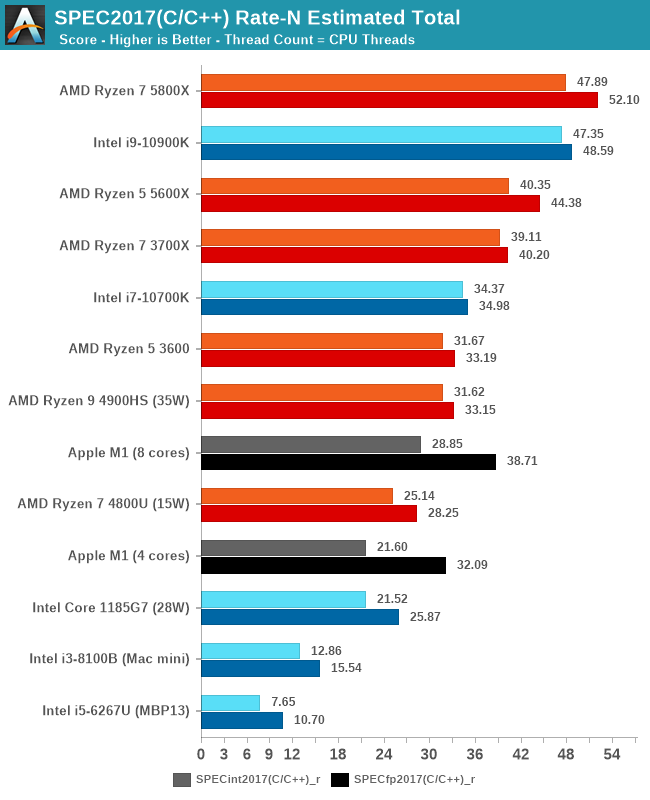
In conclusion, the laptops that will be launched in early 2021, with 8-core Tiger Lake H or AMD Cezanne, will have the same single-thread performance as Apple M1, but higher multi-thread performance. The slower laptops with AMD Renoir already have better multi-thread performance.
Moreover, while Apple M1 has an average IPC 1.5 times higher than the average IPC of Intel/AMD, which enables high scores in benchmarks like SPEC or GeekBench, in computational benchmarks with optimized programs that have higher IPC than the average IPC, Apple M1 is disadvantaged and it is slower in single-thread than even an old Ryzen 7 3700X, unlike in single-thread SPEC or GeekBench, where you need a new Ryzen 9 5900X to exceed the Apple M1 performance.
The M1 is a hybrid 4+4 big.LITTLE SoC and it is the first of its kind that is competitive with the 8+0 pure big Intel and AMD chips.
The M1 has a .LITTLE side that gives it battery powered efficiencies comparable to tablets. This is a very balanced general purpose hybrid architecture. It will be interesting to see the technical strategies used in response.
M1 wins in single core benchmarks, but it loses in multi core.
Also, it beats 9th generation i9 for mobile, not the newer ones (that are still 14nm Vs the 5nm of the M1)
I'm not an Intel fan and I think it lost edge over the years, but M1 doesn't beat the i9 in pure performances, only in controlled benchmarks where the conditions are favourable to M1
Of course the M1 on Apple laptops are faster than every other Apple laptop, but that's only natural.
https://www.anandtech.com/show/16252/mac-mini-apple-m1-teste...
EDIT: for the downvoters
An image is worth thousands words
> Be kind. Don't be snarky. Have curious conversation; don't cross-examine. Please don't fulminate. Please don't sneer, including at the rest of the community.