Re:1% of farms operate 70% of world's farmland
by ip26 on Wednesday November 25, 2020 @10:43AM
(#25210376)
The Jevons Paradox would like a word.
E.g., we spend 14 million acres on non-food corn ethanol, and 80+ million acres of corn is fed to livestock at terrible feed conversion ratios. We'd get the same amount of net calories on our plates for 8 million acres if we ate the corn.
Re:1% of farms operate 70% of world's farmland
by iguy on Wednesday November 25, 2020 @11:20AM
(#25210822)
The area farmed in the US has declined slowly since the 1950s, maybe down 20%? Am eyeballing graphs as google is failing me:
https://www.ers.usda.gov/webdocs/charts/58267/farms_fig01_45...
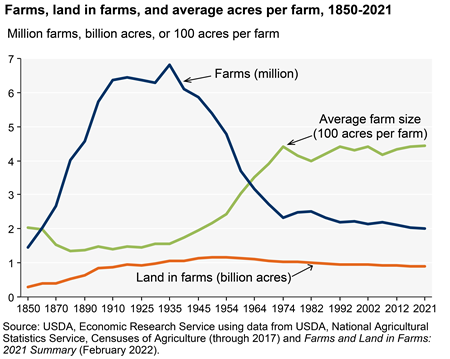
It would decline faster if we didn't subsidize stupid stuff like corn ethanol, for sure.
Edit, a maybe a better graph:
https://ourworldindata.org/grapher/share-of-land-area-used-f...
Re:1% of farms operate 70% of world's farmland
by ip26 on Wednesday November 25, 2020 @11:55AM
(#25211300)
I don't know about France, but I understand in the US that decline has mostly been the result of residential development buying out farmland.
For just one small but hot-button current example, see Napa. For a historical example, see Silicon Valley, which was once orchards.
Re:1% of farms operate 70% of world's farmland
by iguy on Wednesday November 25, 2020 @12:17PM
(#25211574)
Urban land is 69 M acres, cropland 391 (according to some quick googling) and pasture 654. So urban is 17% of cropland, or 7% of all farmland. I'm surprised it's that high to be honest, compared to plane-window impressions. Surely a majority of urban area is post-1950, how much is former crop/ranch/forest I'd struggle to guess. Would be interesting to have better numbers, and over time.
While it certainly reduces on-farm biodiversity, higher yields also let us leave more land completely un-farmed. For example I think maybe 10% of France has returned to forest in the last 40 years, and more since 1900, but I can't seem to find a great link...