News for hackers. Stuff that matters.
Re:1% of farms operate 70% of world's farmland by mellavora on Wednesday November 25, 2020 @05:57AM (#25207931)
Maybe true in glorious future where the industrialized farm can support increased biodiversity. Currently, however, this promotes large-scale monoculture. Which is inherently harmful on almost every level, including the ability to keep the cost of food down and and the supply up.

Food diversity is much much less than it was 100 years ago. Nutritional content of food is down significant levels from 30 years ago.

Re:1% of farms operate 70% of world's farmland by xenocratus on Wednesday November 25, 2020 @06:03AM (#25207970)
> Nutritional content of food is down significant levels from 30 years ago.

Source: https://www.scientificamerican.com/article/soil-depletion-an...

> Currently, however, this promotes large-scale monoculture.

This can be good or bad, depending on what is produced in a large scale, I guess(?) Especially at this point in time we should focus on foods that don't mess with the environment/don't fuel climate change.

Re:1% of farms operate 70% of world's farmland by iguy on Wednesday November 25, 2020 @08:27AM (#25208962)
> Maybe true in glorious future where the industrialized farm can support increased biodiversity

While it certainly reduces on-farm biodiversity, higher yields also let us leave more land completely un-farmed. For example I think maybe 10% of France has returned to forest in the last 40 years, and more since 1900, but I can't seem to find a great link...

Re:1% of farms operate 70% of world's farmland by ip26 on Wednesday November 25, 2020 @10:43AM (#25210376)
The Jevons Paradox would like a word.

E.g., we spend 14 million acres on non-food corn ethanol, and 80+ million acres of corn is fed to livestock at terrible feed conversion ratios. We'd get the same amount of net calories on our plates for 8 million acres if we ate the corn.

Re:1% of farms operate 70% of world's farmland by iguy on Wednesday November 25, 2020 @11:20AM (#25210822)
The area farmed in the US has declined slowly since the 1950s, maybe down 20%? Am eyeballing graphs as google is failing me:

https://www.ers.usda.gov/webdocs/charts/58267/farms_fig01_45...
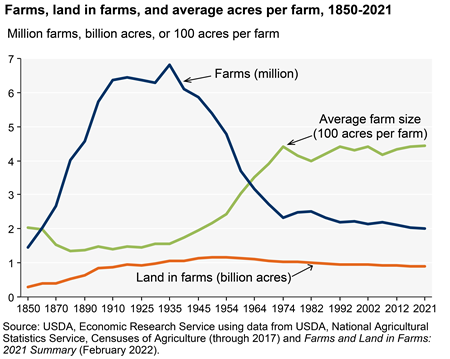
It would decline faster if we didn't subsidize stupid stuff like corn ethanol, for sure.

Edit, a maybe a better graph:

https://ourworldindata.org/grapher/share-of-land-area-used-f...

Re:1% of farms operate 70% of world's farmland by ip26 on Wednesday November 25, 2020 @11:55AM (#25211300)
I don't know about France, but I understand in the US that decline has mostly been the result of residential development buying out farmland.

For just one small but hot-button current example, see Napa. For a historical example, see Silicon Valley, which was once orchards.

Re:1% of farms operate 70% of world's farmland by iguy on Wednesday November 25, 2020 @12:17PM (#25211574)
Urban land is 69 M acres, cropland 391 (according to some quick googling) and pasture 654. So urban is 17% of cropland, or 7% of all farmland. I'm surprised it's that high to be honest, compared to plane-window impressions. Surely a majority of urban area is post-1950, how much is former crop/ranch/forest I'd struggle to guess. Would be interesting to have better numbers, and over time.
Re:1% of farms operate 70% of world's farmland by nemo44x on Wednesday November 25, 2020 @06:17AM (#25208068)
It’s also dangerous from a national security point of view. Consolidating farming and relying on monocultures certainly has economic benefits but it also creates an increasingly fragile system.

A new parasite or disease could easily destroy enough of a years harvest (or more) and now the nation has a food shortage. Because so much of our food is derived from or reliant on the monoculture it would have cascading effects. It would be a disaster on many levels.

Of course this is preventable but who has the courage to stand up for something that could happen when the political capital is won dealing with the cleanup. Food diversity isn’t just a “feels good” thing or an “ought to be” thing - it’s very much important in creating a resilient food supply which in my opinion is a matter of national security.

Re:1% of farms operate 70% of world's farmland by gruez on Wednesday November 25, 2020 @10:32AM (#25210251)
>Consolidating farming and relying on monocultures certainly has economic benefits but it also creates an increasingly fragile system.

But everything you're describing is with monocultures, not with consolidated farming. If a particular crop breed is the most efficient I don't see why a diverse group of farmers wouldn't all go with that.

Re:1% of farms operate 70% of world's farmland by macspoofing on Wednesday November 25, 2020 @06:38AM (#25208195)
>Currently, however, this promotes large-scale monoculture.

Standardization is a hallmark of efficiency and humanity has lots of mouths to feed. I'm not sure you can really do it any other way.

Re:1% of farms operate 70% of world's farmland by danielheath on Wednesday November 25, 2020 @06:44AM (#25208225)
I don't think we could have gotten here any other way, and I'm very glad to be able to eat every day - but if we keep rapidly converting good land into bad, we're going to end up worse off than we were before Haber & Bosch gave us an alternative to famine.
Re:1% of farms operate 70% of world's farmland by stelonix on Wednesday November 25, 2020 @08:38AM (#25209065)
Yes, we can[0]. For agroforests to work though, you need to change the mindset from demanding every fruit everytime of the year to something more in line with how crop cycles work.

[0] https://en.wikipedia.org/wiki/Agroforestry

Re:1% of farms operate 70% of world's farmland by bryanlarsen on Wednesday November 25, 2020 @08:33AM (#25209005)
I'm willing to bet that biodiversity in large farms and in small farms is relatively similar. Sure, if we returned to the way the American Indigenous farmed, co-planting maize, beans and squash that'd be awesome for biodiversity. But that requires hand harvesting -- you can't even use a sickle or a horse to help, let alone any type of machinery.

Small farmers and big farmers both use monocultures.

Re:1% of farms operate 70% of world's farmland by iguy on Wednesday November 25, 2020 @10:17AM (#25210067)
> let alone any type of machinery.

Any 20th C machine. If we do get good enough at robotics that we can switch from herbicides to weeding by AI, that might allow all sorts of interesting things.

Re:1% of farms operate 70% of world's farmland by creato on Wednesday November 25, 2020 @08:29AM (#25208973)
> Currently, however, this promotes large-scale monoculture. Which is inherently harmful on almost every level, including the ability to keep the cost of food down and and the supply up.

It's hard to reconcile this point with the strong trends over the last century of more monoculture, more production, and much lower prices.

Re:1% of farms operate 70% of world's farmland by CameronNemo on Wednesday November 25, 2020 @12:04PM (#25211417)
It is not just monoculture that has created this increase in production. It is also increased inputs like fertilizer and pesticides. At a certain point the pesticides stop being effective and the ground needs so much fertilizer it increases prices. This happens on hundred year time scales, so you can't just look at a small portion of ecological history to reach conclusions.

You are welcome to think what you want, but everything I have read about agricultural ecology suggests that nature is stronger than our science. Pests evolve (perhaps slowly, but faster than the science we stole from nature). Naturally enriched soil is more fertile.

Re:1% of farms operate 70% of world's farmland by tkdubs on Wednesday November 25, 2020 @08:10AM (#25208818)
Agreed. I this trend has made us all a lot more wealthy (and obese) as more people spend less time farming their day away.
Re:1% of farms operate 70% of world's farmland by JoeAltmaier on Wednesday November 25, 2020 @10:34AM (#25210273)
That nutritional argument seems very speculative. I don't know of any 70-year-old food that could be tested side-by-side with 'modern' food. And 'nutritional content' is certainly up per dollar, per man-hour. And its more available with modern refrigeration and transportation.

It seems overwhelmingly true that for most people, their food has improved drastically over 70 years.

Re:1% of farms operate 70% of world's farmland by akiselev on Wednesday November 25, 2020 @11:41AM (#25211103)
What does 70 year old food have to do with it? Just go to any seed store or seed bank and you will find hundreds if not thousands (or tens of thousands) of varieties of everyday fruits and vegetables that you will not be able to find on store shelves. It's not because they're too old, it's because they're not economically viable at industrial scale. Their aesthetics are unappealing to consumers, they spoil too fast off the vine, they bruise too easily in transport, their shapes and textures are harder to machines to work with, and so on.

The age of the variety is a red herring, it's the industrialization of farming that's important. Our access to food has improved significantly, but anyone with a small garden and some seeds from an online shop knows that the "quality" of everything from modern tomatoes to berries is suspect.

Re:1% of farms operate 70% of world's farmland by iguy on Wednesday November 25, 2020 @02:10PM (#25213013)
Seeds are half of it, but wouldn't you'd also want to grow them in the same soil? Maybe manure & bone-meal were providing a different balance of nutrients to modern fertilisers, or just slower growth.
Re:1% of farms operate 70% of world's farmland by gtsop on Wednesday November 25, 2020 @11:06AM (#25210668)
> I don't know of any 70-year-old food that could be tested side-by-side with 'modern' food.

That's a false base for your argument. You can find traditionally grown vegs from villages today. Then you can grab a tomato from your super-cheap super market and test those two side by side. The traditionaly grown veg isn't old per say, but it is surely way closer to the old qualities. So if you find a difference between those two products you must surely conclude there is a difference between old - modern crops.

Re:1% of farms operate 70% of world's farmland by JoeAltmaier on Wednesday November 25, 2020 @04:22PM (#25214441)
So that just leaves soil, tillage, fertilizer, process. Which were pretty primitive 70 years ago.