Anyway, right now it's AV or Continue As You Were. That's the choice we Brits have to make TODAY, and I do hope that any of you reading this will make sure that you do vote.
The trick is to get people to care about it so they become curious and reject the assertions of "it's too hard". The Yes campaign attempted this initially but did a poor job, in this case it turns out much easier to explain the thing than to pose half-truth arguments why people should care!
And ultimately, the population follows the parties -- unless you are a LibDem supporter you probably don't especially want to see the LibDems holding the balance of power in every parliament for the next fifty years.
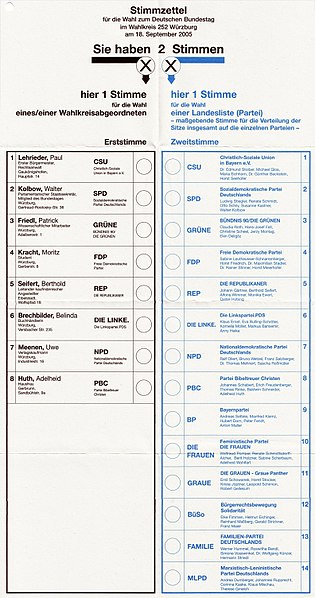
Voters have two votes: one on the left and one on the right. "Hier 1 Stimme" means "Here 1 vote". It is still just an X in a circle but twice instead of once. Most people when shown this grasp it immediately.
A similar Scottish ballot is on the left here: http://image.guardian.co.uk/sys-images/Guardian/Pix/pictures...

If that epic ballot paper isn't confusing then I don't know what is!
If that ballot paper is confusing then you shouldn't be allowed to vote.
What I would say is that the mechanics of AV are more (pseudo?)non-deterministic than the Scottish Parliament system of PR. With PR - seats mirror votes more or less. With AV, nobody really seems to know how things will turn out, and even less representative massive majorities can occur. So in a way AV is more complicated in that sense.
I'm still wondering why I voted for it to be honest.
Germany, for example, has a (pretty complicated) voting system that insures that every constituency has one representative (that's half of the parliament, the other half has, technically speaking, no constituency but they are obviously still from somewhere).
Everyone gets two votes, one for a representative from the constituency (whoever gets the most votes wins and will definitely be in parliament), and, more importantly, a second vote which determines the proportions of the parties in parliament. (Seats that parties cannot fill with directly elected representatives are filled from the party list.)
That second vote decides about the government (proportionally!), the first makes sure that every constituency has someone in parliament they can write letters.
This voting system is called mixed member proportional representation and here is the link to its Wikipedia article: http://en.wikipedia.org/wiki/Mixed_member_proportional_repre...