News for hackers. Stuff that matters.
Re:Supersonic Electric Flight by NikolaeVarius on Thursday November 19, 2020 @09:02AM (#25149508)
> The underlying reason that I believe electric aircraft can break the sound barrier is that electric motors can deliver far higher power-to-weight ratios than piston engines, jets, or turbines. The F-4 Phantom is a textbook example of high thrust, being able to (just) achieve a vertical climb. In contrast, for $100 I can buy a racing drone that can accelerate vertically at 10 gs. There are other factors at play but a power-to-weight ratio of 10 screams possibility.

You can't just ... assume that

Re:Supersonic Electric Flight by Gravityloss on Thursday November 19, 2020 @09:14AM (#25149633)
Jet engines have a thrust to weight ratio of about 10. The power is not so interesting as a lot of the thrust comes from heating the air. Ie the compressor might work at 40 MW and turbine also then of course extracts 40 MW from the airflow.

I'm not sure why one couldn't build an electric supersonic aircraft. It would have very short range. The design presented, could be made more aerodynamic by fairing the motors. Leave a hole in the tip for cooling air. Add a compressor for low speed cooling if needed. Alternatively have liquid cooling.

You could also have a design where the airflow is slowed down in a duct, compressed by a fan and then expanded. The duct would be heavy though. But it might obviate some problems with the free stream propeller.

Re:Supersonic Electric Flight by NikolaeVarius on Thursday November 19, 2020 @09:17AM (#25149659)
Where are you getting this 10 number from.

Wikipedia shows Eurofighter Typhoon as the highest T/W for a Jet airplane at 1.15 and The Concorde at 5.4

https://en.wikipedia.org/wiki/Thrust-to-weight_ratio

You WANT wings for supersonic flight (For a normal non missile aircraft). Sure it sucks that its hard to optimize for supersonic flight and subsonic, but you go Supersonic at extremely high altitudes to reduce drag on the plane. This requires a shit ton of power to go forward, without even counting the effort to stay in the air vertically.
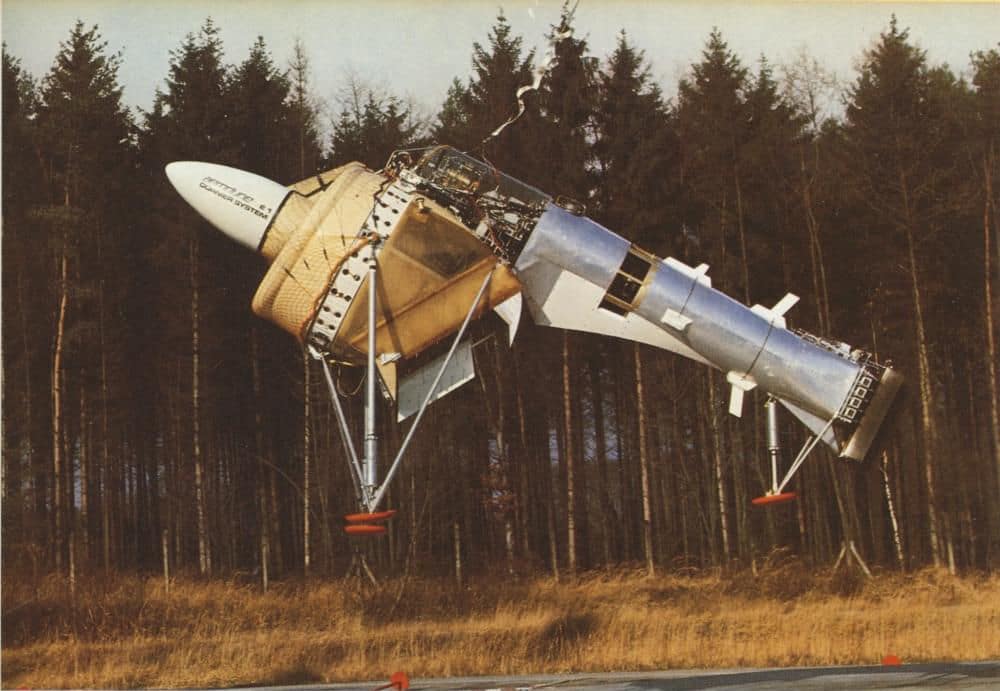
Re:Supersonic Electric Flight by Gravityloss on Thursday November 19, 2020 @09:21AM (#25149703)
That's the plane. I was talking about the engine.
Re:Supersonic Electric Flight by NikolaeVarius on Thursday November 19, 2020 @09:25AM (#25149750)
An engine without a plane around it is called a brick
Re:Supersonic Electric Flight by tim333 on Thursday November 19, 2020 @10:18AM (#25150356)
Re:Supersonic Electric Flight by Gravityloss on Friday November 20, 2020 @11:40AM (#25162094)
https://disciplesofflight.com/wp-content/uploads/2015/05/Aer...

Lippisch Aerodyne. Looks a bit like the X-32 if you squint.

Re:Supersonic Electric Flight by baq on Thursday November 19, 2020 @10:03AM (#25150203)
yes but a two engines with 10 TWR is worse than two engines with 20 TWR all other things being equal.
Re:Supersonic Electric Flight by NikolaeVarius on Thursday November 19, 2020 @10:12AM (#25150289)
What is this even replying to
Re:Supersonic Electric Flight by mnw21cam on Thursday November 19, 2020 @10:02AM (#25150185)
As has been pointed out in another post, that doesn't follow.

My body has a thrust to weight ratio of 1, sitting in this chair. A helicopter has a thrust to weight ratio above 1. But neither is capable of supersonic flight. The key is the reaction mass velocity - you can give something a high thrust to weight ratio using very little power by using a large reaction mass and pushing it slowly. For instance, my body is using the whole earth as its reaction mass, and is using zero energy pushing it downwards at zero speed. A jet is much more impressive because it gets that high thrust to weight ratio while using a small reaction mass ejected at a high speed. That is what is required to push an aircraft up to supersonic speeds. A racing drone is closer to a helicopter than a jet aircraft.

However, if the numbers do work out, then I am wondering if it might be possible to fly supersonic much higher than jets, because there is no reduction in engine power. I don't know how high you have to go before your sonic boom no longer reaches the surface, but might there be a possibility of boom-less supersonic flight?

Re:Supersonic Electric Flight by NikolaeVarius on Thursday November 19, 2020 @10:18AM (#25150349)
> My body has a thrust to weight ratio of 1, sitting in this chair

No it doesn't. Its 0

> For instance, my body is using the whole earth as its reaction mass, and is using zero energy pushing it downwards at zero speed

That is not how gravity works. There is nothing happening.

> A jet is much more impressive because it gets that high thrust to weight ratio while using a small reaction mass ejected at a high speed. That is what is required to push an aircraft up to supersonic speeds

I wouldn't call it a small reaction mass. A shit ton air is needed to feed the compressor. A jet sacrifices efficiency to get as much mass thrown out the back as fast as possible.

> if it might be possible to fly supersonic much higher than jets, because there is no reduction in engine power.

Why would there be no loss in engine power. If you are using standard propellers, you are limited by air density. If you are using some electric engine to turn a turbine, you have the exact same issue. What magical engine is this electricity powering?

Re:Supersonic Electric Flight by ClumsyPilot on Thursday November 19, 2020 @04:30PM (#25154617)
>"I wouldn't call it a small reaction mass. A shit ton air is needed to feed the compressor. A jet sacrifices efficiency to get as much mass thrown out the back as fast as possible."

It's the other way round - a Jet gains efficiency the more air mass it can 'process', because larger mass means you need to throw it out at a lower velocity to get the same impulse from it. If you compare formulas for momentum and kinetic energy, which are, respectively:

p = m * v and e = 0.5 * m * v ^2

You will see that energy needed for higher velocities grows quadratically, while the momentum you get from it grows linearly.

basically that's why we have Turbofan engines with high bypass rations, to increase efficiency of passenger Jets

https://en.wikipedia.org/wiki/Bypass_ratio

Re:Supersonic Electric Flight by NikolaeVarius on Thursday November 19, 2020 @07:08PM (#25155967)
I know how a turbofans/jets work. My comment had nothing to do with the comparison with turbofans, and only that large amounts of air is being moved.

> It's the other way round - a Jet gains efficiency the more air mass it can 'process', because larger mass means you need to throw it out at a lower velocity to get the same impulse from it.

How is it the other way around, I explicitly said a Turbojet sacrifices efficiency to increase exit velocity.

Re:Supersonic Electric Flight by ClumsyPilot on Friday November 20, 2020 @10:08AM (#25161118)
Firstly, if you are gonna poke holes in other people's arguments, don't get defensive when someone corrects you, especially when you make such precise and well qualified claims as "Shitton of air". Neither were also not spesific about Turbofan vs Turbojet.

Regardles of which one it is, the point of the previous poster stull stands. His point of comparison is how reaction mass compares to the weight of the vehicles.

All jets move less air, by mass, than helicopters do, when measured as a fraction of the vehicle's mass.

Re:Supersonic Electric Flight by FooBarBizBazz on Thursday November 19, 2020 @10:46AM (#25150653)
> Why would there be no loss in engine power. If you are using standard propellers, you are limited by air density. If you are using some electric engine to turn a turbine, you have the exact same issue. What magical engine is this electricity powering?

Parent is assuming that combustion engines run out of oxygen to burn before the propeller runs out of atmosphere to push against.

Re:Supersonic Electric Flight by FlyMoreRockets on Thursday November 19, 2020 @11:41AM (#25151256)
Re:Supersonic Electric Flight by jjk166 on Thursday November 19, 2020 @09:41AM (#25149970)
Yeah, big difference between a plane that has to carry a person, weapons, and enough fuel to be useful and a toy which is basically 4 motors, a tiny battery and a few grams of plastic. You take just the F-4's engine and 2 minutes worth of fuel and that thing will accelerate very quickly.
Re:Supersonic Electric Flight by WalterBright on Thursday November 19, 2020 @06:05PM (#25155433)
> You take just the F-4's engine and 2 minutes worth of fuel and that thing will accelerate very quickly.

The design concept of the F-104 Starfighter!

Re:Supersonic Electric Flight by baq on Thursday November 19, 2020 @09:59AM (#25150156)
For reference, the Merlin rocket engine in the Falcon 9 has a TWR of 185.
Re:Supersonic Electric Flight by Gibbon1 on Thursday November 19, 2020 @05:46PM (#25155260)
I have no numbers for the Rutherford engine on the Electron rocket. Amusing idea would be take a page from that and design a ram jet with an electric turbine to get it going.
Re:Supersonic Electric Flight by nradov on Thursday November 19, 2020 @09:47AM (#25150022)
The F-4 Phantom can't sustain a vertical climb.
Re:Supersonic Electric Flight by chrisweekly on Thursday November 19, 2020 @09:56AM (#25150123)
An F-15 sure can though.
Re:Supersonic Electric Flight by rootusrootus on Thursday November 19, 2020 @10:12AM (#25150294)
IIRC it was one of the only fighters that could accelerate straight up at the time. Now there are others, including the F-16, which originally could not, but the more recent variants have considerably more power and now it can.
Re:Supersonic Electric Flight by dTal on Thursday November 19, 2020 @05:04PM (#25154908)
Yes, that's very silly. It's entirely a question of scale, which is handwaved. You can also buy a gloplug fossil-fueled model airplane which can also accelerate vertically at ridiculous speeds.