What makes you think that given sufficient cooling, it will not perform exactly the same as the M1 in the MBA but sustained? It’s not like the ARM architecture changes anything in the thermodynamics of cooling cpus compared to an x86 chip, right?
I’d wager that under load an i9 with passive cooling wouldn’t even last 30 seconds without throttling below even its base clock, if it doesn’t just shut down to prevent frying itself
So again, what would make anyone think that an M1 with decent cooling would not be able to maintain the current ST performance indefintely, or a hypothetical 8+8 or even 16+16 core M1X or M2 with a TDP of 100W and top-notch cooling solution would be impossible?
Don't forget that scaling up is also not just about frequencies, there are also packaging considerations - the CPU dies have to actually be able to dissipate the heat generated, and the package itself has to be able to do so as well. I'd expect that this is something AMD and especially Intel have a leg up over Apple with - although, considering they've already tread that ground it makes Apple's job a bit easier too.
Asking about how it would do in a computer with sufficient cooling is about as relevant as asking how it would do in a computer with a usable keyboard or OS.
https://techcrunch.com/wp-content/uploads/2020/11/webkit-com...
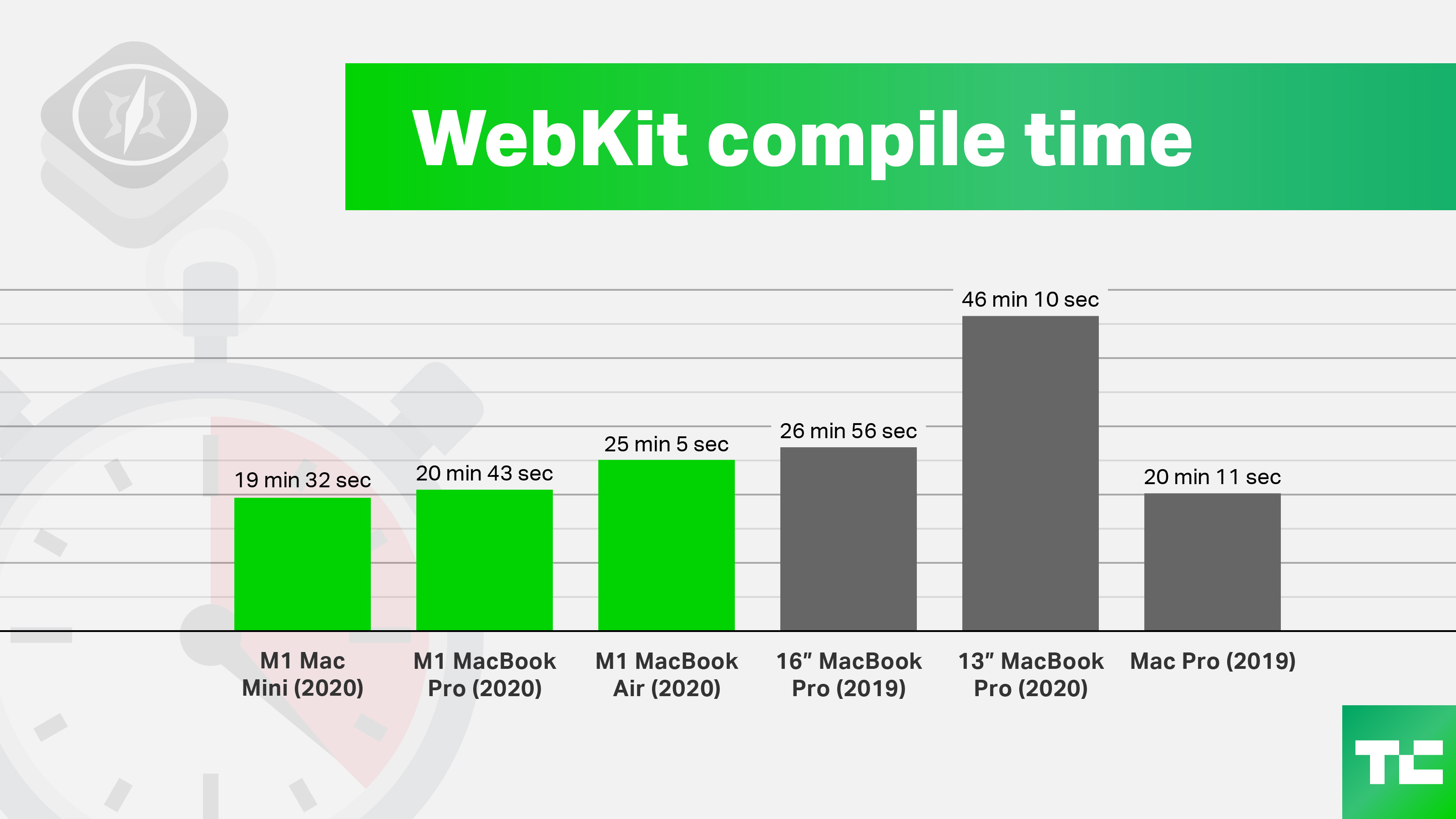
What's also hugely impressive is that under better cooling conditions, it's also 25% faster.
None of these numbers capture headlines like 2x sadly, but that's still massively impressive.
https://blogs.gnome.org/mcatanzaro/2018/02/17/on-compiling-w...
Curiosity got the best of me too and I ran the test on my late 2013 MBP, 2.3 GHz i7, 16 GB ram. Compilation took 44 seconds and the fans didn't even spin up (with 23 ºC ambient temperature).
A little further down the thread [0] he gives the actual numbers, which are around 20s on the M1, which puts the i7 [1] at around 40s.
I'm not sure how much of this is Rust specific, but for my own projects I haven't noticed a big difference between my mbp, an old i7-3930k and a newer i5-8500. The MBP is somewhat slower, but it only has 4 cores while the others have 6.
[0] https://twitter.com/rikarends/status/1328706132752347138?s=2...
[1] A tweet corrects the MBP CPU as being an i7 and not an i9.
I'm not sure this test is deserving of the breathless headline and commentary, especially since the original tweeter later follows up with:
> Extra info: The M1 macbooks (air/pro) can't drive 2 external screens, and the air throttles a bit after 3+ minutes sustained compute (20-30%)
https://twitter.com/rikarends/status/1328753176552632321
I'll be more interested if the M1 can compile something 2x quicker than the i9 when the compile time on the M1 exceeds 30-60 minutes rather than being less than a minute.
EDIT: to be clear, I expect the M1 to feel faster than the i9 for the vast majority of users, however the headline is "in a real world Rust compile", implying that this is a more valid test than synthetic benchmarks. I take issue with that, as I don't really consider something that compiles in less than 2 minutes on 6 year old hardware to be a much more useful test than the benchmarks.
We already know the A-series of chips performs incredibly in short workloads. We have no information yet on how it performs under sustained workloads.