Re:Leveraging a 3D printer “defect” to create a new quasi-te...
by rhklein on Friday October 30, 2020 @03:38AM
(#24939963)
I wrote a G-code Importer for Blender recently.
Having access to the toolpaths directly lets you do some interesting things conventional slicers can't do.
[link redacted]
I've been experimenting with storing extrusion multiplier info inside Blender to make weighted extrusion values based on a texture.
Re:Leveraging a 3D printer “defect” to create a new quasi-te...
by thdrdt on Friday October 30, 2020 @07:58AM
(#24941285)
Gcode for this type of 3d printer is very easy to understand and generate.
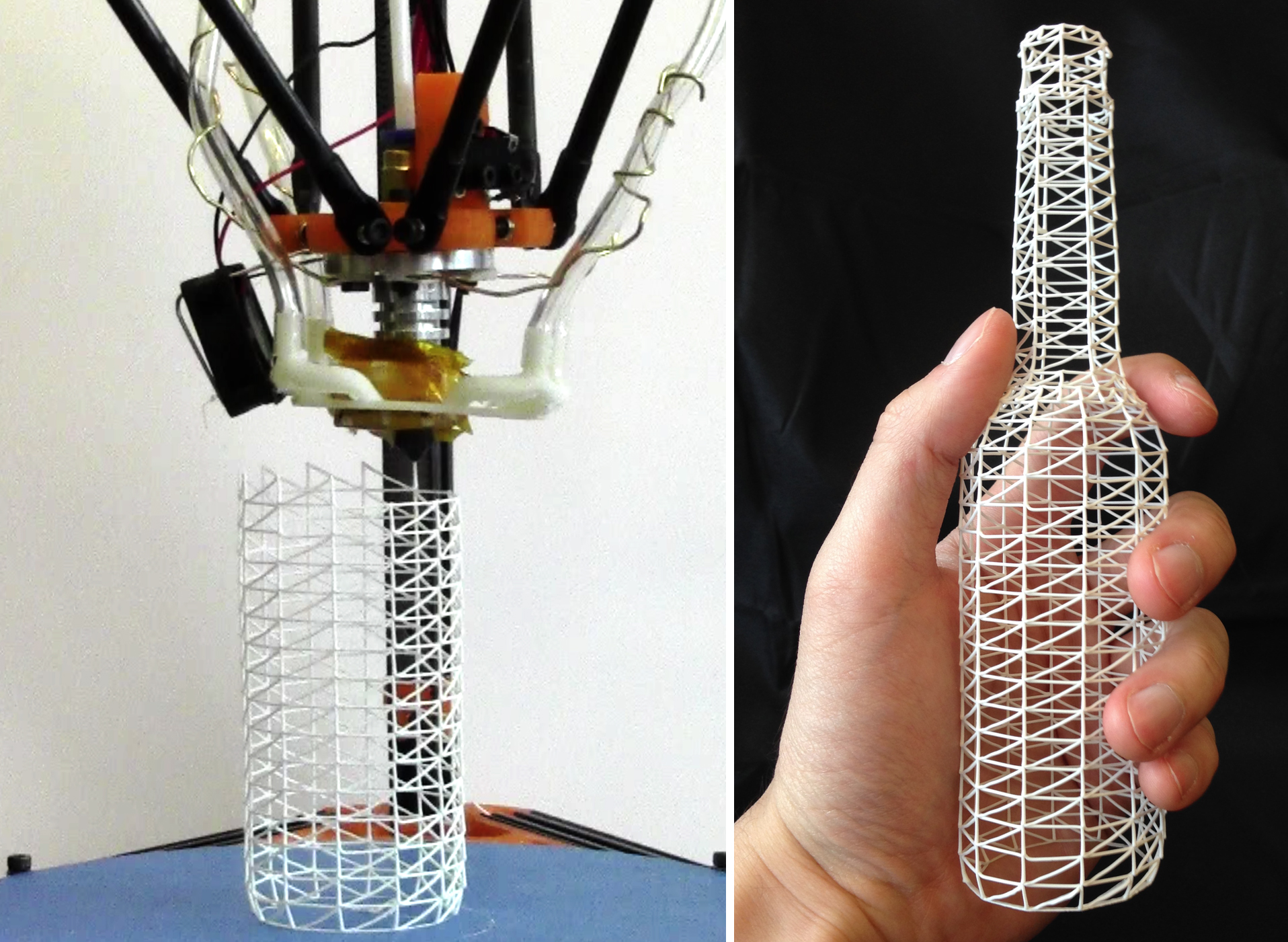
Some years ago I did some experiments with 3d printing in 3d (printing wire frames in 3d).
But it takes time to get the feed rates and print speeds right.
Edit: an example of wireframe printing: http://www.creativeapplications.net/wp-content/uploads/2014/...
Re:Leveraging a 3D printer “defect” to create a new quasi-te...
by curiousllama on Friday October 30, 2020 @07:45AM
(#24941218)
I wonder if they just used a custom slicer. In undergrad, I wrote my own slicer and used it to do silly things (less "can I make this?" than "What would happen if?").
I would imagine they took a similar (though, obviously, much more intelligent) approach here, just thinking directly in terms of slicer features, rather than in terms of models.
I've been out of the loop for a couple of years though, so I'm interested to know if this has evolved much.