News for hackers. Stuff that matters.
Re:The Elusive Peril of Space Junk by sandworm101 on Thursday October 08, 2020 @09:24AM (#24718869)
In the discussion of space junk, and kessler syndrome, there is a large bias that needs to be addressed. Most commentators operate under the impression that most of the stuff up there is "junk" from human activities, that space was essentially clean until we got there. It wasn't. It isn't. There are literally tons of natural rock falling onto earth every day. By some measurements over 100 metric tons per day. That is only the stuff actually landing on earth. Exponentially more of it passes by without striking the planet but nevertheless still passes through the orbits of our satellites and space stations. Worse yet, because we have a large moon, much of that will have itself entered into some form of orbit around earth. Any discussion of the dangers associated with human-created space junk must occur in that context.

Why hasn't the kessler syndrome started already? Why has the ISS not been sandblasted after 20+ years in orbit? Those are great questions.

Re:The Elusive Peril of Space Junk by ceejayoz on Thursday October 08, 2020 @10:01AM (#24719153)
I'd imagine there's a difference in risk between orbiting debris and stuff that's just passing through, like when we have a meteor shower as we pass through a residual debris trail. The really tiny grain-of-sand stuff can be fairly effectively shielded against, as well; bigger chunks are more difficult.

Satellites definitely get sandblasted to some extent; here's a hole made in the SolarMax satellite. https://en.wikipedia.org/wiki/File:SMM_panel_hole.jpg

The ISS cupola got hit and repaired, too: http://www.spacesafetymagazine.com/space-debris/kessler-synd...

Re:The Elusive Peril of Space Junk by dr_orpheus on Thursday October 08, 2020 @10:31AM (#24719374)
True, but generally most the "natural" debris are much smaller objects (micro-meteoroids). These are on the order of micrometers in size. Smaller micro-meteoroids are much more prevalent [0]. These do still cause damage to spacecraft but it is on a much smaller scale. The effects are typically things like cracked solar arrays, tears in multi-layer thermal insulation. This is still a a concern and when things like meteor showers occur some spacecraft will try and optimize the orientation of their solar arrays so that they are not normal to the ram direction (i.e. the solar arrays are facing in the direction of travel which gives a greater chance of hitting something at high velocity)

Larger debris does tend to come from satellites. And things such as satellite collisions cause a noticeable effect on the number of objects (of a size that we can track) [1].

[0] https://www.nap.edu/openbook/0309051258/xhtml/images/img0001...
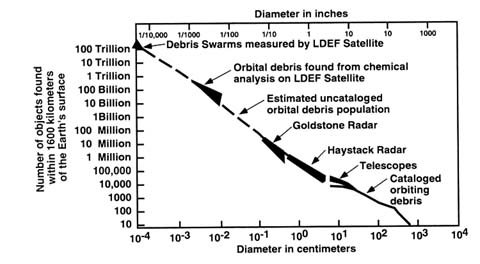
[1] https://en.wikipedia.org/wiki/Space_debris#/media/File:Space...

Re:The Elusive Peril of Space Junk by bumby on Thursday October 08, 2020 @11:02AM (#24719709)
>Why has the ISS not been sandblasted after 20+ years in orbit?

While "sandblasted" might be hyperbolic, micrometeoroid and orbital debris (MMOD) is a known risk to the ISS and they have a variety of shields to try on protect it.[1]

[1]https://www.nasa.gov/sites/default/files/files/E_Christianse...

Re:The Elusive Peril of Space Junk by patentatt on Thursday October 08, 2020 @09:52AM (#24719097)
Are you suggesting the strike rate for the ISS doesn’t match expectations? What could explain that?
Re:The Elusive Peril of Space Junk by waterheater on Thursday October 08, 2020 @10:10AM (#24719213)
The ISS must regularly change position in orbit to avoid debris.