In the developing nation market, go to a remote part of some place in Nepal that has no fiber or terrestrial microwave links back to the big cities. Find an "internet cafe", what you're likely to see on the roof is something like this, a cheap 1.2 meter VSAT on the roof with a 4W BUC:
https://www.satsig.net/vsat-equipment/andrew-123-antenna-mou...
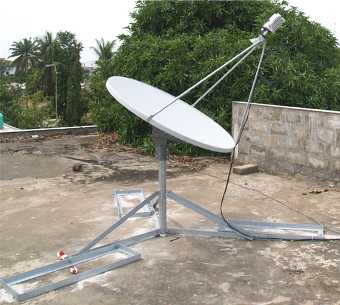
In a highly contended, highly oversubscribed TDMA network in some ISP's small piece of one transponder, linked back to an earth station elsewhere. For 200, 300, 400 bucks a month.
What's going to change is the quality of service and speeds that somebody in $small_nepalese_city is going to get for their 250 dollars a month.
But there are also vast areas of Idaho too sparsely populated to support any WISP at all, where you'll see cheap consumer grade VSAT stuck to the sides of peoples' houses.
https://www.google.com/search?q=wildblue+dish&client=ubuntu&...
Depending on where you are looking, and what your budget is, and your level of motivation you might look into seeing how difficult it would be to build your own point to point link back to a place where you can get 'real' internet.
I also want symmetric gigabit but in a very rural location I might be totally satisfied with 40 Mbps down x 15 Mbps up, if it was sufficiently reliable and good quality (overall uptime in a year, latency, jitter, etc).
There is a great deal that can be done with sets of equipment like a 90cm high performance dual polarity shielded dish (ALG or Jirous or similar), ubnt AF5XHD radios, etc. Perhaps for less than $10k all-in you might be able to build your own link to reach the nearest WISP or terrestrial connectivity. Entirely depending on how remote you are and terrain.
At the moment, Starlink is a bit of a loss-leader for SpaceX. They're putting up the satellites to justify the cost of continuing development on Falcon-9, because they've saturated the market for satellite customers. It's entirely possible that the program continues on that vein and is eventually subsidized by an expanding satellite launch market as companies realize there are things they could do with satellites that they previously couldn't afford, now can.
There is, of course, market risk---both the one you've identified and the entirely mundane "SpaceX goes under and the satellite fleet goes defunct" risk.
extremely unlikely considering the value of the assets already deployed in space. One scenario is a debtor-in-possession arrangement via bankruptcy court.
Another thing that could happen is something like what happened to the first Iridium corporation's bankruptcy, where a group of investors formed a "new" Iridium corporation and stepped in, via the bankruptcy court, to take it over. Google "iridium bankruptcy" for more details. Also this book:
https://www.amazon.com/Eccentric-Orbits-Iridium-John-Bloom/d...
But, what is that value? Of the ~ 800 SL satellites launched so far, about 5% have already deorbited. Of the remainder, all but 2 don't have inter-satellite links. The others will deorbit in 5 years. LEOs, in general, require tremendous amounts of money just to maintain an existing constellation size. At steady state, SpaceX would have to launch something like 60 satellites per week just to maintain their constellation. I can't remember the numbers now, but I think that meant costs in the $10's of millions / week just in maintenance once you account for construction and launch costs.
$500 million per year is a drop in the bucket for ~600Tbit of worldwide low altitude high speed satellite Internet. That’s ~$800/Gbit at 20Gbit/satellite and 30,000 satellites.
Starship will carry 240 satellites at a $2 million launch cost. That’s $250 million in launch costs every 5 years to fully cycle 30,000 satellites. If the satellites themselves will cost ~$250k each or $7.5b for the full constellation, so annual costs overall would be $1.5 billion, but I would guess at that scale per-satellite cost is actually much lower.
If you do the math, a fully operational Starlink will print vast sums of money ($10s of billions annually) until if/when there is a viable competitor.
The beauty is that just the marginal costs to Starlink directly fund SpaceX’s R&D budget — basically the cost side of the equation pays for Starship, while the substantial profit is just pushing Elon further up the Richest List to the point where he’ll have to find another trillion-dollar problem to throw money at.
This is pretty optimistic because the shells at different altitudes have overlapping beams and can not all use the same spectrum at the same time (OK, technically, two satellites can share the same spectrum if they use different polarizations, but, anyway, SL plans to have 3 orbital shells according to WP.) LEO bandwidth scales sublinearly with the number of satellites because of this. Also, this doesn't take into account inefficiency due to timing and coordination between satellites, nor the fact that 70% of the total bandwidth is over water and even the bandwidth over land is mostly not over population centers. The actual cost per bit is estimated to be about 2.5x-10x higher (see https://twitter.com/Megaconstellati/status/13103869669917040...).
> Starship will carry 240 satellites at a $2 million launch cost.
I think the operative word here is "will". In 2019, SX charged around $2700/kg to launch (not sure to what altitude, but let's take that figure, if you will.) A SL satellite is around 260 kg. If I round the numbers down to $2500/kg and 250 kg/satellite, I get $37.5 MM to launch 60 at a time. Suppose Starship can overcome the laws of physics and aerodynamics and launch 240 satellites with the same amount of fuel, so the cost drops by 75%. That's still roundabout $9.3 MM/launch, or, around $1 B in launch costs every five years.
Nevertheless, as you pointed out, that's not much compared to the cost of the satellites themselves. My understanding is that $250k/satellite would be very good, even at scale, but let's take that number. That brings the cost of making and launching the constellation to around $8.5 B / 5 years.
But, that's just the satellites. You need an entire ground segment to make the whole thing work. As a rough estimate, say that's another $8.5 B, but it'll last twice as long, so, $4.25 B / 5 years. OK, now we're at around $2.5 B / year just for the machinery, not including the CPE, landing rights, or personnel to keep things humming.
> If you do the math, a fully operational Starlink will print vast sums of money...
I think that's the big question everyone wants the answer to: Who will pay for this? SL will cost around $2.5 B / year in just the ground segment and the space segment. At $100/month, SL needs a bit over 2 MM customers just to cover the cost of equipment. But those 2 MM customers are not spread out evenly around the Earth, where all of the bandwidth is.
If you have any insight as to who will pay for this, I'd genuinely like to know because I'd be happy to buy into the SL IPO and retire early.
2 million customers for high speed / low latency internet for $100 / month seems like a very small ask.
SpaceX projections are that they can win 3-4% of US households, or ~3.6 million households in the US. IMO I would expect the US would be their smallest market worldwide.
If you had to break that up in a scenario where spacex no longer existed and there were no more re-used first stages, it could cost considerably more. And also cost considerably more if a third party had to be paid to manufacture and QC the satellites.