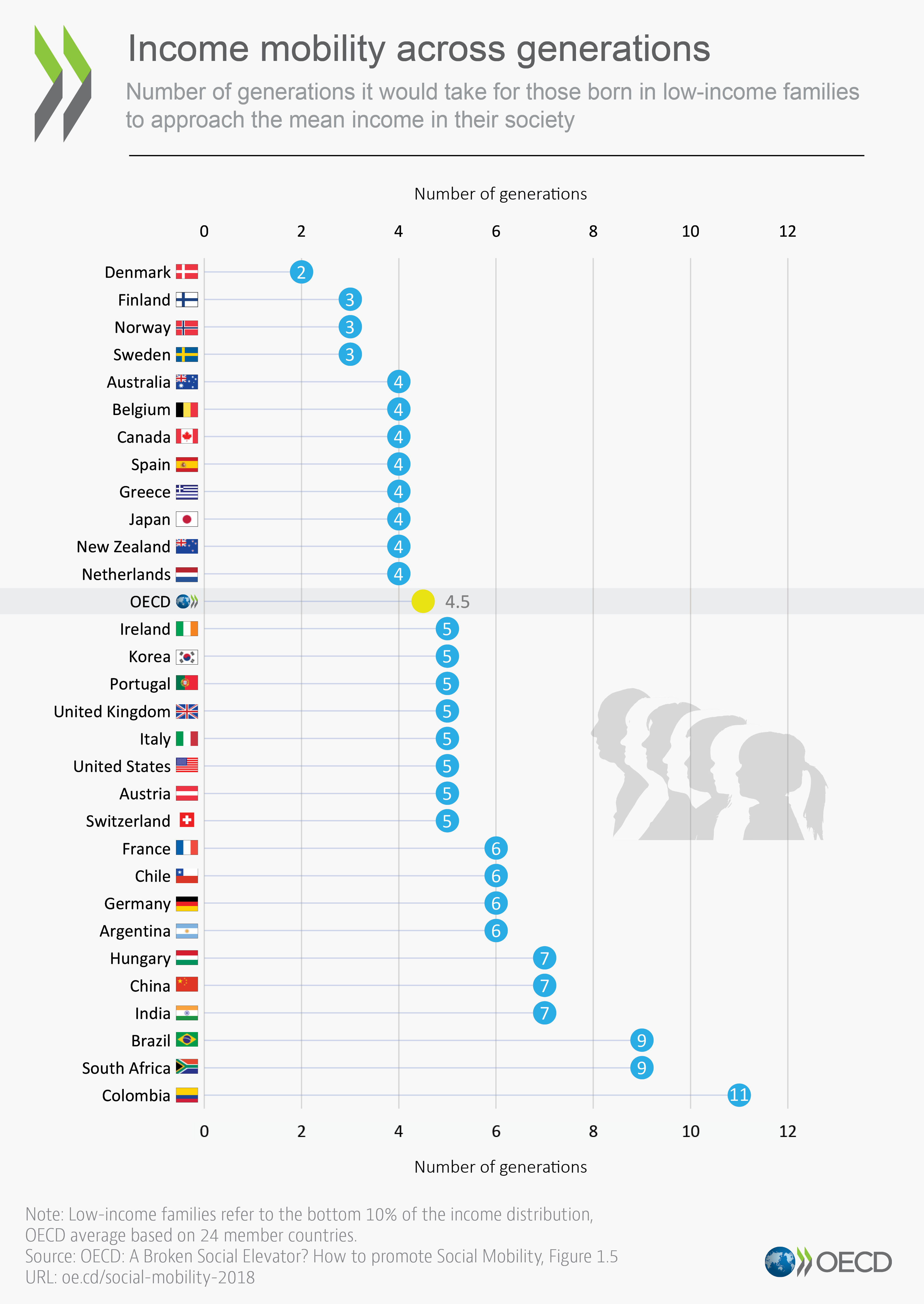
Average people want the opportunity to significantly improve their financial position, and economic mobility doesn't measure that. As a country, the US outperforms most other industrialized countries at the former.
At the extreme, very small differences in relative income can make you "highly mobile" even though you've barely moved your relative financial position. This is seen in smaller industrialized countries with very compressed wage distributions. People in low mobility countries can have better financial outcomes in both relative and absolute terms depending on the mathematical distribution function, and do in practice.
The term "economic mobility" is widely used to push misleading narratives precisely because most people don't understand what it measures.
Freudian slip? Although if they make big bugs perhaps they won't make big bucks...
[ Edit: as of 2020, the US is roughly middle of the pack for economic mobility among OECD nations, and was not lowest or 2nd lowest, but 4th lowest in 2012 ]