When I need to check nesting levels, I use a little acme-trick: double-click on the closing mark (works for parentheses, curly brackets, quotes, probably more) and it'll highlight everything contained within that level. So if I type (some (big (lisp (expression)))) and want to make sure I got the right number of parentheses at the end, I just double-click on the last one and make sure the whole expression gets highlighted. Here's a screenshot: https://i.imgur.com/Qyvv2K9.png

I don't find I need to do it particularly often when writing Go, though, and if I do... well, I start to think about refactoring to make my function invocation less obtuse, or whatever.
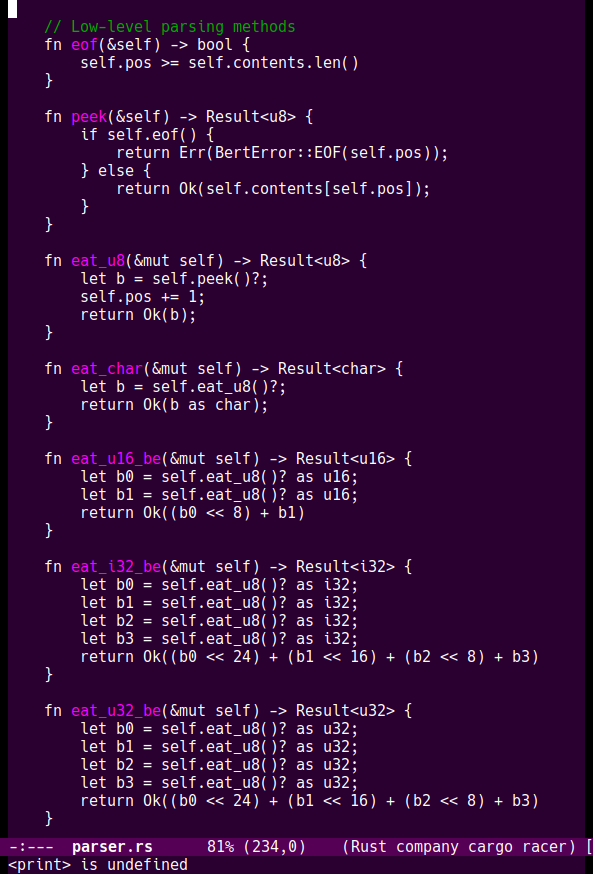
* The name of a function being defined
* Comments
* String and character literals
The result is very calm [1], but I can still rely on colors to know orient myself and know when I forgot to close a string literal.
I find it curious that a higher-than-one dimensional representation of a program is not present: proper syntax highlighting makes debugging much faster.
Say, I want to see some expression with deeply nested parenthesis (lisp-style, or nested function calling in Python) is matching. I can do that with my eyes, checking the color of the beginning and the ending parenthesis. Same goes for, say, if I want to find a string in my program. I don't have to care about the quotation mark, I can just look at its color being different from the rest.
Executing commands with the mouse is heavily underrated and is a behavior I fail to faithfully replicate in i3 - or even Emacs, for that matter - but only if you guys had syntax highlighting...