Re:Seismic waves reveal giant structures deep beneath Earth'...
by Groxx on Sunday June 14, 2020 @05:51PM
(#23521684)
Though I don't know for this one, a semi-common strategy is to use ML to efficiently search for "interesting" datapoints, and then verify with conventional tools.
In that sort of use, it doesn't really matter if it's hallucinating - it'll just produce a lot of false-positives and you'll go (╯°□°)╯︵ ┻━┻ and try something else instead.
Re:Seismic waves reveal giant structures deep beneath Earth'...
by Retric on Sunday June 14, 2020 @09:24PM
(#23522963)
Anything generating a lot of possible ‘interesting’ datapoints is very tricky to statistically validate. Essentially you need to raise the threshold for statistical significance based on the number of possibilities being considered.
That’s almost never done correctly, and often misused. https://en.wikipedia.org/wiki/Data_dredging
Re:Seismic waves reveal giant structures deep beneath Earth'...
by aaron695 on Sunday June 14, 2020 @07:39PM
(#23522419)
I asked this question if it really was Machine Learning last time this was posted and I don't think it was (Feel free to correct me)
It's - http://sequencer.org/
Pseudo-code - http://sequencer.org/static/images/image1.png
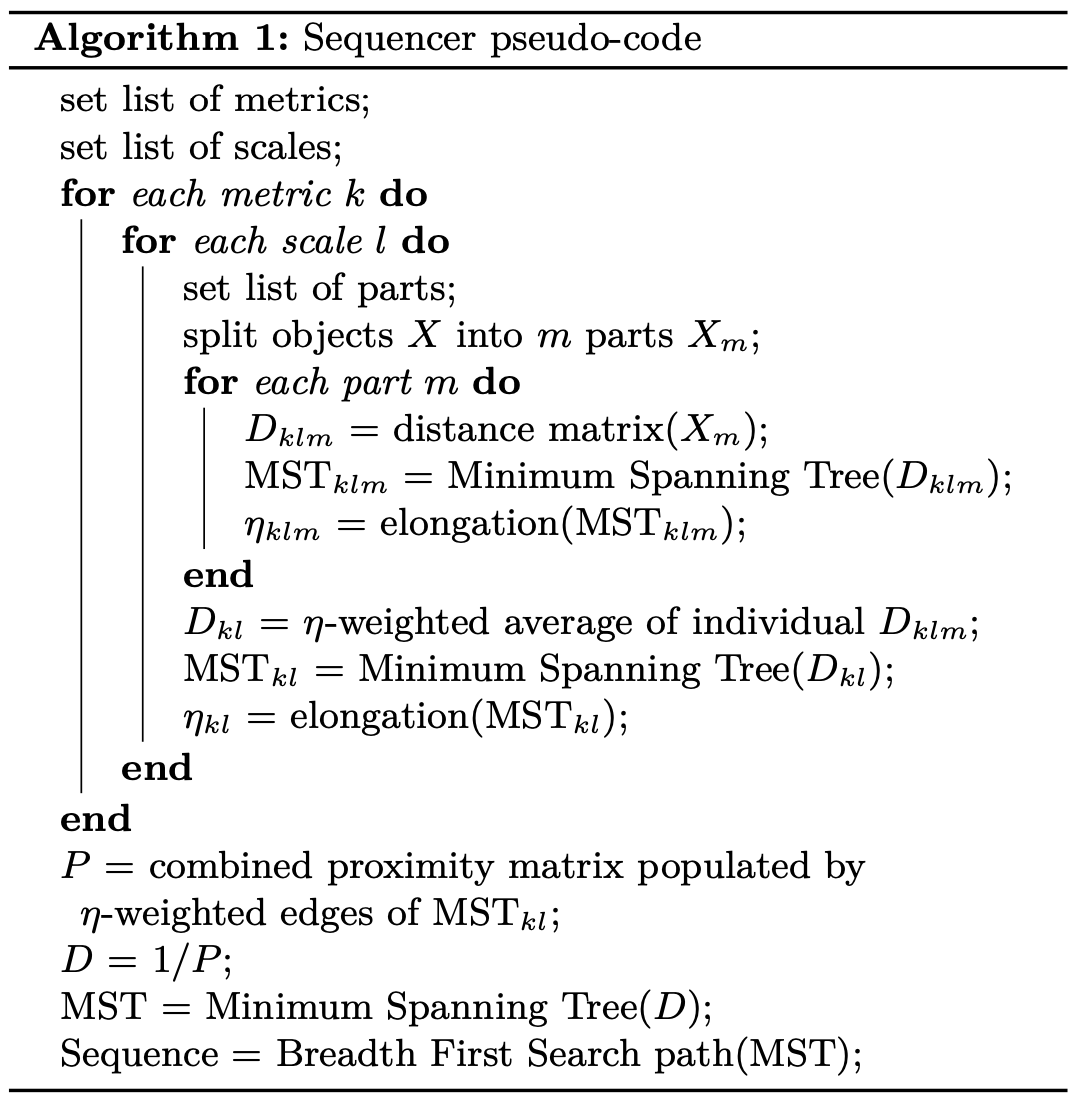
I find it much more exciting than ML because it's both real and seems to be a simple online service for scientists, which is pretty cool.
A video on it - https://www.youtube.com/watch?v=KN-N7l5spmE
Re:Seismic waves reveal giant structures deep beneath Earth'...
by mturmon on Sunday June 14, 2020 @08:38PM
(#23522729)
On a cursory look it seems to construct a distance matrix between all pairs of items, and look for a spanning tree with that distance metric that is "elongated" - i.e., less branching. Straightforward enough.
There seems to be a bit more, involving iterating over different scales and over different distance metrics, but that's not particularly principled or efficient.
Re:Seismic waves reveal giant structures deep beneath Earth'...
by faizshah on Sunday June 14, 2020 @09:44PM
(#23523059)
The github has a good overview of the algo(and clean python code): https://github.com/dalya/Sequencer
How does one convince oneself that such a machine-learning algorithm is finding genuine signal in the noise, rather than just generating echoes of its training data?