If I want to know something about chess, the source code is available, endgame tables are available, everything that we say we know about chess can be confirmed.
Everyone seems to know how card counting works, with vague things like a count goes up with 5's or down with 10's, but there is no first post link to the "solution". The only thing I see referenced is some 1 deck study from the early computer days.
I'm halfway convinced the money making avenue of card counting is telling stories about card counting.
The conspiracy theory part of my brain says these stories are written by casinos to give players hope.
So, where is that github link?
https://github.com/seblau/BlackJack-Simulator is an example of this. The house advantage of blackjack is under 1% for good games (for example 0.33% at Mohegan Sun). So to beat it you just need overcome that which IS possible by counting. But you can see if you play with that sim, decreasing penetration, bet spread and amount really starts to eat into your numbers.
But with the mitigation strategies listed like low penetration, heat gained by betting big, or wild swings in bet amount, and finally no mid-shoe entry it is not possible now to do it and make good money.
https://wizardofodds.com/games/blackjack/card-counting/high-... Michael Shackleford is an expert on gambling analysis and is employed by gaming companies to check out their games. He has loads of detailed information and statistics on his site about every casino game.
But yes. Mathematically possible, and possible in the distant past when casinos didn't know. Pretty much impossible now due to casinos detecting it easily. Not because it isn't mathematically possible.
It's funny, but it also just reads like bad fiction to me. The dialogue doesn't seem natural, and the writing doesn't sound so much like someone describing something they actually experienced as it does like someone mimicking a storytelling style they've seen elsewhere. Add on top of it that almost every aspect of it seems ripped directly from the first half of "21" (the Kevin Spacey movie about the MIT crew) and it just comes across as an amateurish attempt to borrow someone else's story. The fact that these techniques she claims they used just don't work anymore seals it for me.
You can find the author and one of her teammates discussing their careers on a podcast from a couple of years ago here:
But I appreciate your commitment to upholding the proud HackerNews tradition of supremely confident snap judgments uncontaminated by actual knowledge.
"Carlo was betting stacks of orange chips we called “pumpkins,” up to $10,000 per hand."
"Our Big Players naturally drew attention with their wagers in the thousands."
No I didn't read every single story about this ever just the one linked. And yes it is a snap judgement from what I know that it is complete fiction. That doesn't sound like small casino action to me. Also, please let me know about the casino that allows 10k bets mid shoe entry.... I've never seen one.
If this was a story written about some struggling grad students that made small amounts of money on small action at small casinos as you claim on your throw-away account I would not have posted what I posted. But alas this thread is about the article posted and I stand by my claim that it is almost certainly untrue from what is contained in it. I don't need to know the entire history to decide that. The article contains information that is at best highly embellished.
Any customer that wins more than they spend over >50 games is probably doing something not great for business, ban them.
The empirical testing of his work was conducted over a number of years by MIT, Harvard Business School and others to show that indeed card counting and other strategies were effective at giving the bettor a statistical edge [1]. Casinos being casinos, they learned of this soon enough and effectively banned card counters in many outlets (as well as putting various measures in place to prevent or minimize those who are more subtle about it, as discussed in OP's comment). In modern times, even a small town casino will have measures in place to stop card counters, the simplest of which is just to have an automatic deck shuffler.
As for his papers on the academic research that have led to strategies like card counting, you can find most or all of them on his site[2]. Of particular note is his paper "Blackjack Systems"[3] describing a proto card counting strategy, "The Mathematics of Gambling"[4], and of course the book that started it all: "Beat the Dealer"[5].
[1] https://en.wikipedia.org/wiki/MIT_Blackjack_Team [2] http://www.edwardothorp.com/articles/ [3] http://www.edwardothorp.com/wp-content/uploads/2016/11/Black... [4] http://www.edwardothorp.com/books/the-mathematics-of-gamblin... [5] https://www.amazon.com/Beat-Dealer-Winning-Strategy-Twenty-O...
Card counting can be profitable. It's not invented by the casinos, I assure you of that. I've earned enough backoffs from them.
Wizard of Odds is a good site to peruse if you want derived tables/odds/simulations. The author of the blog (Shackleford) is a fairly good statistician and computer modeler.
The information is out there.
In modern times, most of the value of card counting comes from game selection and beating bonuses/weak side bets/match plays. It's not likely a good full-time job. But good advantage players have a wide set of skills, of which beating blackjack is simply one.
That is not vague at all and shows you how simple card counting is. Pair that with a blackjack strategy card which is based on the odds of winning certain hands and its easy to tell how a deck that has a higher proportion of 10's is better for the player.
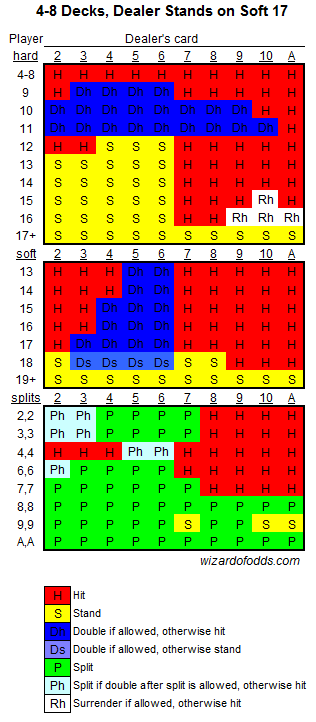
The principle is that you bet (more) when the cards remaining in the deck are favourable to you. Even if you can identify when that happens, precisely or heuristically, it's then also important to consider what percentage of your bank you can bet to best avoid bankruptcy.
If you've considered all of this carefully enough, your method will likely no longer work when the casino modifies the rules in any way - most crudely by increasing their take to cover any variance in bet value.
Edward O Thorp explains the mathematics of card counting extremely clearly and readably.
Like a new tribe finally gains consensus to open a casino and have no idea what they're getting into or have the enforcement procedures. The same for states and municipalities, but they typically have more resources to course correct quickly.
You can take them all to the cleaners though.
https://en.wikipedia.org/wiki/Card_counting
Asking to prove it is like asking to prove that tic-tac-toe is a solved game, since its trivial to understand how it works
Can you do this every night at the same casino? Absolutely not. Can you do it once, then switch to a completely different persona at a different place? Apparently you can, at least ten years ago.
Edit: also, while the big vegas casinos do all this stuff properly, a lot of the small casinos on Indian reservations are more lax with their safeguards. The issue is that table maximums tend to be in the $500 range which makes the dollars per hour somewhat minimal.
I’m no casino regular but every single one I’ve been into in my life use large 6-8 deck shoes and reshuffle as it hits about 2 decks. Counting just isn’t profitable anymore unless you are blatantly obvious about it.
>> Counting just isn’t profitable anymore unless you are blatantly obvious about it.
Game selection is a big part of it. You might be looking at large corporations. Plenty of small shops to beat.
That would kinda break yhe illusion for me but maybe other people/casino doesnt care
I think Casinos like to propagate these stories about counting to encourage people who know a little about it to come down and bet big. Odds are, they'll lose.
So with that said:
- Casinos employ methods such as continuous shuffling machines that make counting impossible. Tables that have hand shuffling of 6-8 decks cut the deck and reshuffle with 2 decks remaining or so. So it is harder to get penetration.
- The way to be maximally profitable is to vary your bet very widely depending on how positive the deck is. This could be 30x your low bet. Behavior like this will get you detected.
- Security personnel and even dealers keep counts. It is not some savant activity. It is not hard especially since all these people do all day is look at cards. So they know when the deck is positive and if you are always betting big when that happens you will be detected.
So the people that are left counting have to avoid heat by "camouflaging" their actions. They don't vary their bet that widely and make purposeful bad decisions to make it appear they are not keeping a count. They want to appear like someone that does not know how to play basic strategy and raises and lowers their bets based on superstition (there's a lot of them). This all eats into their advantage substantially. Then in addition betting big at high limit tables is going to be more carefully scrutinized as well.
With that all added together the life for a modern card counter is grinding out for comps and very low player advantage for very long times. Casinos aren't dumb anymore. So while we watch the chronicles of the MIT team, and others, those days are long, long gone. Makes for great stories as people love Robin Hood like tales, but it just isn't happening like this anymore.
Edit: Also the tactic she mentions: Entering a game mid shoe after watching for a while, and waiting for a positive deck, is called "Wonging" After Stanford Wong a longtime gambling expert and advantage player. There is NO WAY you'd get away with "flashy big bettor Carlos" coming in after she counted detected a positive count. Tables with any meaningful limit usually do not allow mid shoe entry for this reason. It is one of the oldest tricks in the book and you wouldn't get away with that for long or at all.