I also want to stab embedded developers with a pin header if they ever try to use a touch screen. About the only place a touch screen makes sense and is provably better is your phone. Any other application of a touch screen needs to be eradicated from this planet.
The touch screen UI was well researched and won an award even and I dare say one function regressed because of the touch screen, but that function (manual build plate leveling where you look at the nozzle instead of the screen) you should never need any more because the rest of the machine got better.
- Ticket machines
- Food machines
- Informational kiosks
- Border control machines
Basically whenever you have a public-facing system that's designed to be used for a short period of time, with relatively simple input.
Touchscreens are more accessible than mouse/keyboards, because many people genuinely don't use mouse and keyboards at all. Furthermore, it's a lot easier to keep a touchscreen clean than a mouse and keyboard!
The only advantage of a touchscreen is surprisingly not the ability to touch, but the ability to reconfigure the input interface through software. When you don't need to reconfigure things, encoders, toggles, push buttons, rotary switches, etc. are far superior (with some downsides - cost, reliability).
Ok, here's a simple action, that's often solved by touchscreens - Choose a destination from a ticket machine. Let's start with the button-first approach. Here's what the London Underground ticket machines used to look like:
https://pbs.twimg.com/media/B96DRJQIIAE_y1n?format=jpg&name=...
Impossible to sort, filter, search, translate, display updates...
Possibly very efficient for people who have memorized the exact locations of their stations. At least, until they have to lookup a new destination.
Virtually unusable for:
* Anyone looking for a new destination (huge search time)
* First time users (huge search time)
* Non-English speakers (Instructions are in English)
And it's:
* Terrifying
* Expensive to design/build
* Expensive to maintain
* Expensive to update
Compare that to the modern interface, and I know which I'd rather use:
https://cromwell-intl.com/travel/uk/london-underground/pictu...
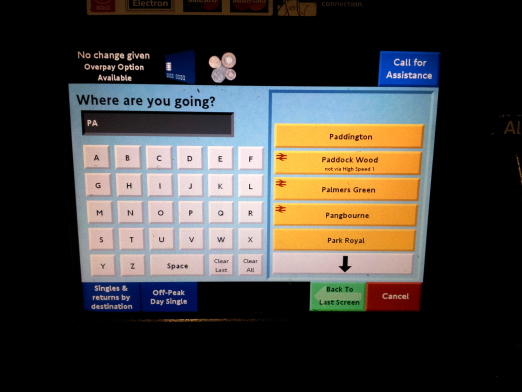
Genuine question - Why do you think so many systems like these touchscreens?
Interesting thing I learned about designing production test equipment. If you show the operator all the nasty state information they quickly learn to associate trashy diagnostic output with corrective action. That janky message means, run it again, it'll pass. This other one means that row of pogo pins needs to be replaced.
Honestly after my experience in firmware and manufacturing I'm amazed anything every works
I work with software now/currently. I'd be surprised it all works if only it wasn't so frequently clear that it doesn't! I suppose the idea of updates has been quite quickly ingrained in the consumer mind - software bugs are somehow more acceptable, seen as just 'to be fixed' rather than 'broken' or 'poorly made', 'not very robust'.