Ok, here's a simple action, that's often solved by touchscreens - Choose a destination from a ticket machine. Let's start with the button-first approach. Here's what the London Underground ticket machines used to look like:
https://pbs.twimg.com/media/B96DRJQIIAE_y1n?format=jpg&name=...
Impossible to sort, filter, search, translate, display updates...
Possibly very efficient for people who have memorized the exact locations of their stations. At least, until they have to lookup a new destination.
Virtually unusable for:
* Anyone looking for a new destination (huge search time)
* First time users (huge search time)
* Non-English speakers (Instructions are in English)
And it's:
* Terrifying
* Expensive to design/build
* Expensive to maintain
* Expensive to update
Compare that to the modern interface, and I know which I'd rather use:
https://cromwell-intl.com/travel/uk/london-underground/pictu...
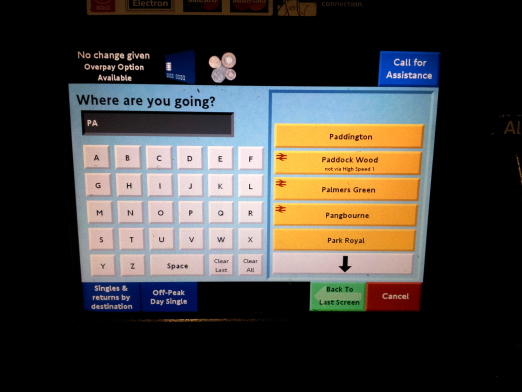
Genuine question - Why do you think so many systems like these touchscreens?
The only advantage of a touchscreen is surprisingly not the ability to touch, but the ability to reconfigure the input interface through software. When you don't need to reconfigure things, encoders, toggles, push buttons, rotary switches, etc. are far superior (with some downsides - cost, reliability).