> The slow-growing trees take 65 to 80 years to reach stable yields.
https://www.hunker.com/13428601/how-long-does-it-take-for-an...
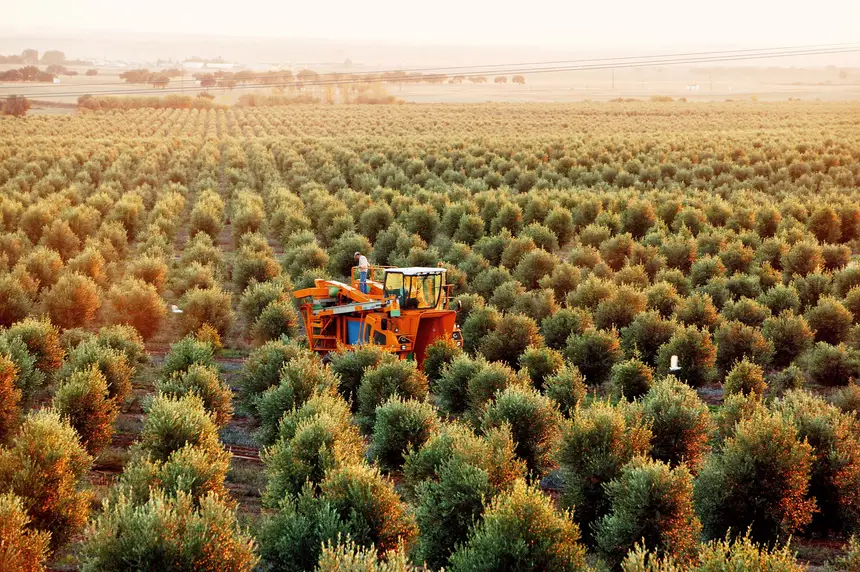
The typical modern plantation in Spain/Portugal uses very young and small trees (they start giving fruit by year 4) supported by intensive automated watering (typically from nearby dam projects) and with the trees spaced out just right for automated picking.
Like this photo: https://images.impresa.pt/expresso/2019-09-06-pag16_T-_IDP.j...
> Olive varieties. Speed things along by choosing the right cultivar. Olea europaea "Rubra" not only can begin producing fruit in its second year, but it also bears prolifically and is a relatively early ripener. "Koroneiki" and "Arbequina" begin fruiting early, at about three years old, compared with other varieties that take five to 12 years to reach bearing. "Koroneiki" is the primary variety grown in Greece for oil production. "Arbequina" is commonly used with newer agricultural methods for high-density planting for olive orchards. All three cultivars are hardy in USDA zones 8 through 10.
The real problem is that these folks (And all other cash crops) have rows and rows of the same crop and nothing else.
That’s not how nature works. Work WITH nature by creating bio-diversity and pests will be eaten by something else, etc.
If you haven’t seen it, I recommend watching “Biggest Little Farm” https://www.biggestlittlefarmmovie.com/
One example is nematode diversity. The more diverse your nematodes, the better your yield. If you kill all the nematodes then you have one season of massive yields followed by really vicious Meloidogyne the next couple of years. If you condition your soil for diverse nematodes (e.g.: multiple genetically diverse rootstocks) then from the top it will look like monoculture (and it is), but your costs and impact with regard to nematicide will go down.
I don't think this is the time for a monoculture soapbox.
Why? There are millions of other plant species aside from almond and cherry, thousands of them edible and many of them support natural predators for the insects that spread Xylella.
Without any more information than this comment, even if you assume olive producing is like wine making, that analogy just means that in over 150 years from now things will be back to normal. That's not much consolation to people owning failing olive farms now.
As a side comment: Xylella fastidiosa is worse than Tuta absoluta in terms of the time frame, but olive oil trees (as another comment has mentioned) are much quicker to re-establish with modern farming techniques. Avocado trees were once considered to be productive if they are really big, but the current knowledge is the smaller they are the better—with heights of as small as 2m and spacing of 2.5m x 6m.
Edit: "Much quicker" can still be a long time. With date palms, you are looking at a 15 year investment before you get high enough yields for positive cashflow.
Hey, this reminds me of the difference between the amount of laundry detergent the washing machine says you should use, the amount the detergent says you need to use, and the amount the detergent has a measuring line for.
This might mean much less olive diversity.
For example, almost all of the vineyards in Europe were wiped out in the 19th century [1]. This is why the oldest vineyards in the world are somewhere in South America. (I think Chile?)
Today, as we all know, France is still the most important wine producing country. South Africa has 100k hectares of wine; France has 100k hectares of merlot.
Yes, people can do more to handle these diseases, but often the simplest way is with a lot of poison, which many people also don't like. Tuta absoluta wiped out 1/2 of the yearly Egyptian tomato crop few years ago and yet it's pretty similar to what we call aartappelmot and unfortunately the way to handle it is with a lot of poison.
By the way, this is why I emphasise that policy is not the main issue in agriculture. The issue is efficiency and efficacy. For example, I am working on building a system that improves time of application of pesticides. (Before getting there, there are some lower hanging fruit to pick.) It's a major problem for farmers of all sizes as the people selling the pesticides actually have an incentive to get you to buy more and more. But the key is to apply at the right stage of the particular pest's life cycle. And as someone who likes mathematics, it's satisfying work due to the inherent complexity of agriculture.
[1] I think this is the one we're looking for: https://en.wikipedia.org/wiki/Great_French_Wine_Blight