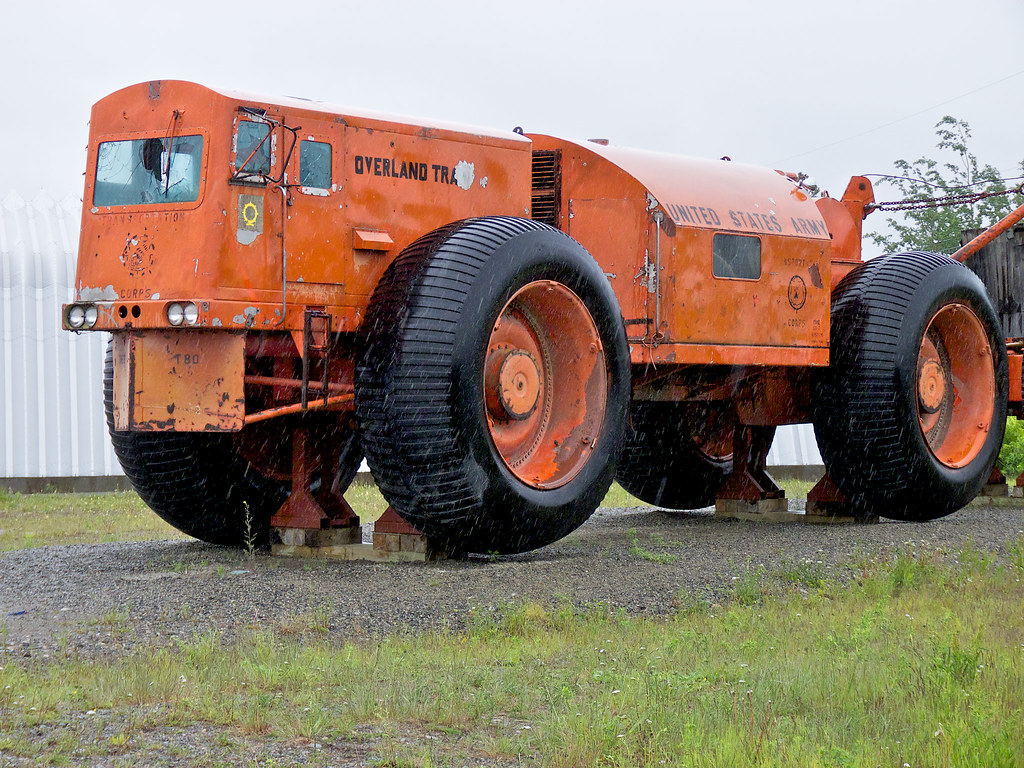
They were designed for swamps, where apparently this tyre design works well. On snow, treadless tyres are essentially useless, and this was a large part of why the cruiser failed to achieve much of anything.
I suspect that at the time producing and transporting suitable tyres was extremely difficult, so they weren't able to try swapping the original tyres for something more suited to the conditions.
Possibly, the LCC-1 that the US Army used in greenland was successful and while the tyres had treads, they were very shallow treads.
A picture here:
https://c1.staticflickr.com/3/2901/14573121102_56c93ec47f_b....
Re:Antarctic Snow Cruiser
by gameswithgo on Monday March 09, 2020 @07:50AM
(#22524629)
probably all that was available in that size plus a lack of understanding. or maybe they thought chains would be fine. but in the pictures there are just four chains! need another 20 or so i would think.
The threads will be packed with snow in no time.
Re:Antarctic Snow Cruiser
by josefresco on Monday March 09, 2020 @09:06AM
(#22525024)
Siping is an important part of snow tire tread.
Siping was cutting edge technology at that time. From https://en.wikipedia.org/wiki/Siping_(rubber)
> [...] It was his son, Harry E. Sipe, who popularised the use of sipes in the USA for the new low-pressure balloon tires around 1939.
> The process was not applied to vehicle tires on a large scale until the 1950s, when superior tread compounds were developed that could stand up to the siping process. [...]
Modern tread blocks are designed to eject mud and snow. Back then though...
I would assume the tyres were chosen to work well on the terrain of Agartha, the ultimate destination of the expedition.
Large and soft tires are certainly good on snow, but smooth?
Maybe that actually works better on ice?