These functions really need to be divorced from one’s employer, and either run independently via private industry, or via government. Especially in modern times when people job and career hop frequently.
Well after you're done working, you don't work anymore. So if a country spends zero on providing pensions, they are actually more economically competitive.
Whether one would want to live there is another matter, but the lower income people have little money to move and build a life elsewhere and the higher income people can arrange a good future for themselves.
You can't build an economy on consumption alone.
https://www.marketwatch.com/story/generation-x-stop-slacking...
[1] https://www.cnbc.com/2019/04/05/these-people-are-on-the-verg...
[2] https://www.gao.gov/assets/680/670153.pdf (GAO report)
During WW2 there was a labour shortage as the wartime economy was booming. President Roosevelt signed into law the Stabilization Act of 1942, which froze direct compensation and bonuses, but exempt to the freeze were benefits like health insurance and pensions. So that's what employers started using to attract employees.
https://www.chicagotribune.com/opinion/commentary/ct-obamaca...
1. http://www.pensionrights.org/publications/statistic/income-p... 2. https://www.cbpp.org/research/social-security/social-securit...
This shouldn't be an issue if the pension was pre-funded, which I thought was supposed to be the case in the US.
Was one of the benefits of the pension a healthcare plan?
The article doesn't say that it was.
If it was, though, that is pants-on-head stupid. A pension is supposed to be a fixed payment investment, not a variable-payment one.
https://www.ssa.gov/policy/docs/chartbooks/fast_facts/2019/c...
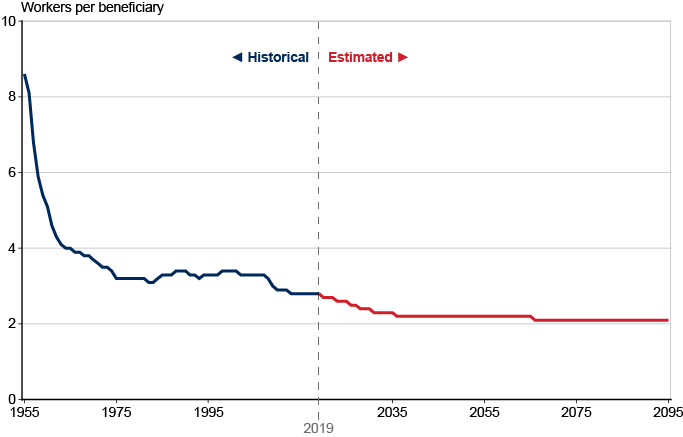
Holy crap. I remember a person from a newspaper told me it was 3-1 for them, and I thought it was hyperbole.