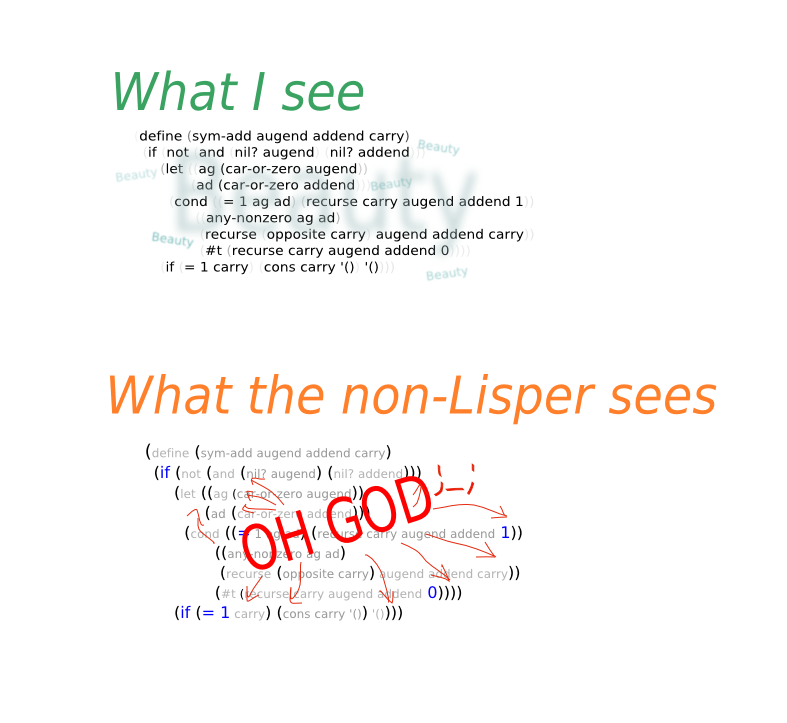
Modern Lisps like Racket and Clojure are not that difficult to pick up. I think Clojure might be easier to learn than Python or Javascript. I'm serious.
Look, I understand the sentiment because I was on the same side relatively not too long ago. I never had a formal introduction into a Lisp. I thought Lisp is a dying language, something like Fortran, COBOL, or Pascal. On a whim, out of the blue, I tried learning it. I don't remember exactly why. I was bored or something. I started reading a book on Clojure. Then I found a conference that supposed to happen in a week. It was the first Clojure/Remote conf. I thought: "Well, it's remote. It's cheap. Let me try it out. What do I have to lose?" That conference has changed my life. Quite literally. I was fascinated by seeing awesome things people building. After the conf, I sat in my chair, staring into the void of my blank screen for several minutes. The next day, I went to the office and told them that I'm leaving. Without writing a single program in a language I did not know, I decided to find a job with a tech stack focused on Clojure.
There are lots of misconceptions circling Lisp. People look at Lisp code, and it just doesn't look "sexy" to them. And they immediately dismiss it, claiming it is hard to read. That's not true.
They say - it's dynamically typed mess. Without ever knowing that Clojure has a type system called Spec, which can do things, most other type systems cannot. There's a ton of research happening around type systems in Racket. "Little Typer" book teaches dependent types using a Lisp.
They say Lisp codebases don't scale - that's not true at all. The truth is - programming in Lisp makes people so productive, you don't need large teams to maintain a massive amount of work. And there are companies with large Lisp ecosystems, one example: NuBank in Brazil has over 400 engineers, and their primary language is Clojure.
People say Lisp is not popular. Sure, Clojure's popularity might look dwarfed in comparison with massively popular Python, Javascript, C++, Java, etc. However, Clojure, compared to other "esoteric" languages, is quite popular - today, it has more books, podcasts, conferences, and meetups. More than languages like Haskell, OCaml, Rust, Elm, Purescript, ReasonML, F#.
Learning Clojure has opened a world of possibilities for me personally. My only regret that I haven't gotten into Lisps earlier. Please, don't negatively take my advice. My intentions are sincere. I wish someone would've convinced me to try Lisp early in my career. Please, do sometimes try to get your head out of your shell and give it a try. I promise, if you give Lisp an honest and heartfelt try, you will find something unique. Even if you end up not using it, you will never regret learning it.
If we look at programming languages like Java, Typescript, C++, Haskell, etc., then we see that their type systems are completely different and have an entirely different purpose. Claiming to those users that spec is a type system, is just misleading them.
It sounds like one has to throw away years of "imperative habits" and just do everything different: reading, debugging, structuring, etc. For us non-Sheldons, it's hard to overhaul our head in a month.