The 777 got a similar upgrade that did include a new wing design.
Ultimately Boeing is looking to introduce an all-composites design that fills the 737 and 757 roles, but airlines desires for crew commonality might push that back.
Though note the A320 is a newer design than the 737; the A320neo as a result didn't have the big problem of the 737 MAX: because its landing gear was always longer, because it was always designed for high-bypass turbofans, it could easily fit the larger engines under its wings without having to relocate the engine mounting.
The 737 MAX is a world away from the original 737 (hell, the shortest 737 MAX is 6.6m/23% longer than the original 737 design!), whereas the A320neo is much, much closer to the original design. The 737 MAX has ~80% parts commonality with the previous-generation 737 NG, yet alone the original 737; the A320neo has 95% with its predecessor, which _is_ the original design.
Probably even earlier. The trim wheels in the Boeing 707 look pretty similar to the 737.
There's a very obvious shared design between the 707 and 737 cockpit that goes beyond anything you could attribute to general cockpit design.
https://i.pinimg.com/originals/1b/67/96/1b67964cc0e7c178bb8b... (707)

https://cdn.jetphotos.com/full/6/22047_1484863414.jpg (737-200)

https://airbus-h.assetsadobe2.com/is/image/content/dam/chann...
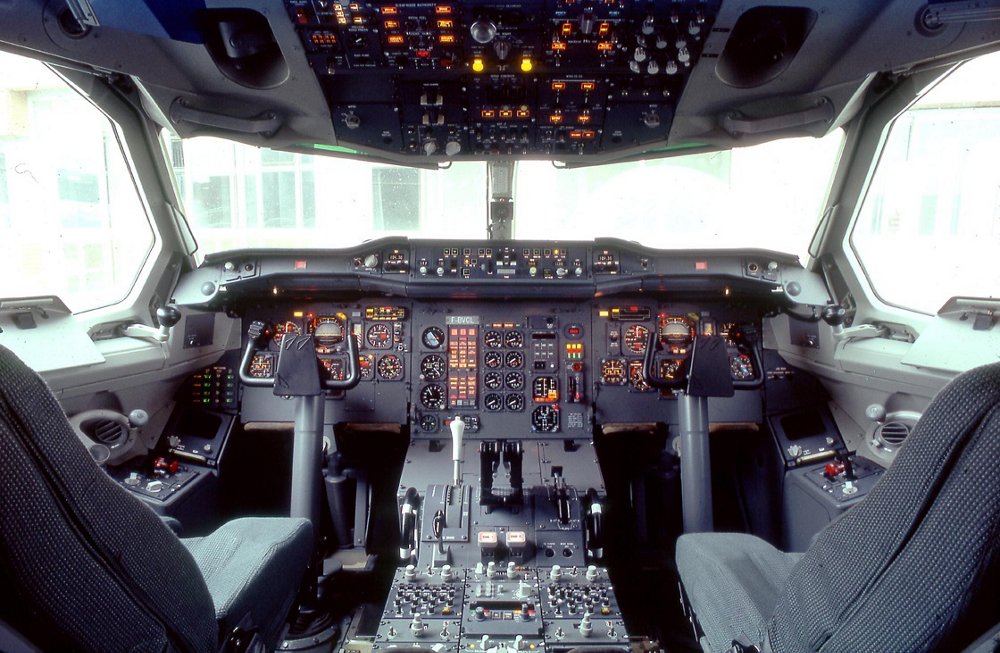
It has trimwheels.
Similarly, when I consulted with one of the major airlines (although not in flight operations) I was told that many of the physical specifications of airplanes were driven/limited by airport gates. That is, wingspans, fuselage curvature, door height, etc. need to be within certain ranges so that it could use existing gates unmodified. This was one of the biggest issues with adoption of the Airbus A380...airports had to build new gates just to support them. I understand that is an issue with the 737-MAX: to place the much larger engines in a place that wouldn't screw up the balance (e.g. under the wings instead of out in front of them) would make the plane inconveniently high off the ground.
I think the mismatch may be that these are all-manual designs, and the 737 is much larger now than when it was first designed, plus the first design didn't have automated systems counteracting your inputs.