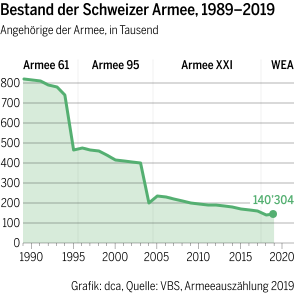
Realistically, our armed forces are at a strength of about 140K soldiers right now (pretty sure that's not a state secret).
The parts of the terrain that are actually inhabited are not particularly forbidding (let them build their RISC processors in a hut nestled beside an 8500ft mountain pass. Don't forget to bring popcorn as you watch them).
And nuclear power plants make a big fat bombing target for opponents too lazy to make their own dirty bombs. Conveniently placed smack in the middle of the inhabitable part of Switzerland, too.
I highly doubt it'll come to that. It would be much easier to just infiltrate the fab and replace stock going to an important destination.
> it's enough to give an enemy a bad time
That depends a lot on the objective, I think. The defenses against an enemy controlling the transalpine transportation axes are fairly strong. But I think this scenario gets talked up a lot for exactly that reason.
The defenses against an enemy controlling 80% of the population and 90% of the economy are much weaker. Then again, it might only take a few sysadmins armed with SQL queries to deal significant economic damage against any attacker.
> It would be much easier to just infiltrate the fab and replace stock going to an important destination.
True. And if I've understood the article correctly, no fabs would be changing location. RISC-V is an open source design, so the fabs in question would probably be located in the "enemy" countries anyway.
Switzerland is filthy rich, too. Private fortunes thought to rival or surpass the biggest public billionaires, money pipes throughout the world beyond measure — the result of centuries of diligently building a discrete but very real financial empire... all of that has to count for something in the age of PMC's and acts of surgical retaliation projecting force accross the globe.
Taking on a too-rich enemy in modern times is choosing an all-out, extremely mobile, stupidly costly, and above all likely painful war. You'll lose a lot at the hand of the best weapons and talents money can buy.
That's why an extremely indebted USA is still very valuable. Because they can park a few aircraft carriers off the coast of whomever they desire (although this may be changing, namely due to China).
But I understand where you are coming at, perhaps it is because major military nations poses A-Bombs. I guess, if they are democratic countries we have no choice but to hope that their citizens can prevent it from getting used; My real worry is the non-democratic/pseudo democratic countries with A-Bombs.
Edit : N-Bomb->A-Bomb.
Switzerland's terrain wouldn't see regular war but guerilla warfare (including mined bridges and everything). Having trained marksmen in almost every household helps a lot in such a situation.
> Atomic weapons or other WMD goes against the ethos of neutral countries which traditionally are pro-Human Rights.
I think Switzerland would adopt a "whatever it takes" approach when attacked. At least that's what they credibly project, and so it's unlikely that they'll end up having to play it out.
A n-bomb is more likely to refer to use of a slavery related term, and is very frequently used in some circles which include the current US president. So demonstrably democracy does not prevent the use of n-bombs, which happens to be true historically for a-bombs as well (which were used by a democracy essentially because the war wasn't over by the time they've built the thing).
>which were used by a democracy essentially because the war wasn't over by the time they've built the thing).
But the same U.S. President Harry S. Truman relieved General of the Army Douglas MacArthur when he wanted to drop A-Bomb on China during the Korean War.
There exist no country in the world where citizens have any say on nuclear weapon use. "Pseudo democracy" is the norm.