Then looking at energy consumption, a container ship might need 8 HP of power per 40 foot container sailing at 18 mph. This airship has 700 HP per container at 70 mph.
Ideally you'd use windpower (sails) and solar (electricity) for the ships.
With airships, smaller businesses can directly trade over long distances. I'm personally excited by agriculture potential... shipping spoilable heirloom produce straight from farm to markets across the country would be disruptive.
However, a single container ship carrying upward 10,000 containers still offers value at larger scales.
Here is the experiment: Stare very hard at this graph. memorize the trajectory and timeframe.
https://www.ipcc.ch/site/assets/uploads/sites/2/2019/02/SPM3...
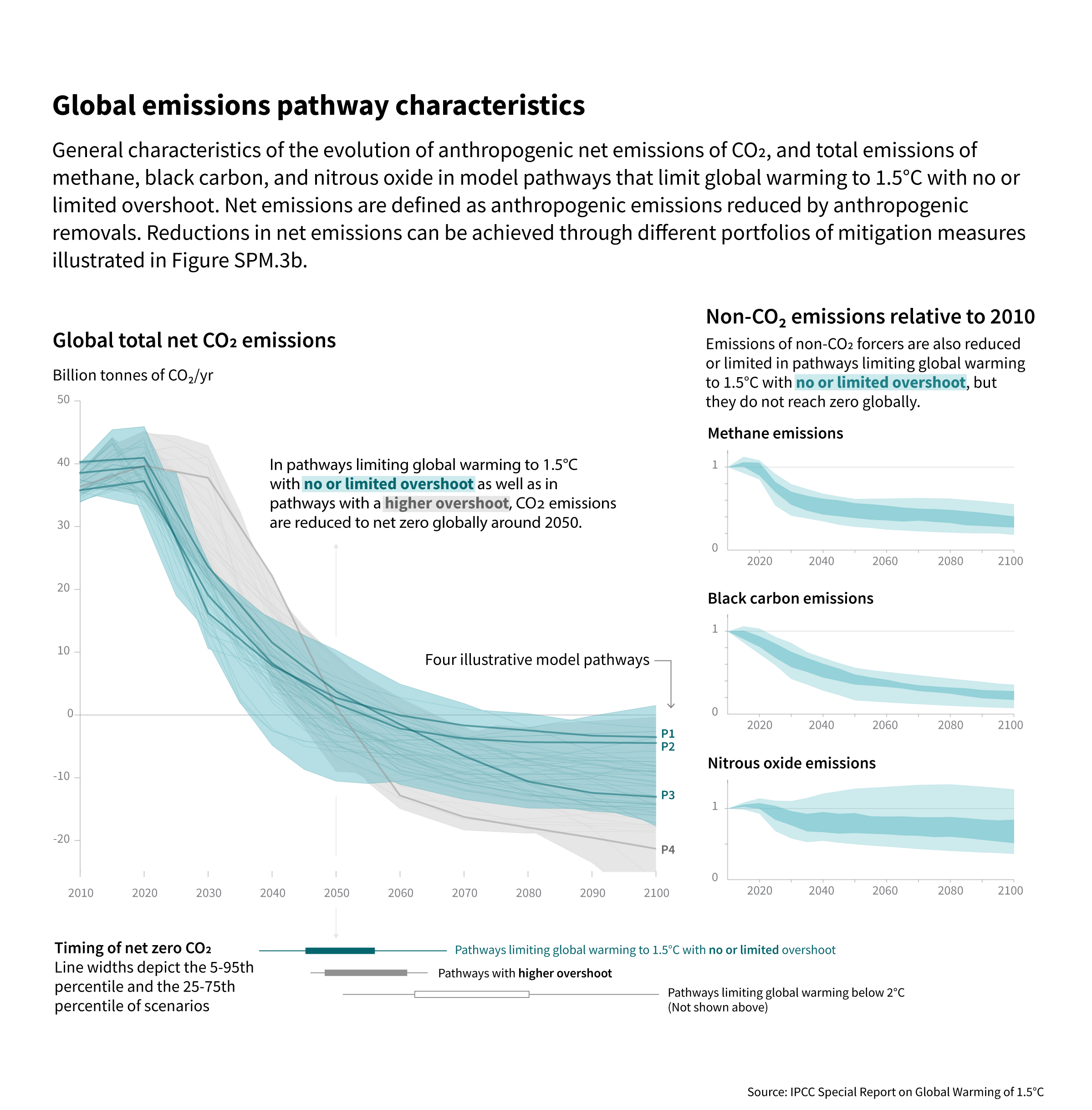
Keep it open in a tab and come back to later, maybe even several times over the course of a week or month.
For those reading along I mean specifically a few points:
  * emissions peak in 2020 (<2 months!)
  * emissions are approximately 50% reduced by 2030 (a mere decade!)
  * emissions achieve net-zero around 2050 (-5 to -10Gt/yr)
  * the entire back half of the century we run -5 to -15Gt/year
What I mean is, assume we succeed in avoiding the worst of the catastrophes. Assume success. Try optimism. Not in a blind way, but in a quantitative mental framing way.
From that place of quantitative optimism, "solve for zero". That is, in all of your thoughts, opinions, comments, actions, causes, votes, etc, ask yourself "is this consistent with solving for zero?"
The point of this experiment is that, in my opinion, the number one hold-up to making meaningful progress on this challenge is people who are trapped in "analysis and debate" mode where they assume the time-horizon is much longer than it is, or they assume the goal is marginal reduction of emissions, rather than zero (and then negative!).
I believe that we, as both a community here on HN and as a global civilization, are in desperate need of quantitative-optimism, rather than dismissive pessimism.
Now after all that typing to tie it back to your post here. We both know airships flying containers are not going to be as cost-efficient as a diesel powered truck or a kerosene fueled jet. That's basically just stating the obvious. But that's also accepting failure.
Please stop accepting failure as the default mental framework with which you engage the topic. For any one person it can seem like reasonable skepticism. But when the majority of a community does it, especially its most vocal members, then the cultural result is one of inaction and delay. Analysis paralysis. Stalling. Stalling on climate change is effectively denial, even if that's not your intent.
Edit: Also, if there is one type of ship that is going to be replaced by airships, its going to be the cruise ship.
But modern cruise ships are huge and are largely oriented around providing tons of activities. In fact, as far as I know, there's only one ship that is more oriented around providing trans-Atlantic transportation (among other things and only for part of the year).
if you could make it battery-electric and autonomous, then you've solved for global shipping emissions (cuz we don't need the ships anymore).