
Various forms of intelligence by age: https://miro.medium.com/max/1038/1*ccb0bgIqgebwJWTdMGMXXQ.pn...
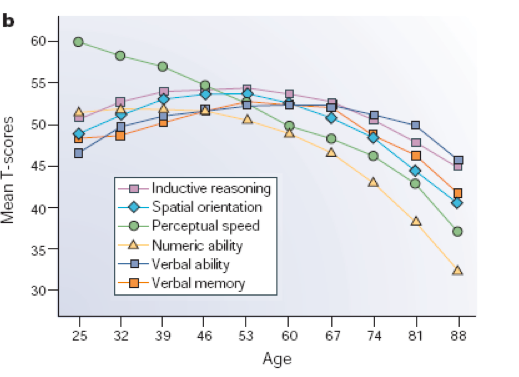
If this correlation isn't causation, then I'm not sure what is.
As to why old people, higher skill levels in many cases.
People between 40-60 tend to have things they care about outside of work at higher rates.
Before I started, I was pretty concerned about whether I would be able to do this even. Most of my peers are in their 20s and 30s, though it was surprising to me when I started this program that I am not the oldest candidate and there are a couple of us in the higher age ranges. Anyway, I had wondered if I would be able to keep up with the youngsters. In fact, I don't think it has been an issue at all. I think that I am performing at least at as high of or possibly a higher level today than during my first run at graduate education.
I think there are certain factors that I, as an older, more settled, less let's-start-living-life(!) person have as an advantage over my young peers. Many of them still focus a lot of time on socializing, whereas I have my spouse and kids and old friends whom I don't have to see every weekend (the old friends--I see my spouse and kids every day). My younger colleagues do a lot of dumb things still, ones that I sure did also when I was that age and have gotten out of my system.
I would say that there were certain advantages to doing graduate work when I was young, and certain advantages now. I find it impossible to say which is better, but it is at least no worse now than then.
Increasing age and increasing decline can't mean that age causes decline, it shows one or more of: processes which cause decline keep happening, repair processes either don't happen or get worse, new generation either doesn't happen or gets worse.
(If worms were eating your brain, your brain volume would go down and your intelligence would go down as time passed and your age increased, it wouldn't prove that age caused your intelligence loss. Correlation isn't causation).
There is a lot of science to back this up. That getting married and/or having kids is what marks a man's decline in innovative output, because they no longer have to impress potential mates.
But it's also correlative and not causative, and assumes most men make the breakthroughs, which has been traditionally true but almost certainly because of some other factor than just gender.
Testesterone decline begins at 30, regardless of the marital status. https://www.menshormonalhealth.com/normal-testosterone-level... This corroborates (in the correlational sense) my original statement.
To those who silently downvoted it: is it politically incorrect to talk about cognitive decline at any age in general, or only starting from a particular age? If 40 was too early, what is the allowed age? 65? 85?
E.g. I remember my first CS classes, and how I during my algorithm classes "invented" thing after thing just to read on to the next chapter and see my "inventions" covered. But now and again someone will come up with a genuine invention to a problem that is novel and important in part because they've not yet come to learn what the "right solution" to that problem is.
As you learn more, you tend to focus on the perceived narrow gaps of uncharted territories or at adding more at the peaks, where making progress is a massive slog.
From a different perspective, having done multiple startups, I think one of the advantages I had in terms of willingness to jump into something new when I was younger, was lack of knowledge.
I went head first into starting and ISP without knowing either the business side, or the technical side of it - I had enough knowledge to know where to start figuring it out, but not enough to know why it would be hard. And so I did it. We weren't tremendously successful, but we learned a hell of a lot, and in the end it kickstarted my career.
Today, it's far easier for me to look at an idea and think up a hundred reasons why it will probably fail because I know more. While that probably saves me a lot of misery, I've also been through enough startups to know that a lot of the objections people raise that looks fatal can be easily overcome; it's very hard to know which flaws will actually be a problem and which will not, and some even turns out to be advantages (e.g. you find a way past them but your competitors don't). In a sense it is frustrating, and I sometimes wish I could look at an idea and ignore the obvious flaws the way I would have at 20...
Another advantage was being less risk averse even when I did see the risks and flaws. I had far less to lose:
No career to ruin; no house to lose; no child I was responsible for, more time to do something else if I got nowhere.
So when we then look at breakthroughs, to determine if it is down to cognitive differences, we also need to consider how large a proportion at different ages are willing to take those risks and put in that level of effort.
My first startup was planned in a couple of weeks; we got seed funding from some random person one of us met in a bar (...); the following week I moved out from parents into a room in our new office.
I'd never be willing to move that fast today, nor live in the office, because my priorities are different. And while I strongly believe I am more likely to be successful at the things I try today, I am also a lot more cautious about the attempts I make. In the end I'm probably less likely to end up with a stratospheric success due to less willingness to take huge risks and fewer attempts, but I'm also less likely (I think, at least) to end up crashing and burning. Startups are obviously different from e.g. success in science, but I'd suggest similar mechanisms are at play - you build a reputation that depends on certain things that are easier if you stay "safe" in a niche you know you can keep publishing in than if you go for something of totally uncertain payoff; you get comfortable in a working pattern that fits your life etc.
Of course that does not rule out cognitive decline as part of the explanation as well.
When you are twenty, doing anything will teach you a lot.