Re:Why are there no animals with three legs?
by cjensen on Friday October 04, 2019 @12:13AM
(#21154703)
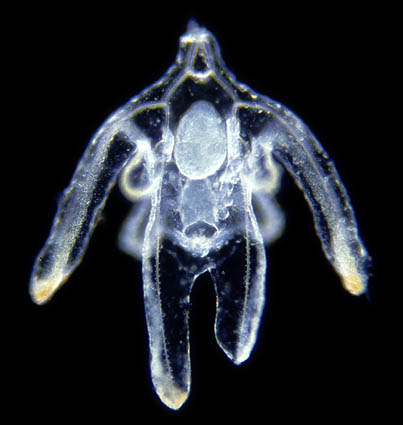
Yep. If you look carefully at a most starfish, you can see that they are bilaterally symmetric. For example, when there are five legs, if you mentally halve the animal along a leg, only one of the five legs results in both sides matching.
Re:Why are there no animals with three legs?
by gowld on Friday October 04, 2019 @01:42AM
(#21155111)
That still undermines the articles thesis and that an odd leg can't be bilateral.
Re:Why are there no animals with three legs?
by kittiepryde on Friday October 04, 2019 @01:46AM
(#21155131)
I have one head and four appendages (two for each side, but only one head bilateral down the middle). I don't see why they couldn't have a leg, bilateral down the middle ( like a head?)
Or a tail
Re:Why are there no animals with three legs?
by smackay on Friday October 04, 2019 @03:50AM
(#21155659)
Anyone know if there is "handedness" in tails, particularly in monkeys where they use their tails while climbing. Do individuals always curl their tails clockwise or anticlockwise around a branch?
Re:Why are there no animals with three legs?
by e12e on Friday October 04, 2019 @04:53PM
(#21161791)
Well, technically you have a tail too. I suppose a better description would be a spine, stunted in one end (tailbone), extended at the top (head), with two set of limb pairs (arms, legs).
Re:Why are there no animals with three legs?
by matt-attack on Friday October 04, 2019 @02:10PM
(#21160307)
Well said and excellent point.
Re:Why are there no animals with three legs?
by elliekelly on Friday October 04, 2019 @12:21AM
(#21154731)
Whoa, it does actually look like a little biped flubber: http://science-at-home.org/wp-content/uploads/2009/12/starfi...
Re:Why are there no animals with three legs?
by eternalny1 on Friday October 04, 2019 @01:44AM
(#21155119)
Hence the "almost all".
Re:Why are there no animals with three legs?
by perl4ever on Friday October 04, 2019 @06:15PM
(#21162365)
Well, if I were a starfish, I would take issue with that dismissive phrase. They are members of a large, and, I assume, proud phylum.
"Echinodermata [is the] second-largest grouping of deuterostomes (a superphylum), after the chordates...Echinoderms are also the largest phylum that has no freshwater or terrestrial (land-based) representatives."
Apparently they're bilateral as juveniles and only become radially symmetric as adults (https://en.wikipedia.org/wiki/Bilateria)