AFAIK, it's actually true. If we live long enough, we'll all get cancer. In the case of men, it's a near certainty we'll get prostate cancer if we don't die of something else first.
Also, 85% of us have Cytomegalovirus, which basically executes a DOS attack on the memory of your immune system, eventually resulting in immune deficiency. However, the progression of CMV is so slow, we'll almost certainly die of cancer before this happens.
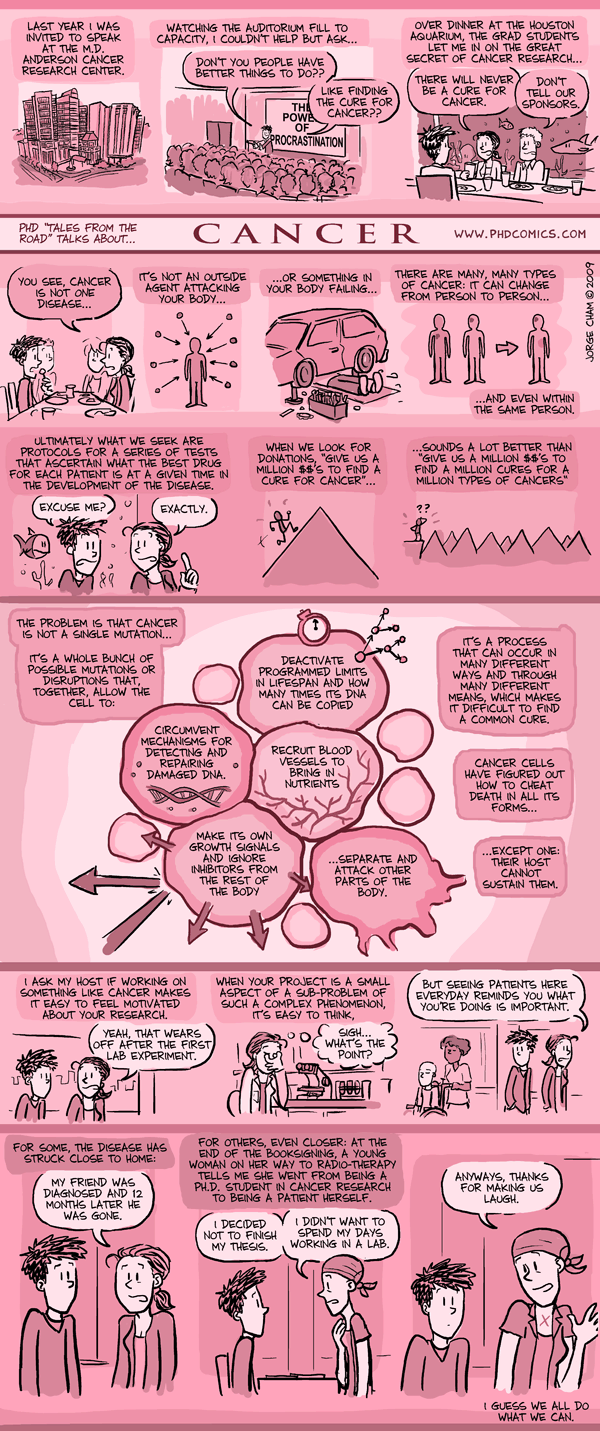
http://www.phdcomics.com/comics/archive/phd042009s.gif gives a nice summary.
Some people value the needs and well-being of others equally, or higher, than their own.
This is very true. I think the most exciting developments in cancer treatment in the past decade have all been targeted therapeutics: drugs that are designed to affect the function of just one particular protein in a cell rather than the "kill anything that moves" action of traditional chemotherapy. These targeted treatments are only effective against the subset of tumors that rely on that particular protein. For example, Trastuzumab and family only help about 10% of breast cancers that have highly amplified Erbb2, but you can test ahead of time to find out if it will likely help you.
I find great hope in this approach. It's possible that in a decade, with a much greater repretoire of anti-cancer chemical weaponry, much better genomic diagnostics, and much better understanding of how genes interact to cause cancer and evade treatments, we could squash a huge percentage of cancers, even pancreatic, brain, and ovarian cancers. Every tumor would have a custom-designed cocktail of off-the-shelf drugs.
There are some fascinating things to be learned, about ageing as an anti-cancer mechanism, and particularly about how much is being discovered right now. It seems that what we characterize as ageing is mainly a side effect of "cellular senescence" which may very well be treatable without increasing likelihood of cancer. There are people who say we basically have the means now to increase life spans by at least 15% but ...
another fascinating aspect is that a huge blockage to research on ageing is that it is not classified as a "disease", which means firstly that it fails to qualify for funding from most public sources and further that it is every very difficult to get drugs through the FDA since the FDA will reject things that don't have a proven clinical benefit (hard to prove for something that isn't a disease in the first place). As a result, even though we could have a huge impact on cancer by funding ageing research, we don't - instead we fund cancer research and some little bits of that trickle into knowledge about ageing.
We should seriously research the possibility of transferring the human consciousness into a machine "body". Our organic bodies will fail us eventually.
Replace a single neuron in the brain with an artificial one. Every time you go out drinking you lose plenty more cells, so clearly "you" are still "you". Now do another, and another, and another. At no point do you "break the pattern", but eventually you're left with a completely virtualized mind. Copying the pattern and destroying the original generally counts as "breaking the pattern", which is what you are describing.
It's not really a new topic, but is still debated: http://en.wikipedia.org/wiki/Ship_of_Theseus
Further, once you did the switch at least once and had the memory of "waking up" in a new body, you'd have a lot more confidence that "you" would still exist after the transfer.
I see no reason to presume that; if it worked at all, you'd expect people of all ages to upgrade immediately.
> Further, once you did the switch at least once and had the memory of "waking up" in a new body, you'd have a lot more confidence that "you" would still exist after the transfer.
That rather is the point of my question... You didn't wake up, a copy did, you got killed afterwards and knew you were about to die. The point was to question the idea that you could ever be uploaded in a meaningful sense.
What I personally see actually happening, is people being enhanced to the point where implants make up more of their consciousness than the real brain does and they feel so disabled without the implants on that they no longer see themselves as whole without them. At some point, our idea of consciousness will simply change and then it'll be no big deal killing off the biological part and going pure machine, gradually.
If the transfer is successful, from your point of view you went to sleep in one body and woke up in another. If it failed, you'll fall asleep and then wake up a few days later.
As a society, we have become exceptionally good at treating pathological diseases. This is how we know we will eventually cure AIDS because we fundamentally know how to do this kind of medicine. (And it appears like an AIDS vaccine, and perhaps even a cure is closer than we think.)
Unfortunately we are terrible at treating any aging-related disease. Diseases such as those that relate to the fundamental breakdown of the metabolic process, cancer or Alzheimer's. We just simply don't have the research and experience to treat these diseases in anything less than a crude way.
For those unaware, Chemotherapy and Radiation are probably some of the least-precise medical treatments we apply on any broad scale today in modern medicine. We try to radiate or kill your cancer cells before we kill the rest of your body. Seriously.
Anyways, more research on aging-related disease is critical if we want people to keep living longer. If we don't, then we should just focus on pain management and let people die as they grow older.