Re:First Programmable Memristor Computer
by heavenlyblue on Wednesday July 31, 2019 @07:23PM
(#20579657)
How’s that “bit depth” different from the bit debth you get when you implement a simple analog summing circuit?
Re:First Programmable Memristor Computer
by rusticpenn on Thursday August 01, 2019 @02:01AM
(#20581348)
The number of elements required is much less.
Re:First Programmable Memristor Computer
by Balgair on Thursday August 01, 2019 @11:12AM
(#20584483)
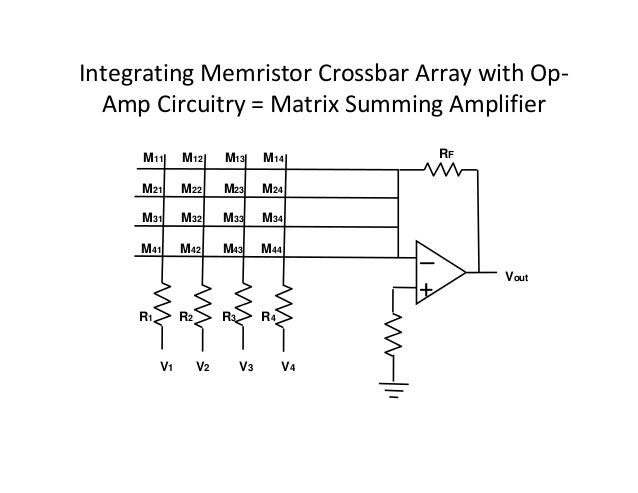
The 'standard' summing circuit [0] typically requires an op-amp, which is in itself a multi-element component, and a few resistors. With a memristor, you can theoretically skip the op-amp and just use the passive elements, though an op-amp is likely still needed to read out the very small signals [1].
[0] there are MANY ways to skin this cat, but here is a simple one: https://www.electronics-tutorials.ws/wp-content/uploads/2013...

[1] https://image.slidesharecdn.com/1205-141021211518-conversion...
Re:First Programmable Memristor Computer
by rusticpenn on Friday August 02, 2019 @02:16AM
(#20590959)
The opamp is mainly needed of impedence matching. There are several ways to contruct such circuits using just inverters.
The real key feature of memristors is not the math or any of that stuff, it's that all that math is stable under power cycling and it take nearly no power to compute things. The article mentions that they preformed 188 GigaFlops with about 0.3W of power. The human brain is about 20W at about 1 ExaFlop (a VERY coarse estimate) for comparison.
This power savings opens up the doors for very good computation (ML stuff) on very tiny power sources.