There is a massive (and sadly too common) social bias in this comment: this is not the life of retired baby boomers, this is the life of retired upper-class baby boomers, but the majority of people isn't like that.
The upper class people also live a lot longer than the lower one (a decade or more depending on the region) so they cost even more.
And since they are generally in a much better shape at the same age, raising the retirement age affects the lower class much more than the upper one.
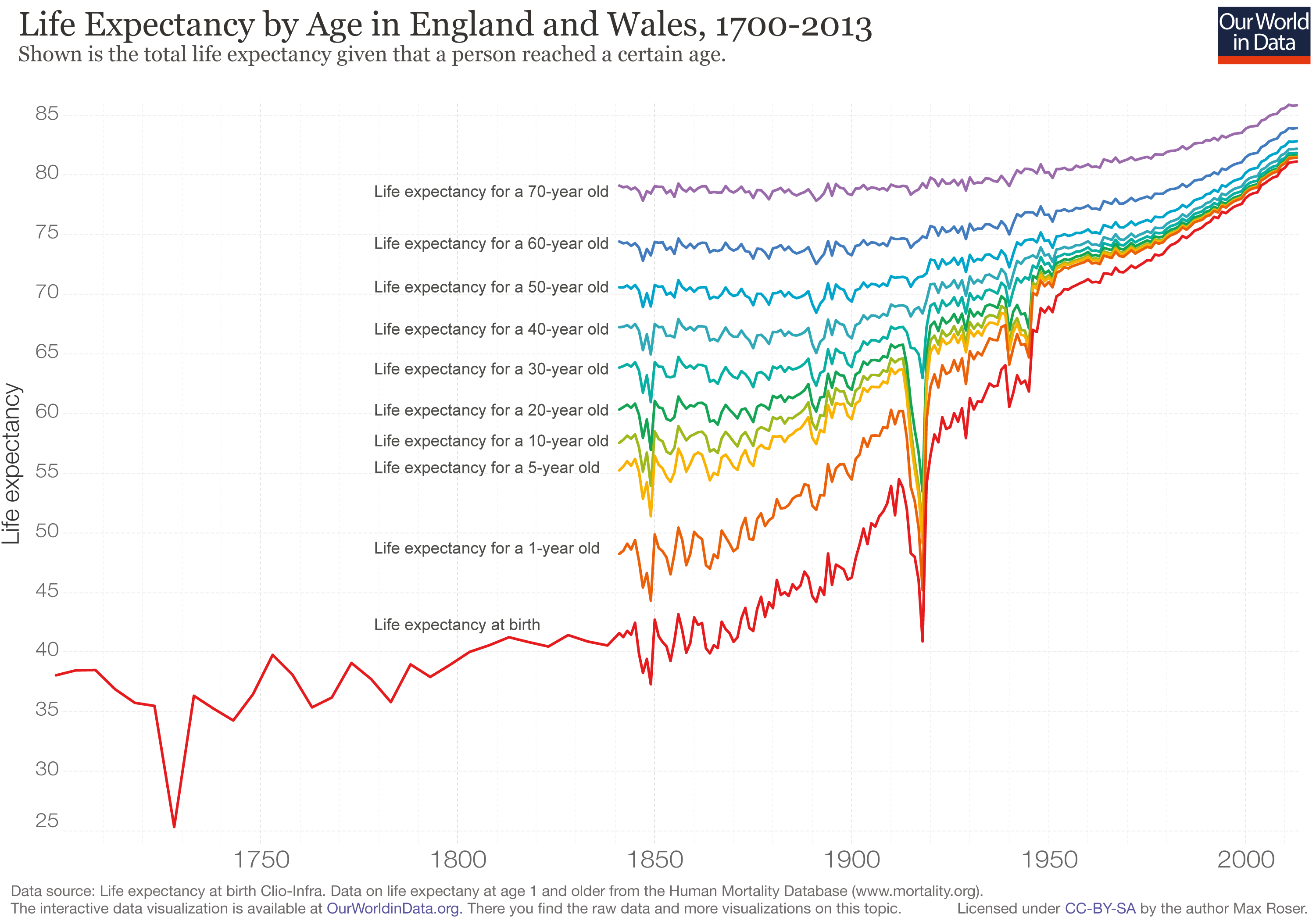
Also, the life expectancy didn't change as dramatically as you'd think since 1950 in that context: in 1950 the life expectancy of a 60 years old British citizens was 77 years. Now it's around 84 years[1]. It rose, but not that much (it didn't go from 5 to 20).
[1]: https://ourworldindata.org/wp-content/uploads/2013/05/Life-e...
The middle class is where all those cruises are being sold to.
They have huge disposable incomes due to final salary pensions and no mortgage to pay, or they've downsized and unlocked huge sums in an over-inflated housing market because we stopped building enough homes year on year 40 years ago when Thatcher banned the councils from doing so.
Pensioners now have higher disposable incomes on average than working people in the UK.
The average person under the age of 50 today will never have it as good as the baby boomers, unless some major, socially liberating, tech advance happens.
And, on average, older retirees are less physically able and require more care.
These are the two things I criticized in the original comment.
Working beyond 65 is fine for some people but there are many cases where this isn't. Take any job requiring physical labour like construction. There is only so long you can do those kinds of jobs. Also the fact that you've been doing them for decades takes its toll, physically.
So what's the solution there? People still need stuff built. So you only work construction until you're 40-50 and then what? Change careers? To what exactly?
Even for jobs that aren't physically demanding, many people have jobs that if they lose them when they're over 50 they may never work again. This could be completely not their fault either. Their company could go under or get bought out. It could be economic downsizing.
The problem, on HN at least, is that there are young people in a high-demand high-paying profession who have never experienced a recession making sweeping statements like "just work until you're 70" as if everyone else is in the same boat as them.
As much as you might be a highly paid tech worker, come back here when you're say 55 and those same companies who were fawning over you as a new college grad won't give you the time of day. In tech we haven't really dealt with this yet but I guarantee you it's coming.
I don't like generalizing by "generations" but this is something where I see a divergence in younger and older coworkers.
Older ones literally say, "I don't want to learn [insert relevant skill] because I'm too old."
Younger coworkers seem to come better equipped with the mindset that they will have to continually unlearn and relearn to remain relevant. And to counter your point about a recession, many of them started their careers in a recession and I see it in their conservative approach to employment.
I think this is more about a complacent mindset with people who may not have recognize that they have to adjust to continue to be valuable. I've known people who were downsized and squandered ample opportunity like free tuition to change careers. I've known others who've successfully parlayed a physically demanding job to one less physically demanding because they knew they couldn't do that forever.
How old are you? Have you tried working at most jobs (not just some office job) as 65+? Have you tried programming as such?
If you mean "paying pensions for people 65+" was too much, and we needed to cut that, I'd understand. And sure, raising the retirement age is one way to do that.
Still, it's not the best way to solve the problem. Nor is it "needed" for any other reason (e.g. because people of 65+ today are more capable than in the 70s).
>Most are perfectly able to work for another 10 years at least
I take it you're in the 20-40-max bracket?
There isn't enough wealth to cover it. All the wealth of all the billionaires in the world is only the EU healthcare budget for five years.
Productivity is what generates wealth, and we can't afford to have a large class of people merely consumptive. People aren't producing enough to do it.
If you want to give 20k/yr to someone it has to come from someone else. That's putting younger generations into a dire financial position.
Work of some form has to be found, even if it isn't covering living expenses for pension-age people. Some form of off-setting the cost has to be implemented, or else there'll be a political and economic crisis.
[1] https://ourworldindata.org/wp-content/uploads/2013/05/Life-e... https://www.ons.gov.uk/employmentandlabourmarket/peopleinwor...

The relevant growth % is the total number of life-years being funded by retirement.
Since the total populaton of US in 1950 was 150, and is 300 million today -- assuming equal distribution of ages -- that's a 4x increase in life-years to fund.
ie., 2x for population size, and 2x for length of retirement
And worse, the distribution isnt equal, ie., there are more of the population today in retirement than in 1950.
So it's at least 4x the number of years, and probably closer to 6x.
And do you have figures for the doubling of the retirement duration ? As I showed above, it only increased by 50% in England and I'd be surprised is the American raise was higher since life expectancy is lower there (in part due to a less efficient health system).
The relevant data needed is total number of retirement hours funded, total productive output, and total "other" essential spending.
What's also happening is the cost of healthcare is increasing, quite dramatically, and eating up productivity gains.
I have a strong suspicion that we're way ahead of "general essential" social spending today, compared to 1950s, per-captia; productivity gains included.
Open to detailed analysis on this though
For one, people pay pension savings throughout their careers (in most civilized countries).
Second, we've already discussing UBI for life, compared to which "paying people not to work for 20 years" is nothing.
Third, money to pay people is an artificial construct, which is not really what's missing. We have the wealth to sustain them. E.g. we have increased productivity dozens of times over the past 100 years, and yet we don't enjoy those fruits in increased leisure time or work-less access to food, health, studies, shelter, etc. If anything the latter have inflated many times over. Where are those "trickle down economics"?
>Productivity is what generates wealth, and we can't afford to have a large class of people merely consumptive.
We have increased the productivity of the average worker dozens of times over the past 100 years. How's that wealth distributed?
The idea is that your future pension is paid by yourself gradually over your productive years. Generally speaking of course - some have no work ever, some do and pay more, some die before they get some of it, and so on.
Complex calculations though, since we can't know the situation 40 years ahead, perhaps not even 5 years ahead.
The sad fact is that expecting to be in a high-flying job your entire career and to only climb is no longer viable. Yes, older people will have to take lesser jobs, but that's what we're all going to have to do.
We can't afford to pay for people to have a second childhood when they can still do lots and lots of jobs.
It is also worth remembering that today's 65 year olds are nowhere near as run down as those 50 years ago. We've got better diets, better medicine, generally less demanding jobs, etc.
And I'm 40 and my 78 year old father only really started detiorating noticeably 3 or 4 years ago and would still be capable of many, many jobs.
I appreciate some older people won't be able to, but it's only fair that being unfit for work due to infirmity should be assessed as any other disability and paid for like any other welfare.
45 years of work should be more than enough economic output for one person to be able to get a “second childhood” as you call it. What the heck are they working for in the first place?
It worked ok back when population grew. Now it doesnt. Basically they voted that their kids will pay for their pensions and then didnt have enough kids. So now we are quite screwed.
By simple approximation, assuming a real rate of return between 2% and 6%, you need to consistently save and invest 10% to 30% your working life income consistently for 45 years to fully fund about 20 years of non-work / retirement. The whole point of the pension problem is that most people are not able or willing to do that.
You've seen the charts, right, showing productivity vs wages since the 80s? We enjoyed a second era of industrialization, with huge advances in efficiency and productivity, and again the benefits were all captured by those at the top.
If society had been structured for the last 4 decades like it had been the previous two, we'd be talking about lowering the retirement age.
Taking loans and working in the summer/internships to pay it off, without being reliant upon your parents is the ideal to aim for.
After all, I think Warren Buffet said that he plans to give enough to his children so that they could anything, but not enough so that they can do nothing.
Buffet is giving his kids retirement money, not yacht money. They've all been in the work force for decades. He's still giving them far more than the price of a college education.
Or, you know, starting a company like Amazon.
That’s probably more than enough to cover quite a few people in their retirement.
(6 trillion)/(43 million) = ~$140,000 [2]
Mean income for retirees aged is $103,000 and below [3]
So, the amount of money spent on a single largely meaningless war that the US is solely responsible for could easily increase the quality of life of quite a few people for quite a few years (if you don't dole out $140,000 in its entirety but spread in smaller chunks over the years or invest in infrastructure, medical care etc.)
[1] https://www.statista.com/statistics/194295/number-of-us-reti...
[2] https://www.wolframalpha.com/input/?i=(6+trillion)%2F(43+mil...
[3] https://www.newretirement.com/retirement/average-retirement-...
There's nothing about it that it's not "sustainable". Pensions aren't and shouldn't be a pyramid scheme (of younger vs older generations etc).
Let's consider UBI.
A UBI of $1000/month for 300M Americans comes about $3.5 trillion/year. That's around 18% of the US GDP.
And that's flat out giving the money.
Now reduce that by the current welfare spending which is $1.2 trillion (and which you could replace with the UBI, or perhaps just keep the 0.2 trillion of it for special cases), and you get to $2.5 trillion/year, or ~13% of the GDP.
For comparison overall government spending was 38% of GDP in 2017.
Of course "free pension" would be far less than that amount, because this UBI amount is calculated for 300M people. Whereas pensioners will be only people > 65 y.o or so -- a much smaller number.
We're getting to something like 5% of the GDP or less.
And that's assuming everybody is equally entitled to that money. Which people already having wealth need not be, living even less people entitled to that "free pension" -- if you have a million in savings you don't really need that $1000/month, do you?
And of course, workers pay (or can be made to pay, with an automatic tax of say 10% month, as most civilized western countries have) for their pensions throughout their careers. So a large amount of pensions can come from that.
Not to mention the pension money wont magically disappear -- it'll be reintroduced into the economy (and further taxed etc).
With sane housing laws and no crazy lifestyles, people can live just fine on $1000/month. In fact they do just that, even with less, all over the world, including in places with more expensive food and consumer products than the USA.
The two things that need to be kept low are rent (which should be: the US has ample space to built on --nobody said pensioners have to live in Miami or NY, and should not be costing more than a few tens of thousands for the kind of constructions that pass for homes there) and healthcare (which in the US is laughably overpaid for what it offers -- I have been asked to pay $200 for perfectly common and safe procedures one can do themselves, and which in other western countries you can have at your average pharmacy for $10).
Then you have professional footballers - don't see any old ones doing that.
So yes, some trades/professions do take a toll and in effect have age/fitness limits that do not correspond to retirement age.
Alas, nobody tells you at school the work-expectancy cut-off age for many a profession. Hence many will do a trade, that they will be unable to do in later life and not everybody wants to or is able to be a manager or business owner.
But many people fail to plan their pensions, let alone their working/income planning for a lifetime.
FWIW many (and I'll agree) would say 35 is when you start to really notice your age catching up with your body and downhill from their.
Alas not all career paths afford remuneration to accommodate the aspect of age limitations and the impact of that career upon health.
The "make them go back into the workforce" argument needs to deal with the realities of aging and low-level chronic illness, or you end up with Amazon-style painkiller dispensers on the walls of the workplace.
(Note that a lot of the state pension debate is basically the same as the UBI debate. But most of the well-off pensioners you see are on either deferred compensation from more generous times, or savings, or property value)
Something where the investment in the worker is low enough that the company doesn’t need to optimize for someone who will perform at the highest level or have some upward career path over time.
It's also not unreasonable or discriminatory to argue that part-time workers can be paid less because they have more overhead .. so long as you apply this across all PT workers.
I'm reading Garbage Land at the moment and she mentions that garbage collectors have an incredibly dangerous job, more dangerous than policemen or firemen, for example.
They're risking their lives to do a necessary job, and in that case I see no problem with the early retirement.
Along those lines, though, I can't help feeling that this result has got to be largely because of the increases in life expectancy rather than falling birth rate (although in some countries the latter is certainly a factor).
The premise of working for cash is that no-one really wants to do it, which is why you need to give people money in exchange for the work.
So if they don't want to work, and they are entirely self funded, good for them! It's their "fault" and I'm happy for them.
But if they have enough cash flow only because of the current Australian franking credit setup (it no longer merely prevents double taxation, it's a subsidy for investors), tax breaks on Superannuation, and so on, then it's the Government's fault for incorrectly calibrating the benefits in such a way that tax payers end up paying people to be unproductive.
It's not just the government's fault, it's short-term thinking by both the government and the voters. Tax rises became anathema in the UK, even for socialist governments like Tony Blair/Gordon Brown.
My parents and other retired people I know feel they've earnt their retirement, when they really haven't. And will be one of the few generations out of the preceding and following to have this sort of luxury of sitting around for a couple of decades doing effectively nothing. Whether it be the rather middle class cruises, golf days, spas, etc. or sitting down the pub or going to bingo or pottering around gardening or sunning it up in Spain or whatever.
They say things like "I worked hard for 35/40 years", I say "So what? The following generations will have to work 50, 55 or even 60 just to pay for the fact you worked 35/40".
At least until automation/robots/AI whatever free humans from work, if it ever happens.
Then again, being in the industry that I am, and most of us are, I will also probably be one of the lucky ones.
Hasn't anyone who can afford to retire earned their retirement? What do you mean by "they really haven't"?
> Hasn't anyone who can afford to retire earned their retirement? What do you mean by "they really haven't"?
I think what mattmanser is point (if this has to do with state-provided benefits and not strictly employer-provided benefits, though arguments about market performance can be made there) is that, in many cases, these benefits either 1) will not exist at all, 2) exist in a severely reduced form, or 3) will have the goal posts raised periodically (30 years until retirement for you means your children will have to work 50 years until retirement).
If that is a correct interpretation of mattmanser's argument, then he/she is effectively saying that current retirement benefits receivers are receiving their benefits only by encumbering future generations with a greater burden than they bore.
As an aside, this brought to mind the notion that perhaps there is such a thing as time inflation, where past promises don't add up in the future and thus result in moving the goal posts. I've seen this crop up more and more with state pension funds in the United States (which always seem to have assumed the most favorable (and unrealistic) rate of return on their investments).
I think the grievances might be to do with the amount of money paid into a pension pot versus the size of that pot. At least in the UK, many companies offered generous final-salary pensions, which (as the name suggests) are based on your income and index-linked. These have been basically phased out now, since they're too expensive (i.e. I think they generally cost more to fund than the person originally paid in + any accumulated investment returns). However, for those people who paid into such a scheme, there's no recourse for the scheme providers but to subsidise these expensive pensions with the rest of the communal pot. This means that they necessarily must offer less generous pensions to those who are currently paying in and will draw a pension in future.
I think there are also some arguments in the UK that oil wealth was used for short-term subsidies (e.g. tax cuts), rather than put into a long-term investment fund, like Norway. The people who benefited from that are the people who were alive at the time, and the eventual beneficiaries of their wills.
I don't know how accurate this all is, so would welcome a more informed perspective too.
The proper thing to do is raise the retirement age to 75, reflecting gains in longevity and economic reality. Other options include some form of part-time mandatory volunteering component to earn the govt. portion of the pension.
However we do it, we are breaking a promise, if you will, that society made to these people when they entered the work force, in that if they endure the indignities and inequities of a salary/wage position for 35 years, then they have earned the freedom to spend the remainder of their time as they see fit.
Politicians are now implicitly or explicitly saying that such a promise is clearly not being made to us, why should it be honored as they're the ones who didn't 'pay it forward'?
Allowing some people retire in their fifties while lots of poorer people are looking after them does not seem fair to me at least. (unless perhaps they started working FT at 15)
This is likely a cultural reffrence to The Beatles' song When I'm Sixity-Four (released in 1967, 55 years ago).
One of my friends to early retirement from BT as other wise for his remaining time he would be working for a pittance
65 used to be retirement age (for men at least), it clearly needed raising years ago, but was hard to do politically in many countries. It is finally being raised. When pensions were first introduced they were meant to run 5 years, not 20.
In the UK, at least, you could argue we're left paying for a generation of Baby Boomers who are swanning about on cruises, golf days and health spas on pensions they never paid even half towards.
Most are perfectly able to work for another 10 years at least (and if you're younger than 50 you'll have to work those extra 10 years), but for some reason we need economic migrants for economic growth. Even though we're not building anywhere near enough homes, schools, hospitals and transport infrastructure for this mass immigration, and we're not training enough nurses, doctors, teachers. We are effectively just shunting all the economic problems of the end of continual growth 20 years down the line. We even scrapped bursaries for student nurses! Utter madness.
And then, rather ironically, it's this same generation who overwhelmingly voted for Brexit to even further destroy their children's and their children's children prospects because they're not happy about the changing face of the Britain they're not even going to live in.