Re:China unveils 600 kph maglev train prototype
by fanf2 on Friday May 24, 2019 @01:15PM
(#20003510)
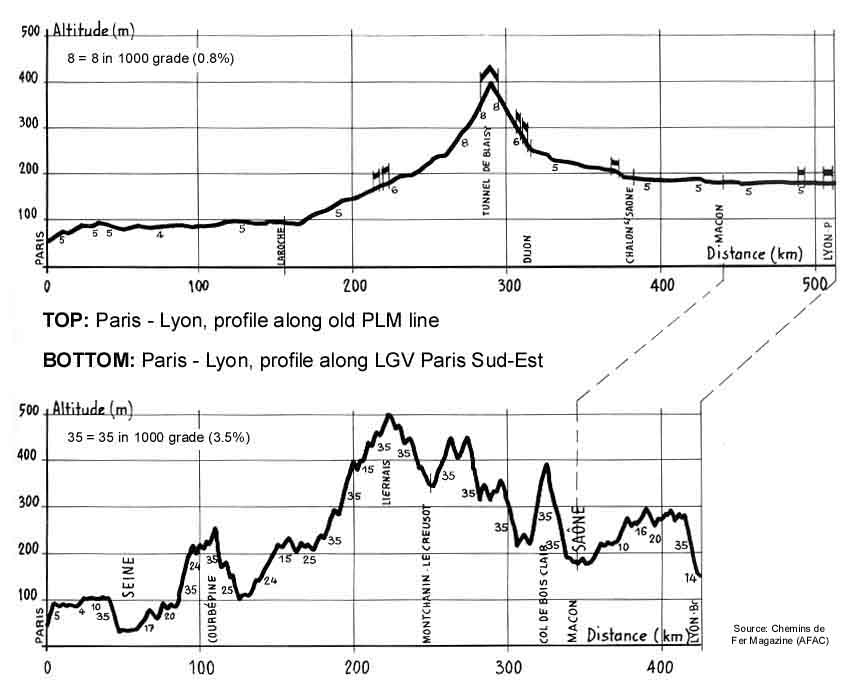
High speed lines can have steeper profiles than normal lines because the greater kinetic energy and loco power makes them less troubled by slopes. Eg this compares the profiles of the old Paris-Lyon route with LGV Sud-Est:
- larger curve radiuses (spelling?). Not much of a factor when a line mostly crosses sparsely populated, flat areas.
- less steep inclines (but if a steam engine can climb an incline, so should every modern train)
- Switches that allow high speeds on the diverging branch. But again, if the population is sparse, you don't need many of them.
And when building a part of the line to HSR standards is too expensive, the HSR train just turns into a regular train while using it. The only part that's expensive even if the geography is great is electrification (having to carry fuel or batteries limits your speed).
Switzerland does not use HSR despite prioritizing rail. I couldn't find numbers, but AFAIK it's very densely populated if you exclude the uninhabitable parts of the alps. Germany is slightly less densely populated and does use HSR. France has less than half the density and its HSR is significantly faster than Germany's. It does not look like HSR requires a high population density. The opposite is the case: HSR works better when it can go long distances without stopping and re-accelerating.
And even if HSR does not make sense everywhere, that is not a reason not to use it where it does.