There is no shortage of high apartment towers in Tokyo and major city centers in Japan. So no, that's not a restriction as much as you would think.
As far as I know most height restrictions are to do with casting shadows over other people's property.
For example, I own an apartment in a complex where some buildings exceed the area's height restrictions through an agreement with the government because the tall building is placed in the middle of the southern side of the block and hence only shades buildings in the same complex. If you're just building one building, that would be a problem.
Of course there are earthquake considerations, but everywhere I have seen them they're to do with choice of construction materials for a given size.
Source: me, I own an apartment in Tokyo and my wife is a licensed real estate broker.
So while I agree that we need to build upwards and increase density, we have to be mindful of air and light, especially air quality and sunlight at street level.
Still real estate is very expensive ( 13K$ per square meter for something downtown [2] )
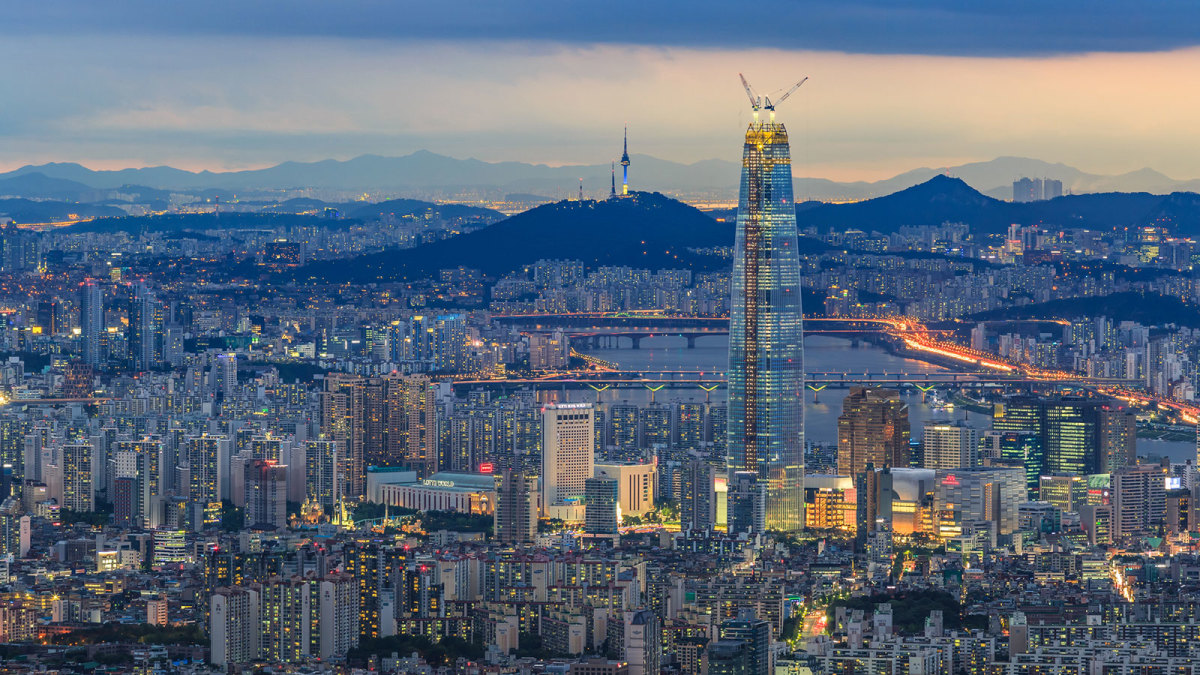
The main effect of building so much is that now almost half of the South Korean population lives around Seoul.
[1] https://www.mensjournal.com/wp-content/uploads/2018/07/Seoul... [2] https://www.numbeo.com/property-investment/in/Seoul
   real estate is
   very expensive
https://mobile.abc.net.au/news/2016-10-21/real-estate-warnin...
You can't just build up and up and ignore the issues at ground-level. As you add more vertical housing you still need more space and resources at ground level, for public transport, for parks, for schools which need sports ground, for everything. Everything else continues to get more congested and building vertically solves none of these inherent problems.
The experience of e.g. Hong Kong and Manhattan seems to suggest that it's easier to provide for public transport, schools etc, in ultra-dense environments. One of the core advantages of ultra-density is that less space is needed for streets and motor traffic. Ultra-density also makes logistics for basic goods and services (e.g. food and health care) more efficient. Even greenery can be more efficiently provided in ultra-dense environments, because multiplexing is possible as parks are rarely used by the majority of the population at the same time. E.g. London parks are pretty empty almost all the time.
(See also the scalability limits that high-rise buildings have w.r.t. economics of floor space, that I mention in another post.)
Why overfit on rare edge cases?
I don’t care if it’s empty when it’s raining, there’s a reason why that’s the case.
Having access to Hyde Park is pointless for the purposes I like green areas (to enjoy when the weather is nice)
The need for transportation is a side-effect of not having sufficient dwellings close to where people are commuting to.
On a more utopian level, people of yesteryear envisioned skyways between tall buildings as viable public transit. Once the density of high buildings becomes high enough, it could become feasible.
Note however that skyscrapers also have scalability limits: as height increases, the amount of interior that gets eaten up by non-usable infrastructure and support (e.g. beams, load-bearing wall, elevators). I have read on the internet (please correct me if my data is wrong -- I've not fact checked it) that the Burj Khalifa in Dubai occupies about 68796.6 m2, while offering about 334000 m2 of interior floor space. Thats about 4.85X increase. This means that if they simply occupied all the land and went up for 5 floors they'd have more floor space. As an example of a low-rise building, the Pentagon in the U.S., with 5 floors and 600000 m2 has more usable square footage than the Burj, the tallest building in the world. (Alas I don't know how much land the Pentagon uses, maybe somebody can tell me?) I also don't know if the Burj Dubai is representative w.r.t skyscraper economics. It's unlikely that Burj Dubai's main raison d'être has been rental income, it's more a landmark, drawing attention to Dubai, to the ruler's power, promote Dubai as a business location etc. (Those will indirectly affect achievable rental income in other, more functional Dubai buildings.) See [1] for a well-written introduction to the economics of skyscrapers.
Note, the floor assignments above are something I made up on the spot. It gives the idea, but it is surely wrong in the details. Anyone wishing to build such a building should do their own calculations.
I know that in Sydney, Australia, there's a perceived "space shortage" but the true issues are regulatory, nimbyism, and behind most of that is a desire to protect the investments of existing property owners. We could just build upwards and have an abundance of centrally located dwellings. Most buildings in Sydney are just a few storeys high.
Tokyo reminds me of Sydney, except for the earthquake factor. If the earthquake factor isn't an issue, then the situation is truly extraordinary; millions of people living in the tiniest of spaces just to protect existing investors.