News for hackers. Stuff that matters.
Re:U.S. to ground Boeing 737 Max 8 by lsh123 on Wednesday March 13, 2019 @03:45PM (#19382891)
An interesting point was made by an airline pilot in one of the plane forums. It appears that Max 8 with full trim deflection down doesn't have enough controls authority to recover (at least in the syms). Thus, the trim issues followed by disabling the trim can lead into a situation when pilots can not recover the plan from steep descend. Of course, this is not necessarily what have happened in real life and we need to see the data.
Re:U.S. to ground Boeing 737 Max 8 by clon on Wednesday March 13, 2019 @05:03PM (#19383756)
Pilot here. Correct, in most aircraft that incorporate a trimmable horizontal stabilizer, elevator authority will be insufficient to counteract the aerodynamic effects of a the entire tailplane having deflected through a certain point. Thus it is important to quickly recognize and correct a runaway trim situation.

Of even more significance is that is currently unclear if it is even possible for a pilot, once it has disengaged the trim motors (following faulty commands from MCAS) to manually correct the trim as per Boeing procedure [1].

The problem lies in the fact that it makes a lot of sense to haul back on the yoke as hard as you can if the nose starts dropping. Elevator upwards deflection loads the tailplane aerodynamically in such a way that it becomes harder to trim the tailplane in the required direction. Called colloquially a yo-yo maneuver, you are then require to "offload" the tailplane (think - push yoke forward..) in order to be able to manually correct the runaway trim.

Plane going nose down, push yoke forward at 500ft? I do not envy the crews at the pointy end of those flights. My heart breaks just thinking about it.

The Lion Air pilots must have been pulling back on the sticks until their tendons break, to no effect. I hope there is a special place in hell for Boeing execs.

[1] 737 Flight Crew Training Manual, chapter Non-Normal Operations/Flight Controls, sub heading Manual Stabilizer trim:

"Excessive air loads on the stabilizer may require effort by both pilots to correct mis-trim. In extreme cases it may be necessary to aerodynamically relieve the air loads to allow manual trimming. Accelerate or decelerate towards the in-trim speed while attempting to trim manually."

This was recently brought to the attention of members of a certain pilots forum that does not welcome lurkers, hence not adding a link.

Re:U.S. to ground Boeing 737 Max 8 by koboll on Wednesday March 13, 2019 @07:32PM (#19385067)
>I hope there is a special place in hell for Boeing execs.

I'd settle for a special place in prison.

Re:U.S. to ground Boeing 737 Max 8 by mikejb on Thursday March 14, 2019 @07:02AM (#19388105)
This desire for a 'final judgement' may be the desperate hope for justice when faith in the human court system is lacking.
Re:U.S. to ground Boeing 737 Max 8 by mywittyname on Wednesday March 13, 2019 @05:17PM (#19383913)
Would it be inappropriate to ask for an explain-like-i'm-5 version of this?
Re:U.S. to ground Boeing 737 Max 8 by bencpeters on Wednesday March 13, 2019 @05:46PM (#19384211)
Maybe not quite 5-year-old, but here's my attempt:

The elevator is the little wing at the back of an aircraft that tilts up and down to make the nose go up and down. When the pilot is flying, this up-down is what moving the yoke forward/back does.

The elevator also has a tab (the trim tab) part of the wing that can move independently from the main part. This trimming movement allows for adjustments to the plane's up/down movement that don't require the yoke forward/back (this is useful to "lock in" the current desired climb/descent/level flight so that pilots don't have to be constantly pushing/pulling on the yoke to get the plane to be climbing/descending/level the way they want it).

The 737-MAX has a system that automatically uses this trim tab to pitch the nose of the plane down when it senses certain conditions, without notifying the pilots. In this case (plane inexplicably pitching down), the natural response from a pilot is going to be to pull back on the yoke to counteract.

This can cause issues because the act of pulling back on the yoke increases the pressure on the elevator (because physics - the more the elevator deflects in an attempt to change the plane's attitude, the more force the airstream flowing over it exerts. This "catching the airflow" is why it can change the plane's attitude at all). Apparently on this plane if the trim tab is way out of line even if disconnect the erroneous system that was automatically adjusting the trim tab and try to reset the trim to a safe position by hand, the airflow over the "loaded" elevator (which is trying to counteract the position of the trim tab and keep the plane from crashing) is too strong to physically allow the manual control to move the tab. So the "correct" procedure is to push the yoke in (allowing the nose to go down/lose altitude) to reduce the airflow that's hitting the elevator, while frantically spinning the manual trip wheel to get it back to neutral. Then, once you've reset the trim manually, you presumably pull back on the yoke to get the nose up and pull the plane out of the dive.

The issue with that is that the ground can get in the way in between when you've let off the yoke and you've spun the wheel enough to get the trim tab back to neutral.

Re:U.S. to ground Boeing 737 Max 8 by bencpeters on Wednesday March 13, 2019 @06:04PM (#19384372)
I wanted to update my explanation ^ a little bit - it's based on how trim works in smaller trainer aircraft (which are all I've flown). On a 737 there isn't a "trim tab" - instead the whole littler wing at the back of the airplane (tailplane) can change its position based on the trim, while the elevator is the adjustable tab at the back of that which moves based on the pilot's inputs.

I think the basic procedure for how to undo the excessive trim based on too much force to move the tailplane still is accurate though...

I just read this great article (https://www.skybrary.aero/bookshelf/books/2627.pdf) linked lower down in this thread for more details.

Re:U.S. to ground Boeing 737 Max 8 by clon on Wednesday March 13, 2019 @05:57PM (#19384300)
Incorrect, this describes a typical General Aviation aircraft with trim tabs. Most (all?) airliners use a trimmable tailplane, meaning the entire tailplane tilts up and down to trim for a specific speed.
Re:U.S. to ground Boeing 737 Max 8 by inferiorhuman on Wednesday March 13, 2019 @10:46PM (#19386120)
Incorrect, this describes a typical General Aviation aircraft with trim tabs. Most (all?) airliners use a trimmable tailplane, meaning the entire tailplane tilts up and down to trim for a specific speed.

The only airliner I can think of that uses trim tabs is the DC-9 and its derivatives (MD-80/MD-90/Boeing 717). Some, like the L-1011, went in the completely opposite direction and use an "all moving tailplane" where the functions of the elevator and stabilizer were integrated into one piece.

Re:U.S. to ground Boeing 737 Max 8 by SomeHacker44 on Wednesday March 13, 2019 @09:32PM (#19385764)
An example fully trimmable tailplane in a general aviation airplane is the Mooney, at least the 201 and related models. Look at pictures of it and compare it to, say, a Cessna 310’s plane. You will see the “trim tabs” at the back of the 310’s elevator and none on the Mooney 201.

I seem to recall some tail draggers I flew had no trim tabs too.

Re:U.S. to ground Boeing 737 Max 8 by foldr on Wednesday March 13, 2019 @06:04PM (#19384377)
Yeah this explanation is completely backwards. The "trim" moves the entire horizontal stabilizer. The elevator control moves the elevator (a moveable section of the back of the horizontal stabilizer).
Re:U.S. to ground Boeing 737 Max 8 by nickjj on Wednesday March 13, 2019 @06:08PM (#19384416)
In an average case (trained pilot, solid amount of experience, etc.) what is the turn around time between detecting this problem and fixing it in the air?

Like, how long does it take to determine the exact problem, spin the manual trim wheel to get to the point where you can recover from a nose dive in this case?

How does that number (in seconds I'm guessing?) translate to altitude levels?

Re:U.S. to ground Boeing 737 Max 8 by clon on Wednesday March 13, 2019 @06:32PM (#19384624)
By regulation, when a system fails (as designed) the pilot MUST be able to recover:

- in 3 seconds when in cruise

- in 1 second when on approach

- when in the landing phase - immediately!

Such a system would be certifiable.

Most modern airliners have ~10 "memory items" that are procedures that are to be recalled and applied immediately without consulting any checklists. Runaway stabilizer is such a memory item. But first you need to recognize the issue as such..

It bears to mention that the 737 is riding on it's "grandfathered" certification status from the 60's, getting a free pass on many newer requirements that are subjected to airliners designed today. This is why it doubly makes sense for the bean counters to not design a new aircraft.

Re:U.S. to ground Boeing 737 Max 8 by nickjj on Wednesday March 13, 2019 @07:10PM (#19384912)
That's really impressive turn around times. I wish I could debug most software errors in 3 seconds or less.

That is pretty frightening about the grandfathered rules.

I don't know much about cars but I do know they have a similar thing. Suddenly because you have a car 1 year before a point in time it can be obnoxiously loud but today it wouldn't be street legal. I almost can't believe the same thing happens with planes.

Re:U.S. to ground Boeing 737 Max 8 by SomeHacker44 on Wednesday March 13, 2019 @09:34PM (#19385775)
If you lose an engine in a small piston twin engine aircraft in the first few hundred feet after takeoff... 1 second might even be generous.
Re:U.S. to ground Boeing 737 Max 8 by zanderz on Thursday March 14, 2019 @01:59PM (#19391700)
have you heard that old pilot joke about twin engine aircraft? The second engine serves mainly to get you to the crash site faster.
Re:U.S. to ground Boeing 737 Max 8 by nradov on Thursday March 14, 2019 @08:42AM (#19388679)
The situation is actually worse with airplanes. When automobile regulations change, owners can generally continue to drive older vehicles but manufacturers can't continue to sell new vehicles approved under old rules. But with aircraft, once a type certificate is issued the manufacturer can generally continue producing it forever.
Re:U.S. to ground Boeing 737 Max 8 by weaksauce on Wednesday March 13, 2019 @08:23PM (#19385369)
which regulations did the 737 get grandfathered into?
Re:U.S. to ground Boeing 737 Max 8 by toufka on Wednesday March 13, 2019 @09:55PM (#19385881)
I think (please correct me if I’m wrong), the plane’s “type” is fixed, and pilots have certifications for that “type”. So theoretically the plane is simialar enough to not require completely new training if a pilot is certified to the type - this new 737 Max is grandfathered into the 737 “type”. If it were different enough, then it would be a new type. If the plane is a new type, pilots, and likely all sorts of other things, mist be retrained, and reissued.

So there’s an incentive to not just make the type backwards compatible to keep the common “type”, but also not introduce too many new features that might bring into question the grandfathered training.

This 737 Max added this new “safety feature” without telling the pilots (because it’s the “same type”). And that feature seems to have an unfortunate interaction with other systems in some circumstances.

Re:U.S. to ground Boeing 737 Max 8 by oliveshell on Wednesday March 13, 2019 @10:00PM (#19385908)
I don’t know the specifics, but I assume the process to get changes approved to an already-certified type of aircraft (the 737 family in this case) is less rigorous than what you’d have to go through to get an entirely new type certificate.
Re:U.S. to ground Boeing 737 Max 8 by clon on Wednesday March 13, 2019 @05:27PM (#19384028)
I guess you can think of it like so:

1. The confuser commands a nose down trim, this means that the leading edge of the tailplane is raised. In actuality, this represents a decreased angle of attack (think of tailplane as a upside-down wing).

2. Pilots haul back with all their might. This means that the elevators (the trailing control surfaces at the trailing end of the tailplane) deflect upwards in order to increase the angle of attack and create more "downforce" from the tail, raising the nose.

3. Think of the trimmable tailplane [1] as moving around a pivot. In reality it is a jackscrew/hinge combination.

4. The elevator deflections (the intuitive response) "creates a twisting force" the tailplane around the "pivot point" and against the desired direction that you want the trim to travel.

5. Unload the elevator pressure to make it easier to trim it. The key is that elevator deflections, despite intuitive are not sufficient. Luckily, it is a trained manoeuvre.

[1] https://i.stack.imgur.com/9RQY4.jpg
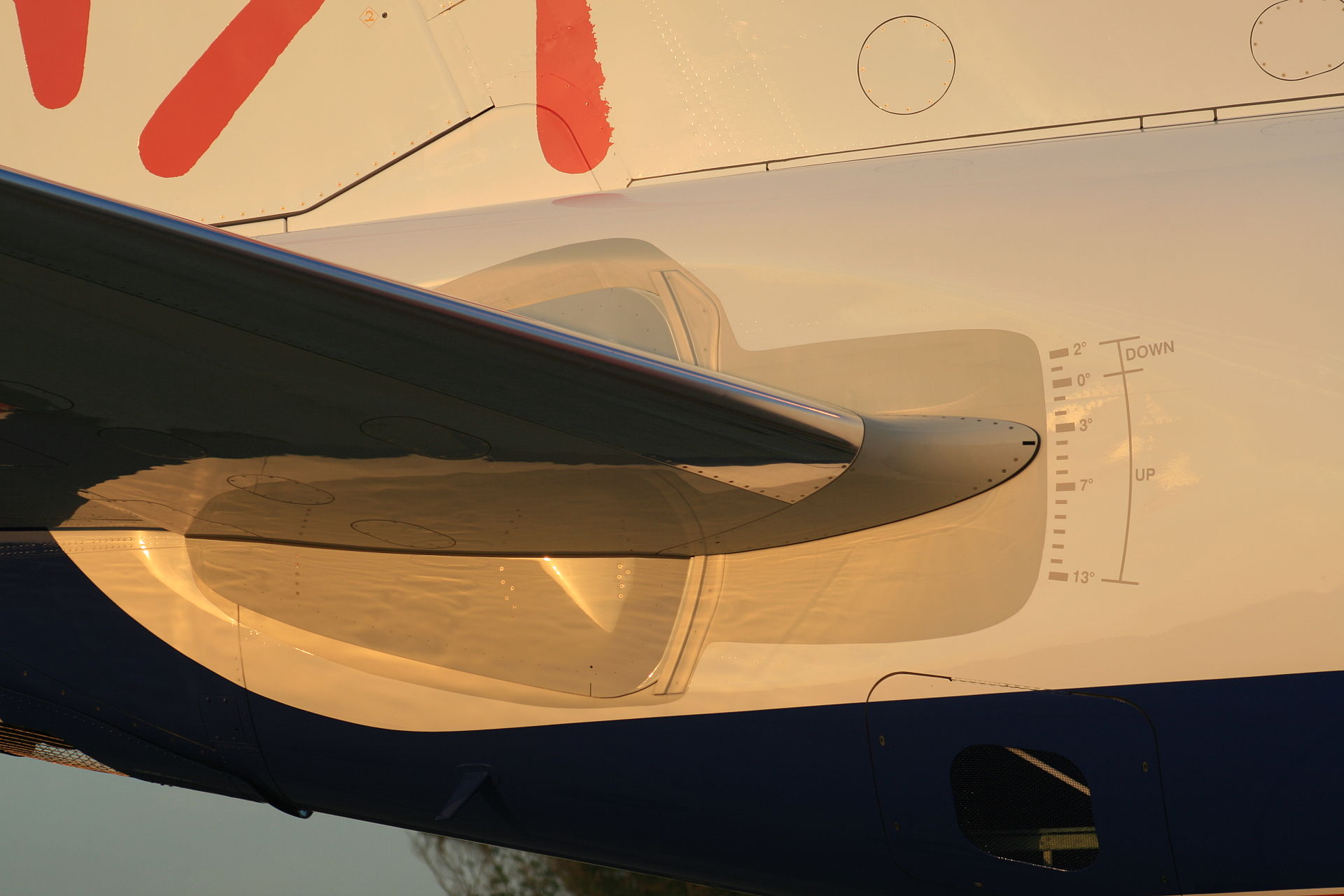
Note the UP and DOWN markings on the airplane's skin.

Re:U.S. to ground Boeing 737 Max 8 by _s on Wednesday March 13, 2019 @05:38PM (#19384140)
The elevator (smaller wing on the back) points up or down, pushing the air up or down, which in turn raises or lowers the tail/nose of the plane (it's pitch).

Some planes have little cutouts on the back of the elevator that move, thus deflecting the wind. Other planes, the whole back wing moves (stabilator).

To keep the nose pointed up or down, it can get tiring to constantly apply force on the pitch control. So now we can "trim", which changes the neutral position of the elevator to be higher/lower.

Some planes have little cutouts on the elevator or stabilator for trim. Other planes, the whole elevator / stabilator moves for trim.

Some times, when the whole elevator / stabilator moves up/down for trim, you need a lot of force to move it back down/up, especially if its neutral position has changed.

Occasionally, under high loads due to wind/pressure, you just can't. So you have to go to it's current neutral position (no matter how high or low) so you're not fighting a loosing battle. Then you have to reverse the trim. Then you can apply the opposite force.

Re:U.S. to ground Boeing 737 Max 8 by webXL on Wednesday March 13, 2019 @05:54PM (#19384277)
> Plane going nose down, push yoke forward at 500ft?

Is this in anyway akin to drivers counter-intuitively steering into a skid in order to regain traction?

Re:U.S. to ground Boeing 737 Max 8 by clon on Wednesday March 13, 2019 @06:06PM (#19384386)
You are correct in it being counter-intuitive and seemingly opposing the desired outcome. You need to recognize the situation fast and know precisely what you are doing. Unenviable position to be in at 500ft AGL.
Re:U.S. to ground Boeing 737 Max 8 by jacquesm on Wednesday March 13, 2019 @10:39PM (#19386099)
In this case you are either going into a commanded descent into terrain or the broken computer will do it for you, at that altitude there aren't many chances of getting out of that situation in one piece.
Re:U.S. to ground Boeing 737 Max 8 by hammock on Wednesday March 13, 2019 @06:23PM (#19384535)
More like how you have to steer a bike slightly in the opposite direction, before spinning the wheel towards the way you want to go.
Re:U.S. to ground Boeing 737 Max 8 by Rtr_nt on Thursday March 14, 2019 @06:55PM (#19394715)
From the previous yo-yo recording and now, a structural engineering boundary seems very likely broken at the connection area to elevator motor. Caused by swelling of a screw type plausible, or a punctured surface mounting causing a built up existence of a opposite hold in sudden decent, then lumbering heat.
Re:U.S. to ground Boeing 737 Max 8 by userbinator on Wednesday March 13, 2019 @07:31PM (#19385060)
Cars have power steering, where it's pretty much impossible for steering to require superhuman effort. Why can't the hydraulic assist of a plane be designed the same way?
Re:U.S. to ground Boeing 737 Max 8 by anamexis on Wednesday March 13, 2019 @07:37PM (#19385096)
Airliner control surfaces are 100% hydraulically actuated. It isn't a matter of actuation force, it's a matter of aerodynamics.
Re:U.S. to ground Boeing 737 Max 8 by userbinator on Wednesday March 13, 2019 @10:20PM (#19386015)
The comment I'm replying to says

Elevator upwards deflection loads the tailplane aerodynamically in such a way that it becomes harder to trim the tailplane in the required direction.

so I'm not sure what you mean by "matter of aerodynamics", because that comment suggests that it only gets harder due to the forces exerted by the air on the control surfaces, and so could be overcome by applying more force --- which a hydraulic system could be engineered to do.

Re:U.S. to ground Boeing 737 Max 8 by clon on Wednesday March 13, 2019 @07:57PM (#19385227)
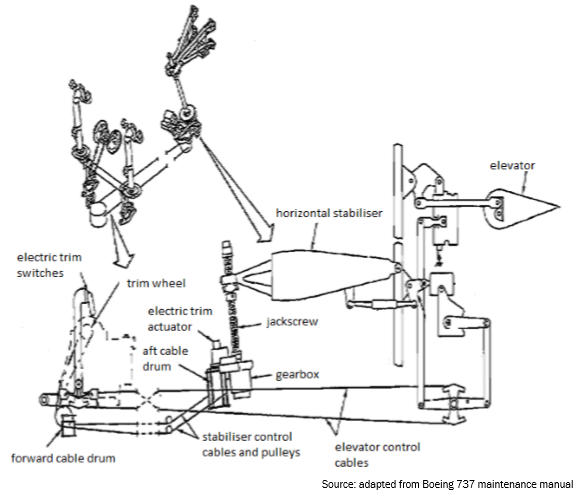
The 737 stabilizer trim is actuated by steel cables running from the nose of the aircraft to the tail, guided by pulleys [1]. The same cables also make the wheels spin when the stab trim motors are running.

[1] http://aerossurance.com/wp-content/uploads/2015/03/737-contr...
Re:U.S. to ground Boeing 737 Max 8 by anamexis on Wednesday March 13, 2019 @08:04PM (#19385260)
Wild. Thanks for the correction.
Re:U.S. to ground Boeing 737 Max 8 by bronco21016 on Wednesday March 13, 2019 @07:52PM (#19385193)
Not always. See the MD88.
Re:U.S. to ground Boeing 737 Max 8 by sokoloff on Wednesday March 13, 2019 @04:02PM (#19383109)
Most airliners with jackscrew activated horizontal stabilizers don’t have enough elevator authority to counter a fully deflected tailplane. I don’t think that’s in any way abnormal to the -Max. What is abnormal is the failure mode that seems like it can deflect to full nose down from stability augmentation.
Re:U.S. to ground Boeing 737 Max 8 by FabHK on Wednesday March 13, 2019 @05:17PM (#19383918)
There's a good article, Do you really understand how your trim works?, that explains how trim works, and in particular how stabiliser trim (what the author calls "trimming tailplane") differs from the trim tab ("conventional trimming") found in smaller planes (that many pilots train with). They operate pretty much the same to first order (for small perturbations), but quite differently for larger deviations from neutral. Bottom line, as you said: You can't overcome bad trim in an airliner by "pulling harder".

https://www.skybrary.aero/bookshelf/books/2627.pdf

Re:U.S. to ground Boeing 737 Max 8 by lutorm on Wednesday March 13, 2019 @04:06PM (#19383163)
Even if this is true (which I suspect it's not, I think being able to override trim in all positions is a certification requirement, but I could be wrong), disabling the trim just disables automatic trim. It's still possible for the pilots to manually move the trim wheel to trim back up.
Re:U.S. to ground Boeing 737 Max 8 by inferiorhuman on Wednesday March 13, 2019 @05:12PM (#19383848)
The 737 can definitely be flown into a situation where the elevator doesn't have authority to overcome the stabilizer. That's been true at least since the 737 Classic. Take a look at the Bournemouth incident.
Re:U.S. to ground Boeing 737 Max 8 by bonzini on Wednesday March 13, 2019 @05:28PM (#19384050)
Re:U.S. to ground Boeing 737 Max 8 by lutorm on Wednesday March 13, 2019 @06:20PM (#19384512)
Ah, interesting. That's nose-up, which is the opposite direction of what we're talking here, and seems to indicate that it is the combination of max thrust at low airspeed and large nose-up trim that exceeds the elevator authority.

It's not immediately clear, at least from my skimming of the report, whether a similar situation exists for nose-down trim, since in that case thrust will help the elevator with pitching up.

Re:U.S. to ground Boeing 737 Max 8 by lsh123 on Wednesday March 13, 2019 @04:49PM (#19383604)
Manual trim is possible but at low near the ground one might not gave enough time.