https://static1.squarespace.com/static/56d9cbd420c647c7373d4...
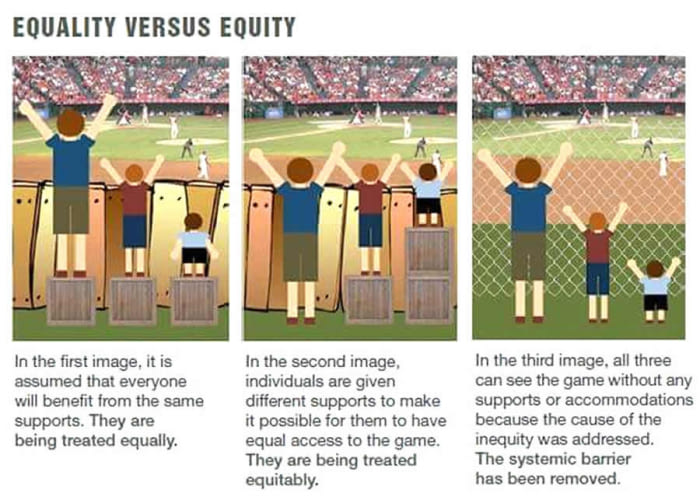
Similar cases: Voter ID laws with disproportionate impact on minorities, gay people having "equal" right to marry someone of the opposite gender, people in impoverished school districts having "equal" rights to an education, etc.
>The short person still has the right to look over the fence. They just have practical difficulties on exercising it.
It all depends on what the fence is achieving. I can't take the cartoon literally, because conservatives wouldn't argue that people should have equal rights to view a ball game - whether you can view one or not has little bearing on, say, your financial success. Nor does it impinge on your right to speech, religion, etc. If the fence represented something that was a barrier to achieving what is viewed as a right, and it's a barrier for one group and not for another, then the approach in the cartoon is not inconsistent with conservative ideology.
With regards to voter ID laws: I'm not even going to go there, as in my past experience, it's an issue that both sides refuse to understand the counterpart's.
Unless we're "no true Scotsman"ing things here, conservative ideologues in the US (and a variety of other countries) have strongly and consistently opposed gay marriage, often arguing they had the "same rights" as others and that allowing same-sex marriage would be "special treatment".
Before that, the same was true for conservatives and interracial marriage.
The point of the cartoon is not to advocate for the right to watch a baseball game. It's an analogy showing how the binary "you either have to have an unfair situation or give someone preferential treatment" isn't always the only two options.
You know, what I'd really like is for parties or candidates to identify what they think the appropriate GINI coefficient should be for the US.
>However, as a lot of pop psychology has taught us: People are fundamentally lazy in applying analytical thought, and will look for simple proxies.
I would not recommend judging books based on a random Internet comment, even my one.
It's an easy mistake to make, but Communism (at least as Marx and his contemporaries and Lenin envisaged it) does not have anything to do with the principle of equal outcomes except in a very narrow sense - this sense being equality of privileges to some portion of society.
Among democrats and liberals, it's usually "equal opportunity" or "equal starting lines", language like that. That's very different than "equal outcomes" because it still believes in self-reliance, merit, diversity in outcomes, etc - it's just that it requires a level of fairness that applies to everyone.
Conservative ideology: Fairness is about guaranteeing everyone equal rights. If different people have different outcomes, the question is: Did one person have more rights than the other? If so, let's correct for it. If not, it is because the person did not fully utilize his/her resources. However, this step is often omitted and people jump to "Person did not put in effort."
Liberal ideology: Fairness is about guaranteeing equal outcomes. This often (but not always) ends up being a metric regardless of the effort the person put in - so if the outcomes differ, it's a sign of something unfair at play.
There is overlap between the two, and they are not fundamentally at odds with each other. However, as a lot of pop psychology has taught us: People are fundamentally lazy in applying analytical thought, and will look for simple proxies. So instead of thinking through as their ideologies dictate, they will jump to the conclusion.