"Monarchs in the western part of the United States migrate for the winter to California, where they gather mostly among fragrant eucalyptus trees, which provide hospitable living conditions."
These eucalyptus trees, many planted in the 1800's and are now quite large and beautiful, are under attack by many environmental groups for being non-native and others for being a fire hazard. Maybe they did not even winter in California until those invasive trees were planted?
Life is complicated, but in general humans have been becoming much more respectful of the environment as we become more wealthy. The key to preserving the wonderfully complicated ecosystems on Earth is probably to continue as rapidly as possible with our tech improvements (and get back on pace from where we stopped in the 1970's) and to eventually turn all of Earth into a park, a la Bezo's plan. Don't work to shut down nuclear power tech (we have plenty of coal to burn and that is much worse) but help it improve. Support a safe waste storage solution instead of using that problem to shut down future construction.
The other alternative really boils down to a belief that it would be best if humans weren't around. Most humans rightly oppose this view and evolution will tend to support an increase in people with that view in the long run. A religion that has "don't have children" as a belief won't last long.
You can't be serious... https://cdn-images-1.medium.com/max/2000/1*IOUIWy_MZuECIpZRK... ("The Great Acceleration")
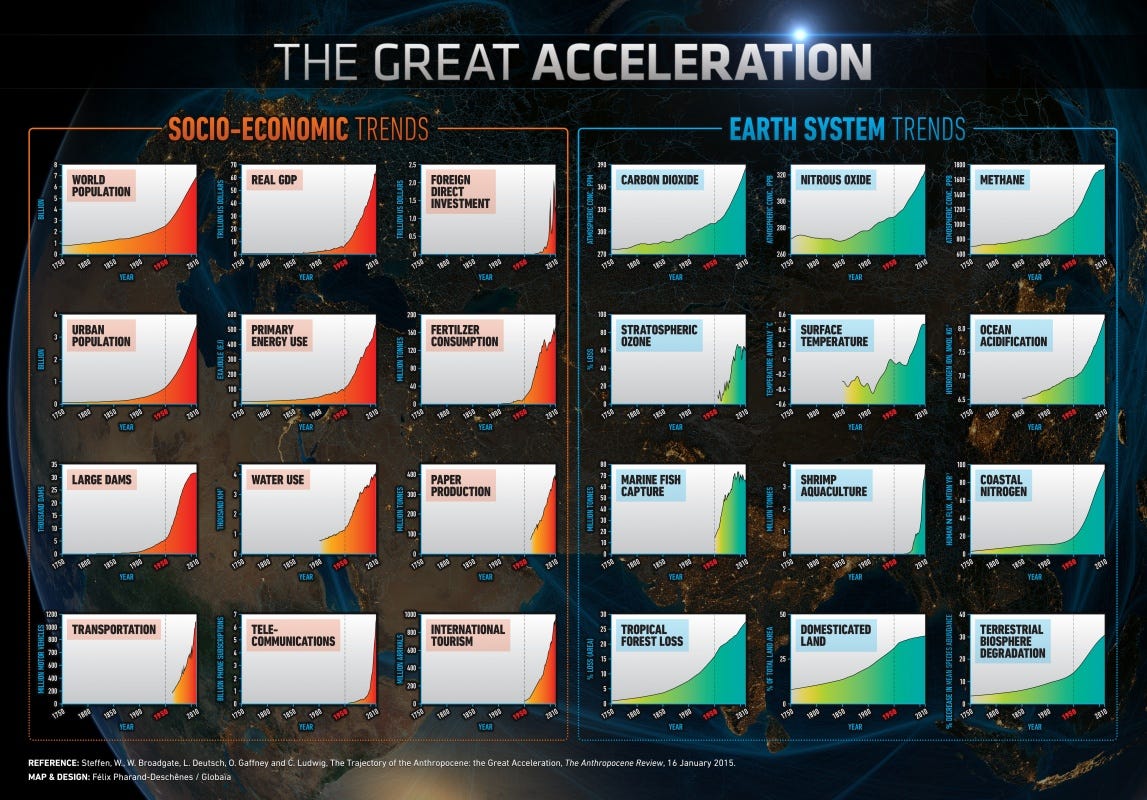
Also read The Anthropocene Review whenever you feel too optimistic about the future.
In fact now that I read your comment again, there's virtually not a single statement I can agree with.
Our current way of "householding" ("economy (from Greek οίκος – "household" and νέμoμαι – "manage")") with this planet is thrashing ecosystems left and right. This is because mankind's economy has long taken on a life of its own, serving itself, without anyone pricing in "negative externalities" (another way of saying we're turning Earth into a Wall-E-esque dystopia, except we're not going to have a big space station to live on).
I agree with you that greenhouse gas emissions are disproportionately from high-income countries, along with meat consumption, food waste, air travel, and lot of other measures. But those charts aren't a great way to make that point.
OP's point is a bit more complex. Per capita, humans became a less respectful on initial industrialization (and initially wealthier), but become more so as they become wealthier. Probably the worse is at a middle-income point (maybe $5k/capita)
This is why forested acres have gone up significantly in the US and Europe: https://www.washingtonpost.com/news/worldviews/wp/2014/12/04...
Given the unpredictability around both environmental respect and capacity for destruction, together with incentives from person to person to act or resist, it's difficult to predict much with certainty.
This is not really true. Humans have been radically changing the environment from before they were even "Homo Sapiens".
For just one example, prehistoric human hunting had devastating effects on animal populations with most large mammals killed off by humans every time we moved into their habitat. We even have a couple of data points when this happened very quickly. In Australia around 50k before present (BP) and in the Americas around 10-15k BP. From this[1] Atlantic article).
"By looking at how mammals have changed in size over time, Smith and her colleagues have shown that whenever humans are around, the mammals that disappear tend to be 100 to 1000 times bigger than those that survive. This isn’t entirely new: Many scientists, Smith included, have found the same trends in Australia and the Americas. But the new analysis shows that this pattern occurred in every continent except Antarctica, and throughout at least the last 125,000 years."
And the abstract of the paper this article is writing about [2]
"Since the late Pleistocene, large-bodied mammals have been extirpated from much of Earth. Although all habitable continents once harbored giant mammals, the few remaining species are largely confined to Africa. This decline is coincident with the global expansion of hominins over the late Quaternary. Here, we quantify mammalian extinction selectivity, continental body size distributions, and taxonomic diversity over five time periods spanning the past 125,000 years and stretching approximately 200 years into the future. We demonstrate that size-selective extinction was already under way in the oldest interval and occurred on all continents, within all trophic modes, and across all time intervals. Moreover, the degree of selectivity was unprecedented in 65 million years of mammalian evolution. The distinctive selectivity signature implicates hominin activity as a primary driver of taxonomic losses and ecosystem homogenization. Because megafauna have a disproportionate influence on ecosystem structure and function, past and present body size downgrading is reshaping Earth’s biosphere."
Human started wild fires would be another.
Humans changing life on Earth is as old as humanity but the last few hundred years is the first time we have started to care at a societal/global level. National Parks were being form in the US starting in the early 1900's. Half of Alaska was preserved in the 1970's, many countries in Africa are doing the same. If those African countries can get rich enough, fast enough some of the great savanna ecosystem could be kept from extinction. As usual, a balance of going forward and preserving what we have will be the best bet for a good outcome. It does not seem that having radical groups of people holding opposing views works well to maintain this balance. Maybe each individual needs to see the value in change and stability for good things to happen more than bad. Moloch[1] is always with us but its power can be reduced from time to time.
[1]https://slatestarcodex.com/2014/07/30/meditations-on-moloch/
[1]https://www.theatlantic.com/science/archive/2018/04/in-a-few...
"The other alternative really boils down to a belief that it would be best if humans weren't around." - This too is overly reductive and amounts to nothing more than a straw man's argument. Are you to suggest that the only way to reduce pollution and environmental impact is to get rid of people entirely? How about tightening emissions standards, banning/taxing destructive materials like plastic, putting immense taxes on dirty energy? All of these measures are oft talked about, half-heartedly implemented for the most part, and could do much to reduce our impact all without addressing the population (not that that isn't an issue in and of itself.
The problem with the argument that we should just plow ahead full steam, hope that we can technologically solve our way out of the problem, and then clean up the mess afterwards is that we don't actually know if the problems will be solvable in a couple of decades when the time arrives. We simply don't know if this will work and the further destruction that happens in the meantime will make the challenge all the greater. For example the risk of armed conflict due to resource scarcity or famine (look at Syria right now) or the unforeseen consequences of fully collapsed fisheries and desertification of farmland is a very real one, and should be viewed as a direct danger of climate destruction. We do know, however, that taking extreme measures to reduce emissions and our environmental impact in the present will make this problem easier to solve. I simply don't understand how some find it valid to respond to such an impending risk with nonchalant suggestions that we'll simply solve this one later.
I think that the "we should just plow ahead full steam" part of humanity started loosing power in around 1970 (I agree we were probably getting a bit too powerful too quickly and a slowdown was a good idea). The "safety first" part of humanity began ascending and has taken over most of the powerful institutions. Some swing back the other way is needed. Seems like life must go in these destructive/rejuvenating cycles and that a steady state of goodness is not really possible.
I also do not believe the alternative that it would be best if humans weren’t around. I agree with the other commenter that that is a strawman. I believe humans can and should look forward to a better world where we use technology to meet our needs more efficiently. I absolutely do not suggest we “slow down” technological advancement. At the same time I instead insist that we must be conscious of the effect we have on the world. Technology will not automatically solve our problems. It will be our choice not to buy single use plastics, not to consume meat, and not to purchase novelty goods that would soon end up in a landfill.
I advocate for a future where technology is developed by groups of people who want to thrive together while also reducing our impact on the world. We cannot allow ourselves to believe that technology alone is enough, we must change our culture to be less wasteful.
Just look to the company hosting this site...
I've flown once since Y Combinator came into existence, Y Combinator requires at least 1 founder of every team that gets an in-person interview to fly to the Bay Area.
CO2 emissions from aviation fuel are 3.15 grams per gram of fuel.
>a round-trip flight from New York to San Francisco emits about 0.9 metric tons of carbon dioxide per person
https://www.nytimes.com/2017/07/27/climate/airplane-pollutio...
YC has funded 1500 something companies funded, let's assume they've interviewed twice that many in person.
So let's say 0.7 metric tons x 3000 companies x 1.5 cofounders, that's 3150 metric tons for in-person interviews.
Now, let's look at data transfer for skype. Saving and storing 100 gigabytes of data in the cloud per year would result in a carbon footprint of about 0.2 tons of >Saving and storing 100 gigabytes of data in the cloud per year would result in a carbon footprint of about 0.2 tons of CO2, based on the usual U.S. electric mix
https://medium.com/stanford-magazine/carbon-and-the-cloud-d6...
Skype, with HD, could use
>Recommended Video Call HD 10.98 MB/min
https://www.orduh.com/data-usage-on-skype-video-call/
Assume 15 minute average interview.
165 megabytes x 3000 companies = about a ton of carbon IF the data is stored for a year so in reality a fraction of a ton.
So an investment company, looking to invest in businesses that ideally will hit a billion plus valuations, could have easily used 3150x more carbon because they can afford to reimburse flights and would prefer to do interviews in person where video chat would have not only cost orders of magnitude less but generated thousands of times less carbon.
Now consider the more money you have, the more likely you are to travel regularly for recreation and here is a clear case where more $$$ can easily result in a considerably larger carbon footprint.
The wealthy generate the most pollution[1]. Also, Native Americans, the most environmentally respectful humans I can think of, were not wealthy.
[1] https://www.oxfam.org/sites/www.oxfam.org/files/file_attachm...
The tragedy of the commons: https://en.wikipedia.org/wiki/Tragedy_of_the_commons
Technically, the planet is doomed. Practically and pragmatically, everyone who is living here today, has a good chance to enjoy his days, no matter what will happen next.
I'm not advocating the way we destroy our planet, just trying to accept facts without emotional barrier. Could be wrong here.
Tragedy of the Commons describes the exact situation where people have unfettered access to exploit a resource, capable of deriving a personal benefit to the detriment of everybody else; and specifically such that exploitation of the resource produces significantly less social benefit than if access were limited. It doesn't matter if 99% of people are conscientious and abstain from unfairly exploiting the resource because of a cultural sense of transitive "ownership" as a citizen or human. The laws aren't for the 99%, they're for the subgroup of people willing to subvert the norm for personal gain (and to be fair everybody has been and regularly is a member of that subgroup at some point).
Things held in common certainly have rules which are either explicit or implicit.
The only times something like the "tragedy of the commons" occurs is when private enterprise gets involved and the perverse incentives demand exploitation. And of course the resources exploited are explicitly NOT commons because it's lawless.
Secondly, we're making the planet a lot worse for more organisms than humans.
If humans go extinct, human timescales cease to be relevant. Since we're talking about the Earth, reverting to geologic timescales makes sense. Earth 10 or 100 million years after humans may not be that different with or without humans.
(I agree, however, that the platitude is unhelpful. We're human. We care about the Earth on a human timescale.)
The next few hundred million years is all the Earth will get before it loses it's amazing uniqueness and turns into another boring rock.
Do you have a source for this? I assumed that the changes to earth was still billions of years away, when the sun finally goes supernova.
But have you seen the latest VR tech? You can just put on a headset and swear your were back at that state park with mom and dad, in front of that old eucalyptus positively twitching with Monarchs.
That in itself would be troubling news. But, combined with a 97 percent decline in the total population since the 1980s, this year’s count is ‘potentially catastrophic,’ according to the biologist Emma Pelton.”
That’s the hard bit for me.
What are we doing to this planet? What will it become? The monarchs are a blessing of a creature. Will we just watch them wither away? Can we escape our petty dramatized politics and think of what we are passing on to future generations? Not just high tech benefits, but mountains of plastics for packaging, toys, and many “novelties” that are useless except for cheap thrills.
So while many will say our system has brought great wealth for humans, it’s important to think about which humans have seen wealth and which have seen further destruction. And what species and vistas all of humanity lost to gain our treasures. Those too have a cost, but not much that any of us will have to bear. The cost is paid by someone else we’ve never met or who may never be born yet. But sometimes, stories like this remind us of the great damage we are doing to this Earth.