Scooters and bikes have an effective range, particularly in places like LA that can have quite long commute distances.
Motive power source doesn't really change much.
Intra-urban flight would increase required energy for transport a lot and also move the crapshoot that is today's roads and traffic above our heads, ready to hurtle down at us.
Boring tunnels being cheaper has yet to be proven, since the main issues with tunneling are that tunnels have to be tailored to ground conditions.
Shuttles to Mars doesn't change how I get to and from work across town, the same way that airplanes did not.
An articulated bus might be able to move closer to 100 people comfortably.
This is why developed subway systems with high usage end up with large trains, that's the best way to speed up the system, reducing the delay caused by trains waiting for other trains that are stopped in the station.
If you have really comprehensive coverage in a densely built area you'd be stopping too often for those top speeds to matter.
This is the problem with the Acela. It can technically go up to 150mph, but it has to stop so often that it averages 60mph for the journey.
For longer distances with limited stops, the speed and shigh capacity of a train are good. But to really fill out coverage in a dense area, short wait times and short distances between stops and destinations should be your chief considerations. Buses and streetcars just do that better. Though really, once you get past a certain level of density you need all of the above.
https://ny.curbed.com/2018/12/19/18146933/mta-new-york-subwa...
New York's system is designed around walking to stations. All the way to the end of the lines, stations tend to be about a half mile apart. There are express lines but even those become locals on at least one end, with half-mile stop spacing.
DC's is an auto-oriented system, where you're expected to drive to the stop and then take the train in from the suburbs. As a result, while there is dense stop spacing in the center, distances between stations in the suburbs get progressively longer and longer. It's over these long stretches in the suburbs that DC is able to attain much higher speeds.
that seems to be unreasonably long. In germany, both the city I am studying at and the city I was born are undertaking big changes in their transportation infrastructure, and both don't take that long. In munich, building just started and is expected to last unit 2026 [1]. And we always complain that it's taking too long to plan and build!
40 years seems to be crazy! You would have to start repairing the old stuff when the whole project is finished.
Or are you talking about the whole process, including the financing? Then it's more understandable, many big project here also stall for 20 years until everyone has enough money and the political will to follow through. But I thought the financing is covered due to the sales-tax increase.
While it's easy to complain about projects not moving for 20 years, the sums are often quite enourmus and i am not sure whether inefficiencies are to blame, or whether gathering enough money just takes a long time.
[1] https://en.wikipedia.org/wiki/Trunk_line_2_(Munich_S-Bahn)
Admittedly, I'm a bit torn on this. Since infrastructure is so important to the liveability and growth of a city, and any sort of long-term thinking is a good thing. But predicting the future is hard, and having a 40 year plan survive (short-term) politics is also unlikely.
There are also project on hold for 30 years in munich.
Another reason why they are building in stages is that some of the new transit projects aren't as useful until other ones are finished. For example, there's plans for a big tunnel (a few miles longer than the one you linked) that they're trying to finish in time for the 2028 Olympics (although construction hasn't started yet). A lot of the projects on the other side of the tunnel are being done with the purpose of getting people to the tunnel,
For comparison, the first intercontinental railroad was built by hand and muscle in 6 years. Including the bridges, cuts, and grading. Including through a mountain range.
Today California High Speed Rail and Texas Central and Florida's Brightline have to deal with angry suburban neighbors, angry farmers, and legal and environmental review processes that are the result of a century and a half's worth of hindsight.
There really isn't any "environmental impact" for construction within the city (the environment there is already destroyed). But that sure does provide fodder for endless delays and expense.
> 20MPH
Travel from Omaha to San Francisco was 4 days at the opening, including stops. The distance was 1,912 miles. So the average was indeed 20, but to achieve that average (including stops) it must have been going at least 40 on much of the route.
Quite a difference from the alternative, months of walking.
If you like, the first Boston subway was completed in 1897, it took 2 years, and it was all done with muscle, too.
Seattle is a bit of an odd case when talking about construction timelines, because the projects are drawn out mostly due to a state law that limits how much Sound Transit can bond out at any given time. Anything more aggressive than that would require passing a 60% vote threshold, which would be quite the landslide election. (It's also how the first Seattle subway attempt died.)
Environmental impact doesn't just concern spoilage of a pristine environment; among other things, it can consider impacts on drainage and runoff, noise pollution, construction impacts, efficacy at diverting car trips and CO2 emissions, etc.
Actual construction, even nowadays, is pretty fast. What takes 20-40 years is the long-term planning. By comparison, the first intercontinental railroad was advocated first in 1832 (before most of the American West was even American), and serious planning first started in the late 1840s and early 1850s, which led to the Gadsden Purchase in 1853.
None of those are mass transit. Personal vehicles are fine and dandy, but they can only move one person at a time and will always, by definition, take up more space and resources per person than a solution that can ferry tens or hundreds of people at a time.
And if you're disabled, scooters and bikes aren't helping you much anyway.
Scooters and bikes are great supplements to a system, but they won't actually do much good without a mass transit system to be the backbone for getting around.
Lots of disabled Americans ride around on scooters (4-wheeled motorized carts). They would do much better on the streets of Europe where there's bike lanes and nice sidewalks than in suburban America, though they'd have problems navigating the shops.
I believed we were talking about the razor scooters/scoot-share services, which are too finicky for people with mobility issues to be able to use on bumpy streets.
The types of scooters you're talking about basically use the same infrastructure as wheelchairs. So if you're pedestrian friendly and have inclusive urban design (like curb-cuts) that won't really be a big deal.
If 20 minutes is "practically an entire commute" then you're already in a dense enough area to where transit coverage should minimize the number of people who are a mile away. At that point, proximity to transit just becomes part of what you pay for in your house. If the transit is there, development patterns will tend to build up around it.
Firstly, that's more like exurbia than suburbia. Suburbia is characterized by low density sprawl surrounding a denser, urban core that acts as the economic anchor. This is also where the nightmarishly long commute times tend to be: (https://www.caliper.com/featured-maps/xus-commute-time-mapti...).
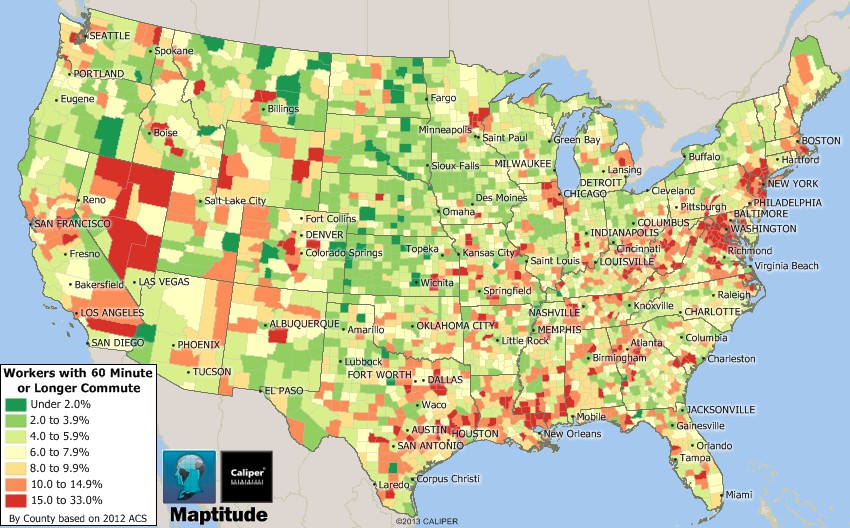
Secondly, people decide where to live and work based on commute times. In other words, people consciously choose to live in places that are within a 30 minute commute from work, and they structure their days (when they wake up, when they leave the office, etc) around minimizing it. This same mechanic works if the transit is available. People will consciously choose to live closer to the transit hubs that minimize the lengths of their commutes, promoting density around the bus or train routes.
This is why the "last mile" problem is not as relevant of a consideration as people think once you get past the "windshield bias" a bit. Firstly because if everyone is within a mile of a transit option then that means the [i]worst case scenario[/i] is that someone has to walk a mile, and most people will choose to live within a space that's even less than that.
And secondly, because a mile isn't actually that terrible of a walk, especially if you make the walk a pleasant one. I live 2 and a half miles from my office. If I ride the bus it takes me about 20 minutes door to door with maybe 5 of those minutes involving walking to/from the bus-stop. If I walk the whole way it takes me about 45 minutes. Despite the walk being more than twice of long, though, I'm honestly indifferent between the two options. My only real consideration is whether I'm in a hurry or not, and usually if I'm in a REAL hurry I'll take a cab.
Even if it's raining, I often just take my umbrella and walk the commute because the walk is, in itself, enjoyable. It's not just a means of conveyance, it's a stroll and a source of exercise. There are plenty of murals to look at, a park to stroll through, flowers and landscaping to see, shop windows to look in on, sidewalk cafes to people watch people on awkward first-dates, etc.
> Everybody surely have cheap electric scooters and bikes or other electric devices and airbag helmets.
> Few, if any, combustion engine cars
> Truly self driving cars
If history has taught us anything, it's that technological progress is orders of magnitude slower than people expect. The infrastructure of NYC, LA, Seattle, San Francisco, etc will not look much different in 2059 than it does today.
We'll probably still be using JavaScript, too. :/
I think there is a Bill Gates quote about how most people overestimate how much things will change in one year and underestimate how much they will change in ten.
Of course, when you find yourself 10 years in the future you'll probably just forget how different your city used to be because the changes unfolded too slowly for you to notice they were changing. In most of these cities, for example, the infrastructure might look the same but the way people are using it is very very different.
The world 20-40 years ago was far more primitive than it is today.
That is not true. Here's the list: "cheap electric scooters and bikes or other electric devices and airbag helmets. Few, if any, combustion engine cars are left on the streets. Truly self driving cars are likely too. Drones that fly you across town? Boring tunnels in multiple levels? Shuttles to Mars?"
How cheap does a cheap electric scooter need to be? Because we had electric scooters 10 years ago. Definitely so if you include "nascent" forms. More specifically, the electric scooter dates from around 1920 - https://en.wikipedia.org/wiki/Autoped . The Segway PT came out in 2001.
Bikes of course are 19th century technology.
Airbag helmets are new.
Electric cars were popular in the early 1900s.
CMU was working on self-driving cars in the 1980s; the Navlab drove across the US in the 1995, and was autonomous 98% of the time. Surely that counts as "nascent", yes?
Drone taxis sound like the proposed helicopter taxis of the 1950s, or flying cars, or jet packs, though without a driver. Drones have been around for more than 10 year. Passenger-carrying drones? That is indeed new.
"Boring tunnels in multiple levels"; many subway systems have multiple levels. What has been new about that in the last 10 years which wasn't deployed earlier, not even in nascent form?
"Shuttles to Mars". I don't know how to judge that one. In 1989 when Bush Sr. announced the Space Exploration Initiative, would you have said that it was a nascent project? You didn't know that that it wouldn't pan out, just like we don't know now if SpaceX's plans will pan out.
The world 20-40 years ago was far more sophisticated than you seem to think.
LA metro is dropping track like crazy and way more usable than it used to be. And it’s cheap. $1.75 each way or monthly pass.
Tl;dr it’s awesome now and getting better!
Personally, I’m fine with any large transit project as long as it goes faster than a car and cheaper as well.
If you buy a house in an LA suburb hoping that you will soon get subway nearby, you might get it once the mortgage is paid out and the kids have left for college.
What will the technology be like in 20-40 years? Everybody surely have cheap electric scooters and bikes or other electric devices and airbag helmets. Few, if any, combustion engine cars are left on the streets. Truly self driving cars are likely too. Drones that fly you across town? Boring tunnels in multiple levels? Shuttles to Mars?
I am not saying the subways shouldn't be built or that planning decades ahead is bad. I love subways. But in the area of transportation we will see huge changes in the coming decades.