Re:Science Misconceptions in Textbooks and Popular culture
by slammdunc23 on Friday October 08, 2010 @08:19AM
(#1771383)
Agreed. Even ignoring the vitriol, the format makes this page very unpleasant to read.
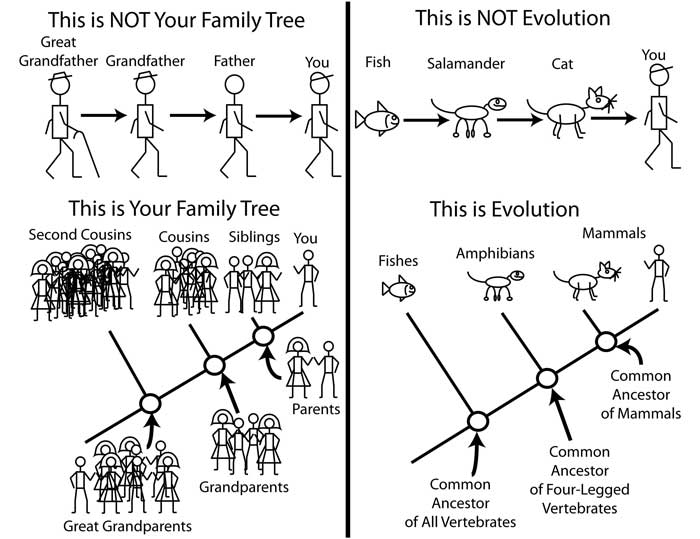
I liked how Florida Citizens for Science did it: they held a contest in which entrants were encouraged to draw stick figure cartoons illustrating a misconception many people have about some aspect of science. Here's one of my favorites:
Re:Science Misconceptions in Textbooks and Popular culture
by Jun8 on Friday October 08, 2010 @09:35AM
(#1771575)
True, the page turned me off so much that I had the patience to look at only one "misconception": Why is the sky blue? What the site states is not that the textbooks are wrong but they could explain it in simpler terms. Well, then, misconception is too strong a word for that. And I think the simpler explanation had holes in it, too, e.g. "air is made up of blue particles, etc."
Re:Science Misconceptions in Textbooks and Popular culture
by acqq on Friday October 08, 2010 @12:23PM
(#1772165)
I don't see the problem there. The author writes first clearly: "This one isn't purely a textbook error. Still, it involves misconceptions on the part of authors." He wants to point that it's not a misconception to explain that the sky is blue because of "wavelengths of light, Tyndall effect, and Rayleigh scattering" the misconception (in the approach to the presentation, not in the facts) is to explain only that single effect on that level and not mention that all the materials with which we are surrounded also have own colors because of the similar behaviors of atomic particles. That is a valid and important insight. And the misconception (again in the presentation, note again that he writes about school books) is not to mention that the air actually always has colors only that we don't register them because a lot of it is needed. I think it's good to point to all this.
Re:Science Misconceptions in Textbooks and Popular culture
by wbeaty on Friday October 08, 2010 @06:14PM
(#1773642)
On the other section of that site I say this below:
"Sorry if the following is a bit contentious at times. I wrote it in an attempt to get some things off my chest. If you keep watching this site, I'll probably clean it up and make it sound a bit more professional"
But then I received constant numerous requests to keep it just as it is. Only a tiny percentage of responses were hostile. I decided against any change. Also note that this was a 1996 page written for Lynx text-only browsers.
Re:Science Misconceptions in Textbooks and Popular culture
by gintas on Friday October 08, 2010 @10:14AM
(#1771699)
Something like http://problemata.com/q/popular-physics-misconceptions perhaps?
I base this suggestion on a sample I visited:
http://amasci.com/miscon/eleca.html#frkel
Let me break down this page: A TITLE IN ANGRY ALL CAPS. A paragraph stating the misconception. Three paragraphs of ranting about the badness of the misconception without actually explaining what is bad about it. A list of sub-misconceptions, again without explanation, but with a helpful WRONG next to each one, in case you needed more shouting. Then another paragraph of throat-clearing. Then, finally, some explanation.
Everyone gets enraged by idiots at one time or another. But capturing that rage in print is rarely productive. Rage tends to be repetitive and soon becomes grating. Fortunately, there is good stuff here; it just needs editing and rewriting, possibly over a nice drink in a relaxing place.