slammdunc23
"Maria toma banho porque sua mãe disse ela traga a toalha."
We had to make those words make sense only by adding punctuation and without changing the order of any words. Can you figure it out?
For those who don't speak Portuguese, the phrase above translates to: "Maria takes a bath because her mom said to her bring the towel." Doesn't make much sense!
The trick is that "sua," which means "her" when the following noun is feminine, is also the present third-person singular of the verb "suar," meaning "to sweat." Thus, with a few commas and quotation marks, it suddenly makes sense:
Maria toma banho porque sua. "Mãe," disse ela, "traga a toalha."
=
Maria takes a bath because she sweats. "Mom," she said, "bring the towel."
Not nearly as ambiguous as the "had had had had" example, but a similar lesson regarding the need for punctuation.
Edit: as personlurking pointed out, suar is "to sweat," not (as I put originally) "to smell." Thanks for catching that!
Cut him some slack! I harbor many doubts re: your competence in the realm of friendliness.
I think another example might be more clear. Back in the 1990s, there was a big hullaballoo about Native Americans out West using peyote, a hallucinogenic, as part of a religious ceremony. Using peyote, however, was illegal in the state of Oregon, so a few members of the Native American Church were fired from their jobs and denied unemployment benefits after they were found using peyote. The Native Americans argued that they should be exempt from this law due to their religious beliefs, and many agreed. I don't, and neither did the Supreme Court (check out Employment Division v. Smith [1990]). And here's the reason: if peyote is "not that bad," i.e., if it's fine for /some/ people to use it (here, the Native Americans), then it should be fine for /all/ people to use it. If peyote is actually /too dangerous/, if it really /must/ be outlawed, then it should be outlawed for /everyone./ What someone believes about peyote should have no bearing on his right to use it. (This is the same reason we wouldn't allow ritualized murder of children even if someone claimed it was central to his religion--it's simply too dangerous!) It's /discrimination based on religion/ (or lack thereof) to say that Tom, who believes that peyote helps him communicate with a higher power, should be able to use peyote, but that Bob, who simply feels that using peyote helps him relax and to paint, should not. Why should Tom's belief be worth more than Bob's simply because a higher power is involved? And what kind of law should involve litigating someone's religious beliefs? Imagine: Q: "Isn't it true that you don't REALLY believe that peyote helps you commune with God?" A: "No, I swear I believe! I pray every day!" Q: "But I have a witness who says he saw you at Catholic mass last week! And here's a Bible we found in your house!" What a horrible mess that would be!
To get back to the dastaar example, then, all the author is saying is this: If a Sikh should be able to wear a dastaar, then an atheist should be able to wear a dastaar on the job, too. In fact, an atheist should be able to wear any hat of the proper color with a badge on it. His beliefs or lack thereof should have no bearing on his right to do something that everyone else can do.
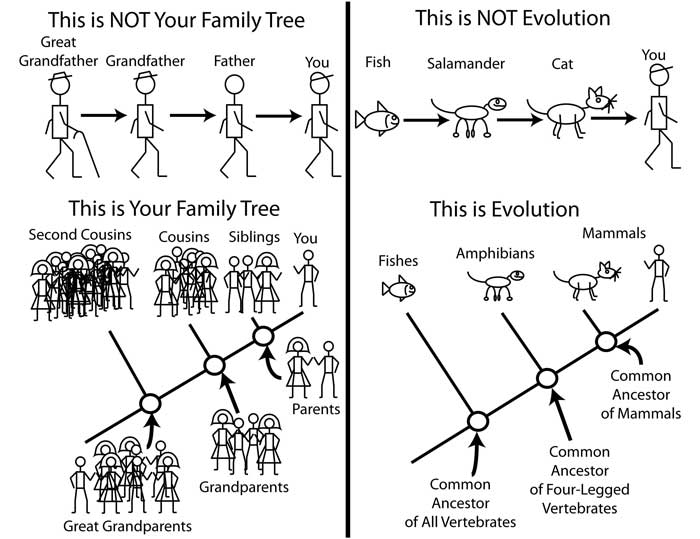
I liked how Florida Citizens for Science did it: they held a contest in which entrants were encouraged to draw stick figure cartoons illustrating a misconception many people have about some aspect of science. Here's one of my favorites:
The way Finder is designed, you often can't simply drag some files from one location to another (e.g. moving to the subdirectory of another directory). You need two Finder windows open in order to accomplish this, whereas Windows Explorer, whose left pane has the directory structure and right pane has the contents of the currently selected directory, lets you do this effortlessly using only one window.
--but I think that it is possible to do this on a Mac by opening Finder, clicking to the file you want to move, and then making sure that the third of the four display modes available (it looks like three vertical bars) is chosen. (These icons are right of the forward/backward buttons on the left of a Finder window.) This changes the display to a directory mode and allows you to drag and drop files from any subfolder to any other. Hovering over a folder's name while dragging a file will open that folder in the rightmost column and allow you to move the file to any subfolder.