I can't comment on how useful this is for understanding the industry, but it is essential for looking at the works.
Game development is a massively complex undertaking[1] and designers' self-expression will quickly cede to the large number of technological and engineering concerns.
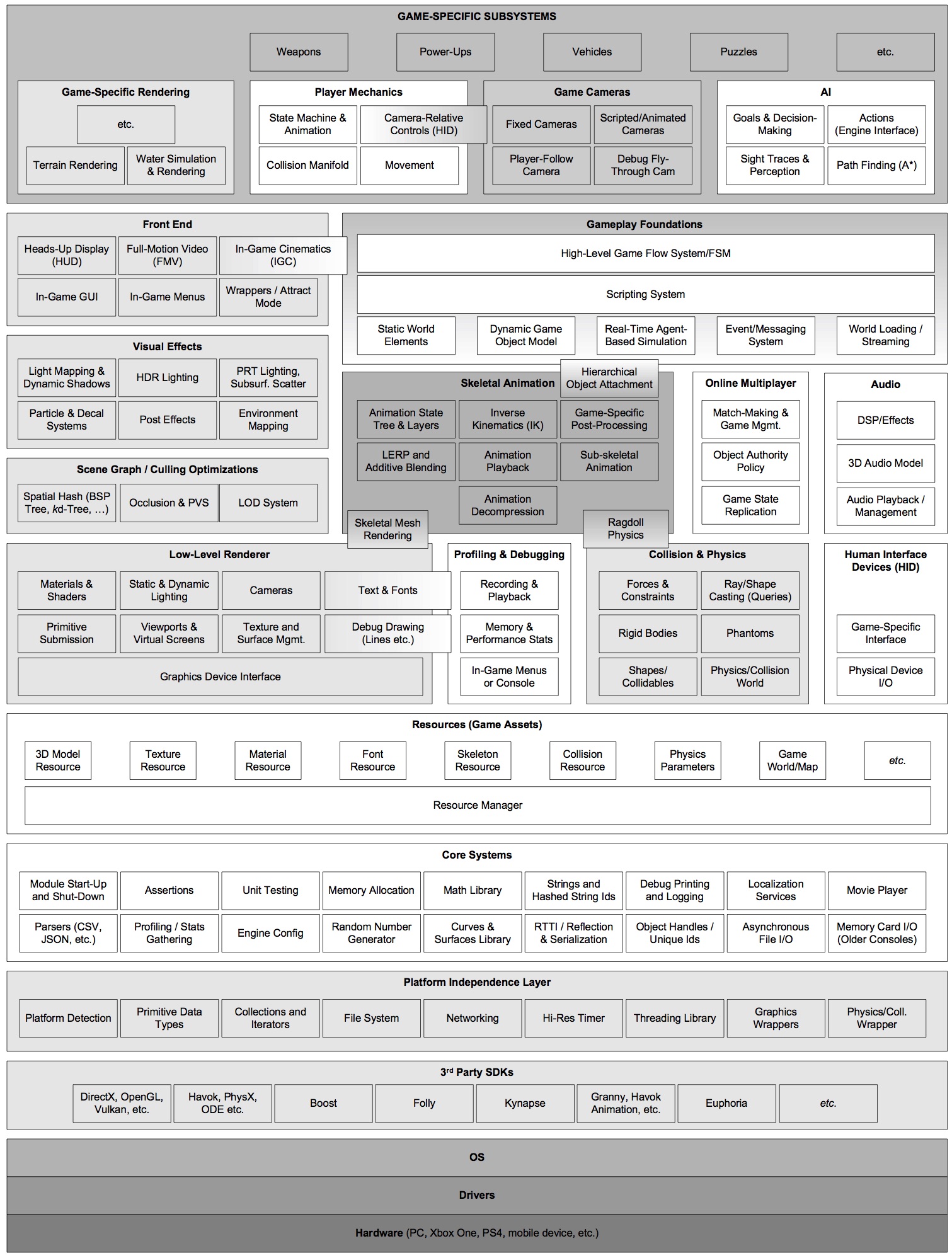
Maybe I'm missing your point, though, and it sounds like I'm saying everyone with a paintbrush is an artist. Certainly many games, even those much less complicated than your game engine diagram, are just made to "work": look pretty, hook players, shift units, sell replays. But I think we can criticize these games for what they lack just as we would for poor visible or audible aspects. We can recognize the existence of an "art film" on the same spectrum as a popcorn-munching AAA blockbuster, if maybe at the shallow end.
I'm not very well-versed in this argument, though I know it has been going on for a long time, sorry if I'm boring you with the easily-rebuttable stuff. I may be trying, as a former game developer and hobbyist game designer, to appropriate something that is better understood much differently. If art has to be the pure expression of one mind, unfiltererd through commercial necessity, engineering, and cooperation, then I have it wrong. I wonder if there's a better term for whatever it is I mean, entertainment doesn't seem to do it justice.
(Edit) fwiw I am trying to understand where you're coming from, too, sorry if this got too argumentative. I was intrigued by your observations about playing games and just a bit confused why you seem to reject game design as an art, as small a part of the whole product as it is.
"Interactivity is a facet of the medium, not the medium itself which contains ideas, challenges and aesthetic representations of things."
Not quite sure what you are trying to say here, but you seem to be underestimating just how abstract interactive systems are. "Ideas, challenges and aesthetic representations" are not necessary for an interactive system, though they are frequently paired because the former features help us engage with and better communicate the game or system. You can take an interactive system and represent it in a million different ways, but the underlying "gameplay" is isomorphic.
Instead, games are more akin to novel mediums, like musical instruments. A guitar is not inherently artistic--it could be crafted by an artisan and composed with beautiful visual design, but it could equally be produced in a factory without a hint of human emotion. Both cases are still a guitar; they have the core feature of interactivity: tap a string, hear a sound.
Therefore, while games are not art, playing a game is art. Art in the sense that the artist is expressing themselves, or performing, on a medium of their choice. Obviously, this varies across games depending on how interactive they actually are (as opposed to being mainly movies). Many enthusiasts of chess see a grandmaster's performance as art, both as a performance art and a persistant art form (there are books written on single games or even moves, albeit the latter from a purely analytical perspective).
To me, shoehorning games into a box of art-as-products is not compelling, and counterproductive to understanding games and the video game industry. That is, the AAA industry is infamously bad to work in relative to other software subindustries--it's certainly no game designer' paradise, a free-spirited realm of artistry. AAA video games are massive feats of engineering, not works of art (notwithstanding the obvious components of visual and audio design). And on the consumer side, we see the continued growth of esports, livestreaming, and other niche performance mediums like speedrunning.