I beg to differ. I live in Eastern Europe, at the crossroads of different migration waves, and I'd say we've been quite successful at integrating people over the millennia. Just look at this widely circulated genetic map of Europe (http://brilliantmaps.com/wp-content/uploads/2015/04/genetic-...), you can see that Romania (the country from where I'm from) is pretty diverse, and that happened because we're at the crossroads between "mainland" Europe, the Asian steppes, Anatolia/the Middle East etc.
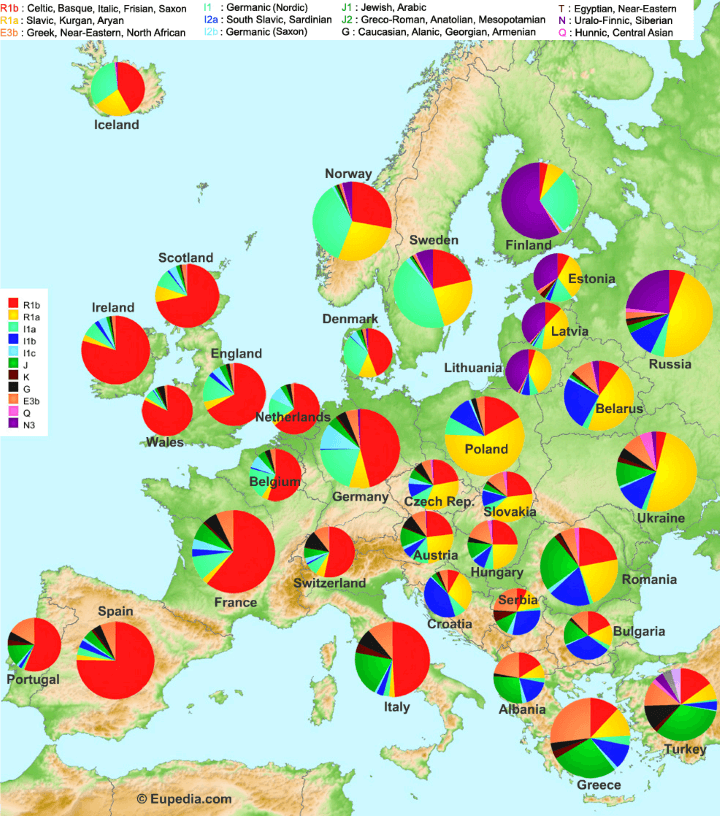
And looking past genetics, I can give you countless examples of Transylvanian Saxons and Hungarians who, once they had passed the Carpathians into Wallachian and Moldavian lands, ended up by giving up their religion and language and completely assimilated (yeah, it took them a couple of generations or more, but the process was generally irreversible). The local Jews were also quite well integrated in terms of customs and everything, in fact one of the most famous Yiddish songs ("Roumania Roumania - https://www.youtube.com/watch?v=vuj-qjyUjxY") mentions Romanian foods like "mamaliga" or "pastrama" (which we stole from the Turks, but everybody from the Balkans did that) in a melancholic way, like it also belonged to them, the Jewish people who used to live here.
Any source for that? I'm pretty interested in the history of the Middle Ages and as such I've learned recently that some historians have even started to question the long-held believe that the famous Mongol invasion of 1241-1242 was that bloody. Yeah, they did ransack a couple of towns in Transylvania and present-day Hungary, but that mostly happened because those people put up a fight, on the other side of the Carpathians (Wallachia, Moldova) there are no visible "destruction markers", so to speak (like burned villages and such). A couple of centuries earlier the Pechenegs and the Cumans did cause some bit of a stir in their wake, but that was comparatively short-lived, as they were very rapidly (again, comparatively speaking) integrated by the Hungarians in their kingdom (there was even a king of theirs called Ladislaus the Cuman) and also by the Wallachian/Romanian population which was not part of any established State: to this day "Coman" is still a a pretty popular family name among Romanians, and some big name-places bear Cuman/Turkic names, like the county of Teleorman (meaning "crazy forrest") or the plains of Baragan (meaning "winter storm" or something of the sorts).
Invasion by the "Germans" is the explanation Caesar gives for the migration of the Helvetii; it's debatable how accurate he was being, and how motivated to find political justification for his actions, but something induced them to pack up and move for greener pastures. A similar explanation may be found for the movement south through the Balkans and into Asia Minor of the Celtic tribes that became the Galatians. There is perhaps more evidence of this effect in the series of great migrations towards the end of the Roman empire, where the Franks, Burgundians, Vandals, and Goths all were forced westward in front of the Huns and Alans, who were themselves pushed westward by other steppe tribes of central Asia, perhaps ultimately terminating in the Xiongnu and their conflicts with Han China. There appears to be another wave of migration some hundreds of years later, corresponding with the migration of the Slavs, Bulgars, Avars and others into eastern Europe and the Balkans, the expansion of the Rus, the rise of the various central Asian Turkic khaganates, and the expansion of Tang China. Then there is of course the expedition of Batu and Subotai, in which atrocity and total war was a favored tactic, and only a succession crisis after the death of Ogodei Khan spared the rest of Europe. Then there is German colonization under the aegis of the Teutonic Knights, the crumbling of the Byzantine Empire under assault from the Turks on the one hand and the Venetians on the other, incessant warfare as the Ottomans expanded and contracted northwards through the Balkans, culminating in the early 20th century "Baltic Question" tinderbox as that empire fell apart and led to hundreds of millions of deaths throughout eastern Europe and atrocity on a scale to rival Genghis.
It's a history of blood and sword; not perhaps categorically different than the history of most places, but amplified by virtue of being the crossroads of so many moving peoples.
> beside that "integration" ended up in violence anyway even before wwii, when romanians started persecuting them.
WW2 and the 1930s were very difficult times (and not only for the Jews). I like to look at those times as the exception rather than the norm.
humans have been a bunch of assholes, we living in a niche of limited peace on a few locations shouldn't give us the peace of mind that everyone else understand the value of integration. note that a person or a family by itself is likely to integrate, it's significant migration that end up into more or less pronounced isolationism.
again, just have a look at all the chinatown and italian quarters. the actual border may be fuzzy, but the sense of identity is definitely there. and while wwii was an exceptional time, smaller conflict are still very present and the failure integration models are popping up every day stronger.
Even with all the carnage of WWII, I have very little doubt we'd have been back at it 10 years later if it weren't for the specter of nuclear armageddon hanging over everyone's heads.
Current Romania was formed out of regions that were occupied by different empires. The Old Romanian Kingdom was formed out of the bits formerly under Ottoman control. In 1918 the kingdom expanded to include regions formerly under Austria-Hungarian and Russian control.
When far right sentiment flared during WW2, the Jews in Basarabia (ex-Russian territory) were persecuted, even butchered. The ones in the Old Kingdom weren't.
In a weird way, they were "our Jews". They were considered different, yet still a part of our community.
I’ve heard the same thing from Ukrainians. Isn’t the world fun like that?
How many generations does the ancestoral language usually survive? Two? Three? Integration succeeds en masse all the time, especially where religion doesn't interfere.
It's just that nationalist wars make more headlines than all the kids I went to school with who didn't even properly speak the language of their own mothers (something I find rather regrettable).
The USA is full of Chinese, Italian, Irish etc descendants, most of whom do NOT live in those ghettos. After a generation to learn the local language and culture, descendants leave the ghettos for success in the wider world.