1) The scientific method will only validate (or fail to validate) predictions that you have made. If you haven't made a prediction about something, or fail to consider other effects, the scientific method often will not reveal those other things.
2) There are a lot of things we understand in many branches of science, but there's also a ton we don't understand. Death is one of many areas where we have a bunch of gaps, and many people don't realize that, or realize that some things that we take as established fact is more like established policy.
Ignaz Semmelweis' sad story is very telling in this regard [1]; however, since i feel uneasy in talking of the scientific method applied to a discipline (medicine) that is alien to me, I'll present another case. In 1929, Edwin Hubble discovered what would have been called Hubble's law, which was the first strong evidence of the expansion of the universe predicted by Friedmann and Lemaitre [2]. The core of this law is a numerical factor, called "Hubble's constant", which quantifies how fast galaxies seem to recede as a function of their distance.
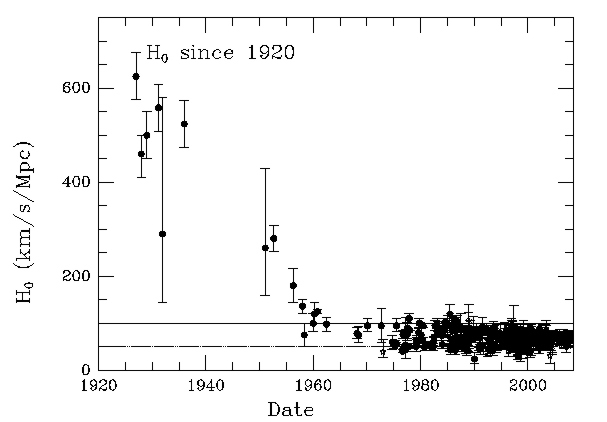
As year passed, several people improved the estimate of the Hubble constant, which moved from 600 km/s/mpc to the current estimate of 60-70 km/s/mpc. As plot [3] shows, the first estimates had confidence intervals (the error bars around each point) that were far too small: in fact, the best value found so far (70 km/s/mpc) is several sigmas out of the oldest one: therefore, Hubble's original confidence interval was blatantly wrong.
What happened is that Hubble relied on Cepheid stars to estimate distances, but he was unaware of the fact that there exist two groups of cepheids, with quite different characteristics.
When I used the expression "people with an irreducible faith in science", I meant that this sort of people would have dismissed any claim that the Hubble constant is far smaller than the estimate because they would have blindly stuck to the error bars found in Hubble's paper. Salvatore Crisafulli's and this girl's stories are in my opinion like the "true values" falling far out of the currently acknowledged "error bar".
[1] https://en.m.wikipedia.org/wiki/Ignaz_Semmelweis [2] https://en.m.wikipedia.org/wiki/Friedmann%E2%80%93Lema%C3%AE... [3] https://www.cfa.harvard.edu/~dfabricant/huchra/hubble/h1920....
I have faith in the process of science in that I believe iterative addition to our knowledge based on evidence and ezperimentation is the best process we’ve found to adapt out understanding to changing circumstances and affect outcomes.
Why is that bad?