News for hackers. Stuff that matters.
Re:IBM mainframe tube module part II: Powering up and using ... by Animats on Sunday January 14, 2018 @03:32PM (#16146208)
The IBM 705 came in a bigger version, the IBM 709, and there was a transistorized version, the IBM 7090. The IBM 7090/7094 powered much of the US space program of the 1960s and 1970s, and some of those machines were used into the 1980s.

Those big control panels were mostly for maintenance use. UNIVAC separated the operator and maintenance panels on their transistorized machines, and in normal operation, nobody was near the maintenance panel. IBM kept a lot of lights, buttons, and knobs facing the operators well into the System/370 era. By that time you could debug the OS inside a VM, so all those manual controls were unused, but it took IBM a long time to get rid of them.

Re:IBM mainframe tube module part II: Powering up and using ... by ChuckMcM on Sunday January 14, 2018 @03:41PM (#16146262)
So true, because no doubt somewhere there was an engineer inside IBM that liked the blinking lights :-). One summer when I was working for IBM in high school I got to work at the 'operators console' for a System 370. Pretty much everything you did happened on a light pen enabled 3270 terminal, except the IMPL (initial microprogram load) button was still a real switch, and the 'load meters' which were pretty neat analog meters that read out system load were useful for tuning the batch queue that was filling in batch jobs when ever the meters showed less than 50% utilization. When it got over 95% the operator was supposed to pause one or more batch jobs. At the time, IBM felt there was no way the computer could know which batch jobs were "important" and which could be pushed off.
Re:IBM mainframe tube module part II: Powering up and using ... by DrScump on Sunday January 14, 2018 @07:34PM (#16147537)
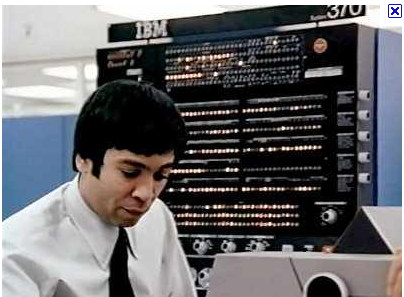
The most striking difference to me as an operator was that the Series 370 console was more than just the terminal/screen. You had switches and lights right out of a sci-fi movie, right down to rotary dials to set the address of the boot device.

With its successor, the 303x, the console was a glorified terminal. (My favorite command there was quiesce[0], where you could bring activity to an orderly freeze without ruining programs in process. I half-expected to hear it sing "Daisy, Daisy" in slowing decrescendo.)

[0] https://www.ibm.com/support/knowledgecenter/en/SSLTBW_2.3.0/...

Re:IBM mainframe tube module part II: Powering up and using ... by DrScump on Sunday January 14, 2018 @09:28PM (#16148037)
I've done some image searches (to no avail) hoping to find images showing the distinctive built-in screen and keyboard.

The screen displayed characters using a "font" that I've never seen elsewhere, more resembling characters a human would handprint than a modern fixed font. I was hoping to find images of that. I did at least find a partial image[0] of a S/370 console with the light arrays that triggered my sci-fi comparison above.

[0] https://popesixteen.files.wordpress.com/2012/04/picture-syst...
Re:IBM mainframe tube module part II: Powering up and using ... by pdw on Monday January 15, 2018 @06:14AM (#16149843)
Re:IBM mainframe tube module part II: Powering up and using ... by DrScump on Monday January 15, 2018 @10:59PM (#16155707)
No, in these S/370 models, the keyboard was built into the desk and the monitor was embedded in the console/control panel.

That's from memory, which in my case has no parity bits and is vulnerable to a variety of exploits.

Re:IBM mainframe tube module part II: Powering up and using ... by Stratoscope on Sunday January 14, 2018 @06:24PM (#16147184)
> an engineer inside IBM that liked the blinking lights :-)

I can relate. I bought my first personal computer shortly after the IBM PC came out - but I did not get a PC. It had no lights or switches! How could I debug my code?

Instead I got an Ithaca Intersystems DPS-1 S-100 system because it had all the lights and switches.

https://www.google.com/search?q=Ithaca+Intersystems+DPS-1&tb...

Not one of my wisest technology decisions! But a few months later a friend bought a PC and an Apple II, decided there wasn't enough software for the PC, and gave it to me figuring I would write some kind of software on it.

Re:IBM mainframe tube module part II: Powering up and using ... by monocasa on Sunday January 14, 2018 @06:21PM (#16147170)
> So true, because no doubt somewhere there was an engineer inside IBM that liked the blinking lights

Customers (and therefore marketing) dig that shit too. The Death Star's computers were even designed after some S/370 operator's console.

https://en.m.wikipedia.org/wiki/IBM_System/370#/media/File%3...

vs.

http://starwarswallpaperhd.com/web/wallpapers/death-star-ins...

Re:IBM mainframe tube module part II: Powering up and using ... by glhaynes on Sunday January 14, 2018 @08:55PM (#16147870)
Was the light pen used?
Re:IBM mainframe tube module part II: Powering up and using ... by kens on Sunday January 14, 2018 @04:05PM (#16146440)
I wouldn't call the IBM 709 a bigger version of the 705. The scientific machines (701/704/709) and the business machines (702/705) are really entirely different systems: completely different architecture, console, word size, instruction set, physical construction, and even basic internal circuitry and voltages. You're better off thinking of them as unrelated systems that marketing tried to turn into a coherent product line (see also Intel 4004 and 8008).
Re:IBM mainframe tube module part II: Powering up and using ... by wizbonk on Sunday January 14, 2018 @03:41PM (#16146267)
My understand when I had a school visit to IBM was it was customers who wanted the lights, as it would look more computery.
Re:IBM mainframe tube module part II: Powering up and using ... by walshemj on Sunday January 14, 2018 @03:46PM (#16146303)
At one place i worked awe had a brand new state of the art supermini from PR!ME. Oneday we had a film crew turn up but they filmed our old PDP/1140 as it had lots of blinking LED's
Re:IBM mainframe tube module part II: Powering up and using ... by pinewurst on Sunday January 14, 2018 @09:33PM (#16148060)
The 705 wasn't related to the 709->7090/7094 at all, being a variable length word machine. The 702 and 705 are close relatives with the 7080 their transistorized descendant. The 709's predecessor was the 704.