I actually find roundabouts easier to navigate than large crossroads, I think this is partly because they actually are objectively easier and safer to navigate (one stream of traffic) and partly (but mostly) because they are dominant in the UK.
But for the same reason (familiarity) I expect many in the US would find roundabouts hard to navigate (and maybe unsafe as a result?), it's more about what you are used to and what you had to learn as part of your driving test.
Are roundabouts part of driving tests in the US?
Personally, I freak out when I see a roundabout coming up, and slow down dramatically. Or, I completely avoid them.
[0] https://www.citylab.com/transportation/2016/03/america-traff...
You can see the segment here[0]
They measured throughput for both 4-way stops and roundabouts, with both people who hadn’t used them before and people who had.
Unsurprisingly (for me at least) roundabouts were significantly better, even for people unfamiliar with them.
0: https://m.wimp.com/mythbusters-four-way-stop-vs-roundabout/
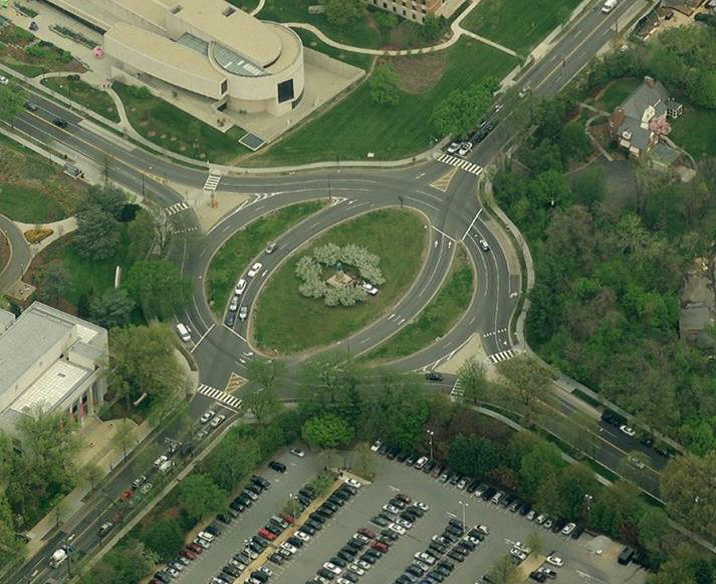
> Hans Monderman and others have suggested that, by creating a greater sense of uncertainty and making it unclear who has priority, drivers will reduce their speed, in turn reducing the dominance of vehicles, reducing road casualty rates, and improving safety for other road users.
clearly, Hans Monderman has never driven in Mumbai, India.
But for modest to high volume traffic, roundabouts are better (although if the traffic flow is constant, you usually have to place the crossings a bit further away from the center of the roundabout, which makes it a little harder on elderly pedestrians to go fully "across" since they have to walk the extra distance).
It does work incredibly well and there are rarely any accidents. The downside however is that it's quite a struggle to cross. It makes me dread to leave the ferry and enter the warzone once again every morning. I understand that it is designed to make me uncomfortable, but it is taken to such an extend that I don't even really want to walk there.
You mean, no cars?
https://en.wikipedia.org/wiki/High_Five_Interchange
That crosses 16 lanes with 14 lanes. (3,5,5,3 with 3,4,4,3)
I'm reminded of my time in Berkeley. Now, in spite of what Fox News might tell you, Berkeley is one of the most ridiculously upper class places possible. But, it's right next to Oakland, a place that... isn't.
In Berkeley? If you even look like you were about to step out into the road in the middle of the street, people would stop for you. Over in El Cerrito or Oakland? you could be in the crosswalk, and nobody even slows down.
Or Naples, Italy.
https://www.theguardian.com/cities/2016/may/17/superblocks-r...
In my experience they keep traffic moving really well, as long as the traffic load into each entrance is roughly equal - otherwise it's hard to enter the roundabout from a lesser used entrance.
They take up more space than traffic lights in most situations, however Canberra is a planned suburbia so that wasn't an issue there.
[1]: http://www.abc.net.au/news/specials/curious-canberra/2016-12...
People will learn to use turn signals quickly if they are fined.
Works well in Europe. Though I can understand why this wouldn't work in the US.
There was even a BBC report on the latter (which I can't find right now, as usual, only a follow-up: http://www.bbc.com/news/uk-33303031).
Drawing a (admittedly inaccurate) parallel with shared spaces (which are harder to navigate by sensory deprived humans than standard intersections), I'd say roundabouts (which preserve crossings) would be a more sensible short-term approach overall -- especially considering the remaining human drivers.
Full disclosure: I don't drive anymore. Gave it up decades ago because I prefer to do something useful with my commute times, and resort to public transportation or Uber whenever possible, which (ironically) allows me to arrive earlier to meetings than most of my colleagues (who need to hunt down a parking space).