I'd prefer a systems-y, zero-cost take on algebraic effects, similar to what OCaml is going to get. Could be much more extensible, and open things up to annotating whether functions panic or not, access global state, etc. Alas it's still a tricky research problem, even after all these years. There were some nice discussions from ICFP here - the comments strayed into talking about how effects might be implemented without a GC: https://www.youtube.com/watch?v=DNp3ifNpgPM
For me clippy evokes the image of a well-meaning, if at times clumsy helper that tries to nudge you in the right direction. I find that very fitting for a tool that...well...tries to nudge you in the right direction of writing good, fast, idiomatic code.
Had to look this up - very cute!
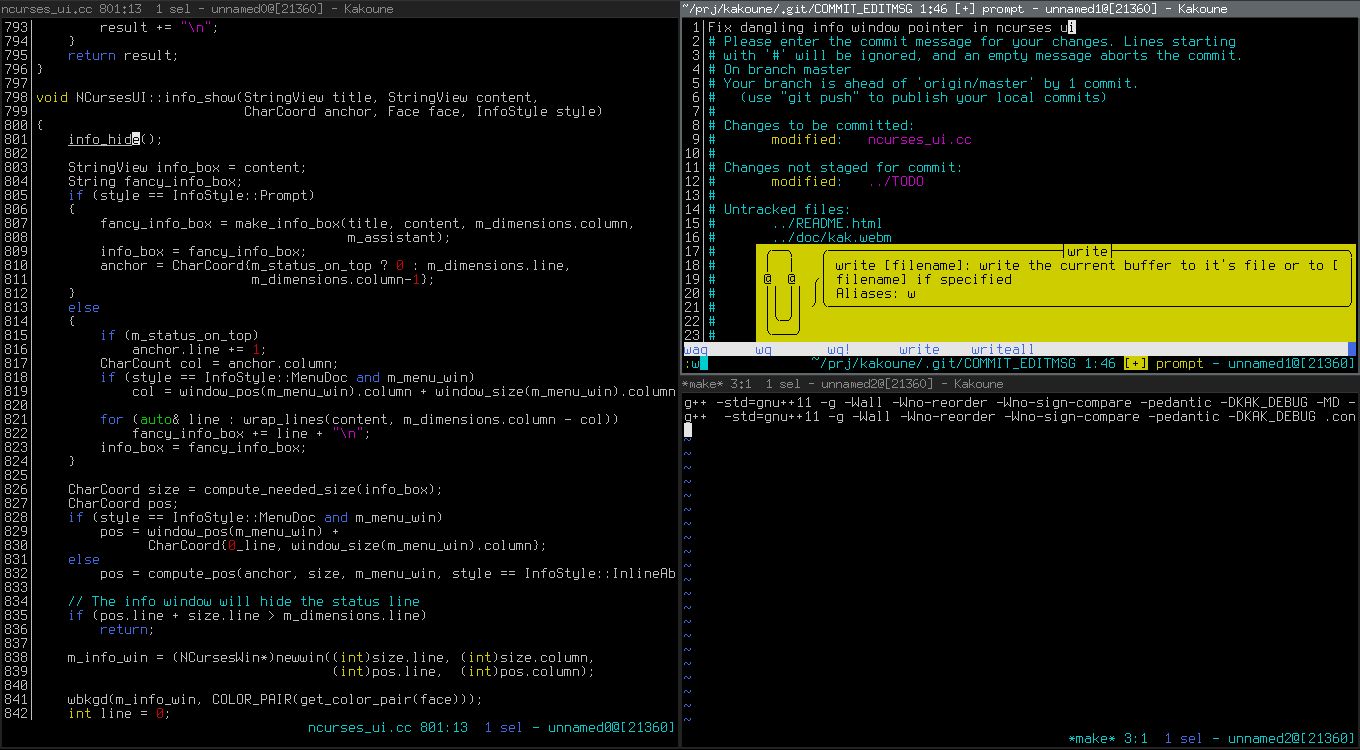
https://github.com/mawww/kakoune#screenshots
https://raw.githubusercontent.com/mawww/kakoune/master/doc/s...
1: http://tmsearch.uspto.gov/bin/showfield?f=toc&state=4805%3At...
Aside from the almost completed features in the pipeline, I only see procedural macros (macros 2.0) and whatever happens to make async code easier to write[1] really impacting day-to-day code for most people.
[1] I'd really like to see F# Computation Expressions instead of async/await. I know the language experts have said Haskell-like do notation doesn't work in Rust but I'm not sure if the F# tweaks would make it work or not.