It also sounds like you are downplaying the effects of climate change, in contradiction with the data displayed in the article, which is bound to get downvotes.
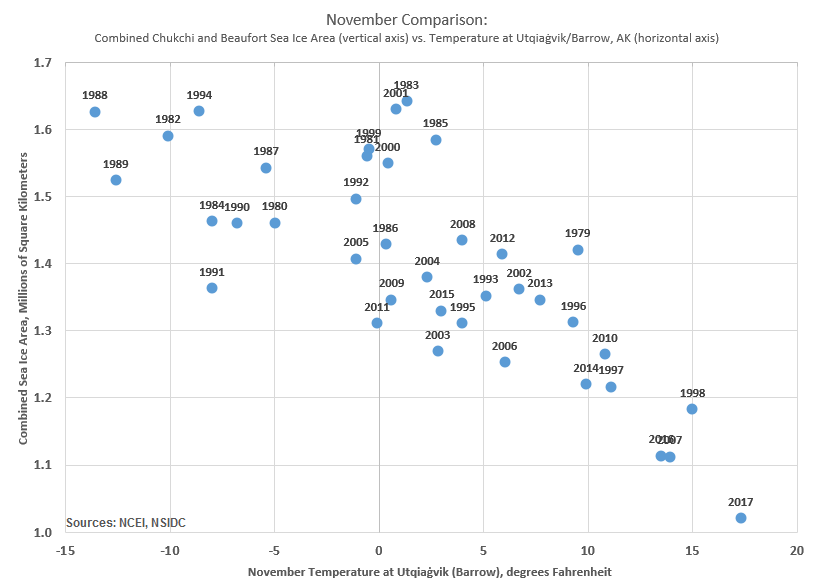
Here's one, showing Barrow temperature vs sea ice: https://www.climate.gov/sites/default/files/barrow-temp-vs-n...
(These two being that nearby stations' temperatures would rise and fall together, and that all stations would have nearby stations.)
From the article, the only change they are making to fix this breakage is to reduce the strength of these two assumptions for far north stations.
-
The popular perception is that the currently measured global warming means that every part of the globe is getting warmer at the same rate, all year long. The reality is that Barrow is getting a tiny bit warmer in the summer, a lot warmer than it used to be in the winter, and the rest of Alaska that we are measuring isn't seeing the same scale of changes.
That's totally cool - it's just not the popular perception on either side of the debate. Here's a relevant XKCD for real life science https://xkcd.com/683/
Can you also please cite your source that it's a "data import code" problem as you claim above? I don't see it in the article and I understand the article differently, I consider the assumptions they used being correct ones for the given data sources.
Edit: I see your edit and I don't agree with your claim "it's just not the popular perception on either side of the debate" -- "it should warm the same everywhere" is only actively used by the "deniers" even if no scientist ever made such a claim:
https://www.climate.gov/news-features/climate-qa/does-global...
https://www.treehugger.com/natural-sciences/uks-met-office-r...
etc.
The November 2017 temperature readings from Utqiaġvik (Barrow), Alaska were 2.5 degrees higher than November 1998. The NCEI's ingest code for their monthly report flagged this station as a probable sensor setup change and ignored the data.
Crucially the code for choosing which data to ignore looks for "agreement" with nearby sensors. Utqiaġvik (Barrow) is one of the most remote sites, with the nearest other site being many smaller European countries away. The other "nearest" sites did not show similar warming, therefore the NCEI's code discarded Barrow. If there had been other, closer stations, showing similar data, their code would not have discarded it.
A classic case of a programmer making an assumption that is almost, but not quite, universaly true. "There will always be many nearby stations who's average temperature will behave roughly similarly," works for most of the US, but not here.
They are now updating their data ingest code to relax the agreement requirements for isolated, far north stations.
-
[Update: ye gads, how is this downvote fodder? My points are going up and down like a yo-yo! If I'm wrong about anything, here, let me know!]