News for hackers. Stuff that matters.
Re:Bitcoin: A Peer-to-Peer Electronic Cash System (2008) [pdf] by betterunix2 on Friday December 08, 2017 @09:17PM (#15883863)
"That is the beauty of it. It is only eight pages long, but fundamentally changes the concept of money."

Not really; it only serves to validate the beliefs of people who already agreed with the basic premise that money is something that can exist without central authority. That view was already common long before the Bitcoin paper. Plenty of libertarians believe that money is an emergent phenomenon of free markets, something which arises on its own as the market converges on a common currency as its medium of exchange.

On the other hand, if you are aligned with the mainstream of economics, the entire premise of the paper is easily dismissed. In that view, money can never be separated from banks, the paper is basically nonsense.

Re:Bitcoin: A Peer-to-Peer Electronic Cash System (2008) [pdf] by nerflad on Friday December 08, 2017 @09:44PM (#15883960)
Money is an emergent phenomenon of markets, and it has nothing to do with libertarians.

https://en.wikipedia.org/wiki/Coincidence_of_wants

Re:Bitcoin: A Peer-to-Peer Electronic Cash System (2008) [pdf] by betterunix2 on Friday December 08, 2017 @10:07PM (#15884049)
How does that prove money is an emergent phenomenon of markets? In fact, that article suggests exactly what the historical evidence suggests: markets cannot really exist without money. Societies without money tend to only engage in trade with strangers, rather than having markets:

https://monoskop.org/images/3/36/Graeber_David_Toward_an_Ant...

Re:Bitcoin: A Peer-to-Peer Electronic Cash System (2008) [pdf] by Retric on Saturday December 09, 2017 @12:39AM (#15884497)
For an example of money showing up in Barter systems look at diablo 2's use of stone of Jordon's as a proxy for money.
Re:Bitcoin: A Peer-to-Peer Electronic Cash System (2008) [pdf] by nerflad on Friday December 08, 2017 @10:38PM (#15884144)
It can't prove it any better than than anything else can bridge the is-ought gap. I agree that markets can't exist without money, but I think historical evidence suggests that they will create money in order to exist. Almost every society in human history has developed a monetary system; either one based around a commodity as simple as camels, bullion or sea shells, or backed by fiat.
Re:Bitcoin: A Peer-to-Peer Electronic Cash System (2008) [pdf] by betterunix2 on Friday December 08, 2017 @10:43PM (#15884159)
Well, the same author from the link I gave happens to have also written a book on that very topic that you might find interesting:

https://en.wikipedia.org/wiki/Debt:_The_First_5000_Years

Re:Bitcoin: A Peer-to-Peer Electronic Cash System (2008) [pdf] by nerflad on Friday December 08, 2017 @10:49PM (#15884177)
I'll check it out. Thank you.
Re:Bitcoin: A Peer-to-Peer Electronic Cash System (2008) [pdf] by em3rgent0rdr on Friday December 08, 2017 @11:37PM (#15884322)
> "Money is an emergent phenomenon of markets, and it has nothing to do with libertarians."

let me fix that for you: "Money is an emergent phenomenon of markets, markets are a fundamental feature of libertarianism, therefore money has everything to do with libertarianism."

Re:Bitcoin: A Peer-to-Peer Electronic Cash System (2008) [pdf] by Retric on Saturday December 09, 2017 @12:42AM (#15884501)
Markets are ~10,000+ years older than libertarians. Some early examples had people swapping from banditry to trade depending on how well armed the people they encountered where. No outside forces nessisarily, but no rule of law either.
Re:Bitcoin: A Peer-to-Peer Electronic Cash System (2008) [pdf] by em3rgent0rdr on Saturday December 09, 2017 @01:42AM (#15884629)
Sure markets may be older than libertarians, but even though libertarians didn't exist to enunciate libertarian theory back then, the fundamental libertarian phenomenon of non-aggression and voluntary exchange as you mention was indeed present.
Re:Bitcoin: A Peer-to-Peer Electronic Cash System (2008) [pdf] by amarkov on Saturday December 09, 2017 @02:13AM (#15884681)
But most non-libertarians believe in non-aggression and voluntary exchange too. They just argue that some taxes aren't aggression and some exchanges aren't really voluntary.
Re:Bitcoin: A Peer-to-Peer Electronic Cash System (2008) [pdf] by Retric on Saturday December 09, 2017 @07:47AM (#15885572)
These where often rather agressive trades, even without violence actually occurring it's threat was still on the table.
Re:Bitcoin: A Peer-to-Peer Electronic Cash System (2008) [pdf] by nerflad on Saturday December 09, 2017 @12:46AM (#15884509)
Markets are a reflection of human action. Political science is concerned with quantifying and influencing human action, thus markets are a fundamental feature of all political schools of thought.
Re:Bitcoin: A Peer-to-Peer Electronic Cash System (2008) [pdf] by colordrops on Saturday December 09, 2017 @01:21AM (#15884601)
No need to be so dismissive. The abstract term "decentralized" hides a lot of the complexity in Bitcoin. It is also programmable money, irreversible money, geographically unbound money, fast money, and transparent money.
Re:Bitcoin: A Peer-to-Peer Electronic Cash System (2008) [pdf] by runeks on Saturday December 09, 2017 @04:20AM (#15884996)
> On the other hand, if you are aligned with the mainstream of economics, the entire premise of the paper is easily dismissed. In that view, money can never be separated from banks, the paper is basically nonsense.

So, did banks invent gold? Or did gold give rise to banks?

How can banks even exist in the first place unless we already have a common medium of exchange (gold), which can deposited into said banks?

Re:Bitcoin: A Peer-to-Peer Electronic Cash System (2008) [pdf] by betterunix2 on Saturday December 09, 2017 @08:17AM (#15885665)
Actually, the first banks, along with the first money and the first markets, developed from the palace economies of early city states. Originally the proto-bank maintained records of what each person had deposited with the temple, what had been given to various people, and what was available to give. Those ledgers recorded each type of deposit (wheat, cloth, olives, etc.) with a different unit; the innovation that gave rise to money was the transition to a single unit of account.
Re:Bitcoin: A Peer-to-Peer Electronic Cash System (2008) [pdf] by runeks on Saturday December 09, 2017 @01:01PM (#15887038)
That’s really interesting! Were these banks private enterprises? I assume people voluntarily deposited commodities in exchange for a common medium of exchange.

The problem arises when depositors can’t redeem their medium of exchange for the commodities they originally deposited, or something of equivalent value.

By the way, I’m convinced Bitcoin will not function without credit instruments, just like was the case with gold. I’d argue there’s a huge difference between redeemable and irredeemable credit instruments, though. The latter being an artifact of government regulation.

Re:Bitcoin: A Peer-to-Peer Electronic Cash System (2008) [pdf] by betterunix2 on Saturday December 09, 2017 @06:02PM (#15888697)
"Were these banks private enterprises?"

Sort of; at that time it the boundaries were less clearly defined between what was governmental and what was private. The basic economic structure was for a large temple to store the various goods people produced, and to give the goods out to people as necessary. For example, a farmer would deposit grain, and the grain would be redistributed throughout the city-state; the farmer would receive other things from the temple, like clothes and tools. The record-keeping served two purposes: to keep track of what was available for distribution, and to keep track of who was contributing what. This was the "palace economy:"

https://en.wikipedia.org/wiki/Palace_economy

The bible makes reference to such a system in the story of Joseph (which is ancient enough that palace economies still existed when the story was first written), who was the administrator of such a system in Egypt:

http://www.mechon-mamre.org/p/pt/pt0141.htm#47

"I assume people voluntarily deposited commodities in exchange for a common medium of exchange."

Not originally and not universally. It was more like a system of 100% taxation in some of the early palace economies, where everyone deposited everything they produced with the temple, and then received things as they were needed. You were basically not allowed to live in the city without contributing something (he who does not work shall not eat), though a person could always work for the temple itself e.g. as a sacred prostitute. Of course the specific laws and economic organization varied from city to city, and plenty of people lived far outside the cities and had their own ways to manage goods; the specific details varied with different places and periods of time.

What you received for your deposit was often just an update to the temple's ledgers clearing a debt you owed the temple (i.e. indicating you paid your taxes; often referred to as "offerings" in the biblical legal code) and possibly offset future taxes. If you were unable to make good on that obligation, your land could be seized and you could become a slave until the king declared a general amnesty (not uncommon in the ancient world; the biblical legal code requires slaves to be given amnesty after 7 years of service, and a similar amnesty provision is in the code of Hammurabi). The story of Joseph also indicates that this exact scenario had played out under Joseph's administration in Egypt: the farmers were forced to turn their lands over to the government during a famine (I am not suggesting that the bible is historical; rather, in ancient Israel at the time that story was written, people were familiar with the situation).

As the economies became better developed and the scale increased, money (i.e. a single unit of account that serves as a common medium of exchange) and markets (i.e. trade between inhabitants of the same city) began to replace the temple economy system, at which point private banking enterprises became more clearly defined. For example:

https://en.wikipedia.org/wiki/House_of_Egibi

https://en.wikipedia.org/wiki/Murashu_family

Re:Bitcoin: A Peer-to-Peer Electronic Cash System (2008) [pdf] by stale2002 on Friday December 08, 2017 @09:43PM (#15883950)
And yet, reality has seemed to prove these economics wrong.

You can use this "nonsense" money right now. And nothing that any economist says about it can stop you.

Re:Bitcoin: A Peer-to-Peer Electronic Cash System (2008) [pdf] by Barrin92 on Friday December 08, 2017 @10:02PM (#15884028)
if I'd be willing to pay 6-20 bucks for a simple transaction with a volatile currency and wanted to live with the threat of having my account hacked and no insurance whatsoever, sure
Re:Bitcoin: A Peer-to-Peer Electronic Cash System (2008) [pdf] by Frogolocalypse on Friday December 08, 2017 @10:09PM (#15884060)
Your money has been hacked. You just don't recognize it.

https://d3fy651gv2fhd3.cloudfront.net/charts/united-states-m...
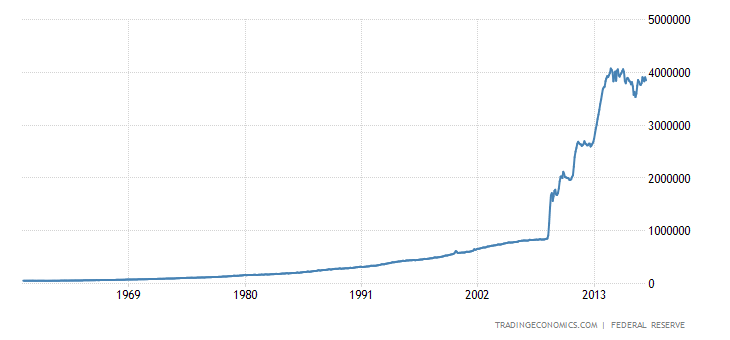
PS. Every standard sized bitcoin transaction bar the past three days (and those will too), that people paid over 5c for has been committed to the blockchain.

Re:Bitcoin: A Peer-to-Peer Electronic Cash System (2008) [pdf] by jcranmer on Friday December 08, 2017 @10:16PM (#15884088)
Yeah, that rampant inflation sure destroyed my savings account.

Oh wait, no it didn't.

Re:Bitcoin: A Peer-to-Peer Electronic Cash System (2008) [pdf] by Frogolocalypse on Friday December 08, 2017 @10:25PM (#15884111)
House prices look like they're continuing their 30-year boom in my area. Oh that's right, they took them out of inflation statistics in 1983.

How's education costing these days, anyway? Healthcare?

Re:Bitcoin: A Peer-to-Peer Electronic Cash System (2008) [pdf] by jcoffland on Friday December 08, 2017 @11:45PM (#15884342)
Can you buy the same things for the same prices as when you first started saving?
Re:Bitcoin: A Peer-to-Peer Electronic Cash System (2008) [pdf] by Barrin92 on Saturday December 09, 2017 @12:18AM (#15884436)
That's not my money because I do not own any US Dollars, and more importantly I don't really see why a graph showing me the money supply is supposed to convince me to buy Bitcoin
Re:Bitcoin: A Peer-to-Peer Electronic Cash System (2008) [pdf] by Frogolocalypse on Saturday December 09, 2017 @05:55AM (#15885239)
Don't. No one is forcing you to buy bitcoin. If you don't recognise its value proposition, don't invest in it.
Re:Bitcoin: A Peer-to-Peer Electronic Cash System (2008) [pdf] by betterunix2 on Friday December 08, 2017 @09:52PM (#15883989)
You cannot use it to pay your mortgage, nor to pay your taxes. You cannot even use it to pay Steam...
Re:Bitcoin: A Peer-to-Peer Electronic Cash System (2008) [pdf] by Frogolocalypse on Friday December 08, 2017 @09:54PM (#15883999)
I have a bitcoin debit card. I use it to pay all of these things. Your argument is akin to a person in the US saying that a person from Europe using their visa card, isn't using real money, because you don't control it.
Re:Bitcoin: A Peer-to-Peer Electronic Cash System (2008) [pdf] by beefield on Saturday December 09, 2017 @02:50AM (#15884773)
> I have a bitcoin debit card. I use it to pay all of these things. Your argument is akin to a person in the US saying that a person from Europe using their visa card, isn't using real money, because you don't control it.

If the person from Europe comes to US, goes to McDonald's, buys a meal whose price is denominated in USD with his European credit card and tells me he made the purchase with Euro, I would consider that a false statement. To me, he made the purchase in USD, his credit card company just will make the FX conversion for him and accept EUR from him when he pays his credit card bill.

Re:Bitcoin: A Peer-to-Peer Electronic Cash System (2008) [pdf] by betterunix2 on Friday December 08, 2017 @10:09PM (#15884063)
What is a Bitcoin debit card? What payment system does that card actually use?

Converting BTC to fiat currency on the spot is not really the same thing as using Bitcoin to pay your bills, any more than selling some shares of stock and using the money to buy a house is the same thing as buying a house using shares of stock.

Re:Bitcoin: A Peer-to-Peer Electronic Cash System (2008) [pdf] by zik on Friday December 08, 2017 @10:31PM (#15884128)
It's a standard mag stripe card that draws from a Bitcoin account and can be used anywhere. They're quite common.
Re:Bitcoin: A Peer-to-Peer Electronic Cash System (2008) [pdf] by betterunix2 on Friday December 08, 2017 @10:46PM (#15884165)
IOW you are not paying with BTC, you are selling BTC for some fiat currency and using the proceeds to make the payment.
Re:Bitcoin: A Peer-to-Peer Electronic Cash System (2008) [pdf] by jcoffland on Friday December 08, 2017 @11:42PM (#15884334)
If I take my US debit card to Europe and buy things there, essentially the same thing happens.
Re:Bitcoin: A Peer-to-Peer Electronic Cash System (2008) [pdf] by Marazan on Saturday December 09, 2017 @02:59AM (#15884799)
But you are not paying the European merchant with USD.
Re:Bitcoin: A Peer-to-Peer Electronic Cash System (2008) [pdf] by jacquesm on Saturday December 09, 2017 @04:52AM (#15885075)
Neither are you paying with USD even if your debit card directly debits your USD account. It's a proxy for paying with USD, just like a bitcoin debit account is a proxy for paying with bitcoin. That the conversion and account adjust ment happen in one currency or another does not mean that currency is directly involved, it is merely a convenient stand-in for the number reflecting your balance, an attribute of it.

People think that banks hold their money: they don't. The bank simply owes you your money but they don't hold it for you. What you get in return for your money is a statement from the bank what debt they owe you and a device to convert that debt into goods whenever you feel like it. That device is not the same as the underlying money, it is merely a proxy for your debt.

Which you'd find out about in a hurry if your bank ever went under and your card stopped to work.

Re:Bitcoin: A Peer-to-Peer Electronic Cash System (2008) [pdf] by FabHK on Saturday December 09, 2017 @04:50AM (#15885073)
Are there standard mag stripe/chip cards that draw from a BTC account and exchange into fiat at the time of purchase of a good?

All the cards I've seen when I looked into it a bit ago converted into fiat at the time of charging the card with BTC (ie, you send BTC, that got converted into fiat immediately (at pretty mediocre rates), and then you could use that fiat to purchase stuff or withdraw cash (at pretty mediocre rates, again)).

Re:Bitcoin: A Peer-to-Peer Electronic Cash System (2008) [pdf] by endless1234 on Saturday December 09, 2017 @03:15AM (#15884847)
If you buy a debit card with $1000 on it with an ounce of gold, do you now have a gold debit card?
Re:Bitcoin: A Peer-to-Peer Electronic Cash System (2008) [pdf] by AndreKoster on Saturday December 09, 2017 @08:12AM (#15885645)
Yes. I think GoldMoney issues those kind of cards.
Re:Bitcoin: A Peer-to-Peer Electronic Cash System (2008) [pdf] by leshow on Friday December 08, 2017 @10:03PM (#15884034)
Maybe I'm not clear on how a btc debit works but that seems foolish. Maybe a few years ago when it could actually function as a medium of exchange. Now the transaction fees are exorbitant.
Re:Bitcoin: A Peer-to-Peer Electronic Cash System (2008) [pdf] by AndreKoster on Saturday December 09, 2017 @08:17AM (#15885666)
> Now the transaction fees are exorbitant.

All the remarks about the skyrocketing fees can be cut short by pointing out that Bitcoin Cash (which is much closer to the Bitcoin described in the white paper than Bitcoin Segwit [BTC]) doesn't have this problem. Just like Satoshi Nakamoto said that the block size limit could be raised once blocks started to get full, the developers of the Bitcoin Cash software also say the current max. block size of 8 MB can be raised if the blocks get full.

Re:Bitcoin: A Peer-to-Peer Electronic Cash System (2008) [pdf] by Frogolocalypse on Saturday December 09, 2017 @11:30AM (#15886475)
If you want an alt coin with more capacity than bcash, more decentralised, and faster, use litecoin. It even has atomic swaps with bitcoin.

Look at the price. Going bananas.

Re:Bitcoin: A Peer-to-Peer Electronic Cash System (2008) [pdf] by AndreKoster on Saturday December 09, 2017 @07:30PM (#15889011)
No, I'm good. Besides, Litecoin's capacity isn't bigger.
Re:Bitcoin: A Peer-to-Peer Electronic Cash System (2008) [pdf] by Frogolocalypse on Tuesday December 12, 2017 @09:10AM (#15905629)
Like i said...
Re:Bitcoin: A Peer-to-Peer Electronic Cash System (2008) [pdf] by Frogolocalypse on Friday December 08, 2017 @10:12PM (#15884075)
> I'm not clear on how a btc debit works but that seems foolish.

Not sure there's any response possible for that one. "I don't know how it works, but I think it's dumb."

> Now the transaction fees are exorbitant.

Every standard sized bitcoin transaction bar the past three days (and those will too), that people paid over 5c for has been committed to the blockchain.

Re:Bitcoin: A Peer-to-Peer Electronic Cash System (2008) [pdf] by leshow on Saturday December 09, 2017 @02:46PM (#15887677)
Either pay a ridiculous fee or wait a ridiculous amount of time for confirmation?

Replace by fee is a thing, as long as the tx is unconfirmed it could be replaced. You're effectively saying the wait time is now 3 days unless you want to pay a fee of several dollars. So that rules out most transactions.

How do you pay for anything given those restrictions?

Re:Bitcoin: A Peer-to-Peer Electronic Cash System (2008) [pdf] by Frogolocalypse on Saturday December 09, 2017 @11:04PM (#15889825)
By aggregating commits to the blockchain, and doing them in batches.
Re:Bitcoin: A Peer-to-Peer Electronic Cash System (2008) [pdf] by leshow on Sunday December 10, 2017 @04:38AM (#15890679)
Sorry but non of this sounds very convenient or useable. It seems like you just really like btc so you're making concessions on usability.
Re:Bitcoin: A Peer-to-Peer Electronic Cash System (2008) [pdf] by Frogolocalypse on Sunday December 10, 2017 @05:51AM (#15890856)
> Sorry but non of this sounds very convenient or useable

Then you don't understand how bitcoin works, so it's probably best you refrain from commenting on bitcoin architecture.

https://www.youtube.com/watch?time_continue=6&v=4E3NiDC9i8E

Re:Bitcoin: A Peer-to-Peer Electronic Cash System (2008) [pdf] by leshow on Wednesday December 13, 2017 @09:41AM (#15914466)
You can't explain how your bitcoin debit is usable without paying a high fee or waiting a long time, so I don't know how bitcoin works? I hardly think that's fair. Your responses are practically non-sequiturs.

Lightning network hasn't been rolled out yet. It has nothing to do with our conversation.

Re:Bitcoin: A Peer-to-Peer Electronic Cash System (2008) [pdf] by Frogolocalypse on Friday December 08, 2017 @09:18PM (#15883870)
What it did, was it made it possible to create a decentralized store of value without the need of a central authority. And that has definitely made people question their understanding of what money even is.
Re:Bitcoin: A Peer-to-Peer Electronic Cash System (2008) [pdf] by betterunix2 on Friday December 08, 2017 @09:40PM (#15883939)
Not really. Anyone who is confident in the mainstream view of money, which requires the existence of a bank or government of some kind, would quickly dismiss Bitcoin. If I cannot pay my taxes or mortgage with it, why should I accept it?

(And of course, if I can pay my taxes and mortgage, how can anyone claim to have removed the central authority from money? Just like the gold standard, nothing would prevent a government from changing its mind about whether or not to accept Bitcoin for tax payments.)

Like I said, if you already believe that money can exist without a central authority, Bitcoin simply serves as validation. Otherwise it does not really change anything, because if you accept mainstream views of money, then the premise of Bitcoin makes no sense at all.

You think Bitcoin is a decentralized store of value? Tell that to all those people whining about the Mtgox bankruptcy proceeding, which is being resolved by paying for the lost BTC according to the price in Yen at the time Mtgox declared bankruptcy which is a tiny fraction of the current prices. When push comes to shove the "value" being stored is measured in fiat currency, with all its associated central authorities.

Re:Bitcoin: A Peer-to-Peer Electronic Cash System (2008) [pdf] by colordrops on Saturday December 09, 2017 @03:35AM (#15884902)
> You think Bitcoin is a decentralized store of value? Tell that to all those people whining about the Mtgox bankruptcy proceeding

That is a gross misrepresentation and a misunderstanding of the point of a decentralized store of value. "All those people whining about the Mtgox bankruptcy proceeding" were not using a decentralized store of value. They were using a centralized broker that handled things for them. If they kept their own private keys and managed their coins directly, in a decentralized way, they would be still whole today.

Re:Bitcoin: A Peer-to-Peer Electronic Cash System (2008) [pdf] by sumedh on Friday December 08, 2017 @10:01PM (#15884022)
> Tell that to all those people whining about the Mtgox bankruptcy proceeding

Not sure what your point is, dollars(cash) can be stolen as well.

Re:Bitcoin: A Peer-to-Peer Electronic Cash System (2008) [pdf] by betterunix2 on Friday December 08, 2017 @10:31PM (#15884126)
The context: MtGox is currently going through a bankruptcy proceeding in Japan. The complaint right now is that the creditors i.e. people who had accounts with positive BTC balances when MtGox declared bankruptcy will be repaid in JPY, according to the price of their BTC balance when MtGox declared bankruptcy in 2014. Since then, the value of BTC has obviously increased quite a lot, so much so that MtGox can actually use its remaining BTC assets to repay those creditors, leaving plenty of BTC to pay the shareholders.

In other words, even if you think Bitcoin acts as a "store of value," that still does not make it "money" according to the law. You can have 1BTC or 100BTC, but the law is only concerned with the monetary (i.e. fiat currency) value at some particular time (not necessarily right now).

Re:Bitcoin: A Peer-to-Peer Electronic Cash System (2008) [pdf] by Frogolocalypse on Friday December 08, 2017 @10:38PM (#15884145)
Ergo : Don't trust banks.
Re:Bitcoin: A Peer-to-Peer Electronic Cash System (2008) [pdf] by betterunix2 on Friday December 08, 2017 @10:50PM (#15884179)
...the same would apply if I had promised to pay you in BTC and then failed to make that payment. This is not really about trusting banks.
Re:Bitcoin: A Peer-to-Peer Electronic Cash System (2008) [pdf] by Frogolocalypse on Saturday December 09, 2017 @12:03AM (#15884394)
Actually it is.
Re:Bitcoin: A Peer-to-Peer Electronic Cash System (2008) [pdf] by Frogolocalypse on Friday December 08, 2017 @09:44PM (#15883956)
> Anyone who is confident in the mainstream view of money

That belief structure is being challenged as we speak.

> Tell that to all those people whining about the Mtgox bankruptcy proceeding

The only thing that proved, is that you can't trust a bank.

Re:Bitcoin: A Peer-to-Peer Electronic Cash System (2008) [pdf] by njarboe on Saturday December 09, 2017 @12:34AM (#15884483)
Gold and silver were a decentralized store of value from about 600BC till 1935AD, so ~2500 years. FDR and Congress made owning gold illegal in 1934 and then the dollar went off the gold standard in 1971. Previous fiat currencies have usually not lasted more that a few generations before they blow up. Now is about the right time for that to happen.

Reading history is fun and can help one understand the present. I'd highly recommend it. "Debt: The first 5000 years" is a great book and a good start at trying to understand what money is/has been.

Re:Bitcoin: A Peer-to-Peer Electronic Cash System (2008) [pdf] by Udik on Friday December 08, 2017 @10:04PM (#15884035)
> it made it possible to create a decentralized store of value without the need of a central authority

In itself, that always existed: it's called gold and gems. It's the most primitive store of value ever- modern economies were born when we went past it.

Re:Bitcoin: A Peer-to-Peer Electronic Cash System (2008) [pdf] by zik on Friday December 08, 2017 @10:30PM (#15884125)
Gold and gems can't be instantaneously and safely transacted over the internet.

Name-calling cryptocurrencies "primitive" when they're clearly not doesn't lend a lot of weight to your argument.

Re:Bitcoin: A Peer-to-Peer Electronic Cash System (2008) [pdf] by Udik on Friday December 08, 2017 @10:35PM (#15884139)
Yes, bitcoin is better than gold in that it's virtual and can be transferred over the internet. But that doesn't change the fact that it's a store of value like gold is, and not a currency.

> Name-calling cryptocurrencies "primitive"

I called gold primitive as a currency. And made an argument for bitcoin (specifically) being similar to gold.

Edit: btw, gold 500 years ago had the same exact property of bitcoin today: it was immediately transferable to anybody you were in contact with and could buy goods from. That didn't make it better.

Re:Bitcoin: A Peer-to-Peer Electronic Cash System (2008) [pdf] by usrusr on Saturday December 09, 2017 @06:24AM (#15885331)
BTC cannot be instantaneously transacted at all, over the internet or otherwise.
Re:Bitcoin: A Peer-to-Peer Electronic Cash System (2008) [pdf] by imglorp on Friday December 08, 2017 @10:38PM (#15884142)
It's closer to a commodity than a currency: fixed supply. In fact, the IRS is treating BTC as a commodity, to be valued, for tax purposes.
Re:Bitcoin: A Peer-to-Peer Electronic Cash System (2008) [pdf] by Frogolocalypse on Saturday December 09, 2017 @07:42AM (#15885554)
You should probably at some point recognize that everyone doesn't live in America
Re:Bitcoin: A Peer-to-Peer Electronic Cash System (2008) [pdf] by imglorp on Monday December 11, 2017 @08:07AM (#15896780)
Oh sure, US was just demonstrative: I think commodity is the right mindset, both as a user and as a community. Banning it's not going to happen, taxing it will be tricky, and it may be premature to rework anybody's tax system just for BTC.
Re:Bitcoin: A Peer-to-Peer Electronic Cash System (2008) [pdf] by pmorici on Saturday December 09, 2017 @01:59AM (#15884655)
Pretty sure paper says it is a p2p cash system. The goal wasn't a store of value that was a natural side effect of the limited supply and the utility of the network effect from being a means of transacting.