Cool anecdotes and all, but there's data on this question and you're wrong. PhDs do not increase lifetime earnings.
This isn't a case of dueling anecdotes. It's a normal fact we can verify with data.
> As for oil executives: they're not going to be the biggest winners here. Shareholders likely will be.
And I suppose oil executives store their fortunes in bold bars...?
> PENSION FUNDS for state employees
This is such a BS excuse for favoring capital.
It is, in fact, possible to write tax code that differentiates between the two.
The current tax bill does not, in fact, actually do so.
And worse, it even rolls back benefits that did differentiate between "filthy rich" and "working class saving for retirement"!
> I wonder if you realize how much you sound like a lobbyist?
Says the one conflating upper class investment income with pension funds while defending a policy that slashes retirement benefits and dismissing hard facts with personal anecdotes about how well-off people making 30k/yr are...
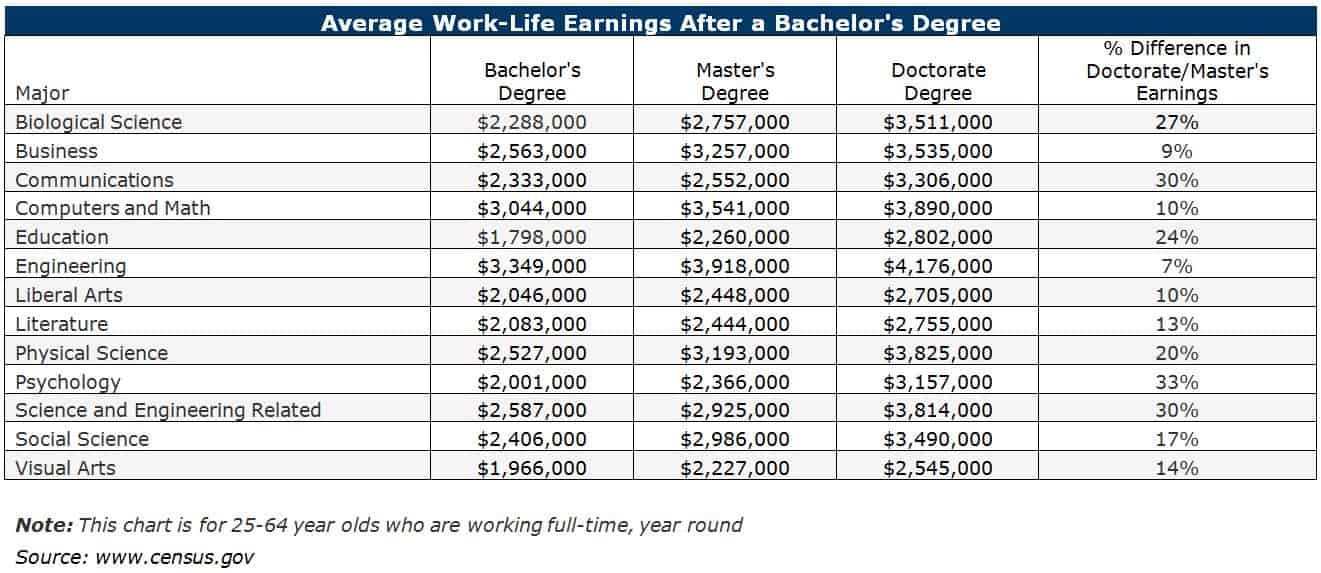
1. What it shows: Students good enough to get accepted into PhD programs are good enough to get paid more in general. Good we're talking about this -- the market clearly values these people!
2. What it misses: ... But what if a PhD-capable person instead just went directly into industry? What is the opportunity cost of taking a pause of 4-7 years to do R&D for the public?
3. What economists found: By looking at students graduating from a good school and therefore PhD-capable, and then comparing the result of them doing 4-7 years of PhD vs not.. the students who took time to contribute to science lost out on a ton of money. They're quite literally donating their time to society.
Phrasing it as _subsidizing_ these people to do R&D is misleading. The reality is the government is underpaying for the public service of growing the economy, especially relative to market rates for people equally qualified to make a bunch of $$$ working on social media ads and fancy juice machines.
But that breaks the narrative. The actual studies show the salary sweet spot is somewhere between a BS and MS. That means federal institutions must _lure_ PhDs, not drive them away.
This sort of uncharitable swiping breaks the HN guidelines. So do insinuations of astroturfing, which you did elsewhere in this thread. I realize it can be hard to restrain oneself when someone else is wrong on the internet, but please make the effort and edit such acid out of your comments if you want to keep posting here. You can always set 'delay' in your profile to give yourself time to edit before others see your comment; that's what I do.
1. Value: Your census data shows PhDs have a high $ value. Data shows your supposition is wrong: the gov already underpays for PhD-candidate-caliber labor relative to market by 2-3X.
2+3. What if + data: Dropouts have resume stigma, so I'm not sure why that measures what you want. For the "phd or industry?" decision facing BS grads, you can do a back-of-envelope in < 3 minutes. Arbitrarily, I picked Cornell 2010 BS grads, where students chose between a ~$75K salary vs going to a top 10 MS/PhD: https://www.cs.cornell.edu/undergrad/cscareers/placementrepo... . Berkeley falls in that bucket, with stipends being around $30K and MS/PhDs earning ~$105K. Assuming a ~5% annual bonus, 2yr MS and 5yr PhD... MS students out-earn everyone within 7 years, and it takes 20 years for a PhD to start to catch up to a BS, and with a low salary for some of their best years. For fun, also read up on impacts for things like having children. Professors explicitly tell students not to do a PhD for money because of the opportunity cost. HN friendly is ex-Harvard Matt Walsh.
The rest of your comment continues to be bogus:
-- There's underpaid, and there's systemically eating the seed corn.
-- If you're against using the tax code to incentivize behavior... this change without a compensating increase in R&D funding means Republicans are using the tax code to disincentivize American R&D
-- Previous generations, according to _data_, paid way less for their opportunities: https://www.economist.com/news/united-states/21567373-americ... . The trend has been getting even worse since the 90s, as is worsening R&D funding, which is curiously correlated with anti-intellectualism in the Republican party.
-- Students are doing it for charity and thus can take more cuts? As a fun example, UCSF, a top medical program (as in, actively solving cancer), can no longer provide subsidized housing for its PhDs, and has been losing its ability to enroll top students. Squeezing them further will have predictable results.
The one argument I'd agree to, and you aren't using, is that administration costs are increasing. However, cutting grad student wages is evil. It sets fire to seed corn instead of the administrators, so we know who'll burn first.
If you care about economic impact, you should be increasing funding, not eating the seed corn.
And as my above post, it seems you are either unaware of what R&D does and who does it, or are effectively performing the work of a paid Russian troll.
I meet plenty of PhD's in my regular practice. Not every person earns a PhD and stays in academia. PLENTY earn that degree and use it as a stepping stone to a high-paying job in the private sector.
As for oil executives: they're not going to be the biggest winners here. Shareholders likely will be. That repatriated capital is going to lead to a huge share buyback and dividends. Wanna know who's going to get a large chunk of that? PENSION FUNDS for state employees. If you think CALPERS doesn't stand to benefit from this surging stock market you're not paying attention.
I wonder if you realize how much you sound like a lobbyist? Without a tax subsidy, there is a calamity. Every time someone warns that a tax increase will affect investment or job creation or cause a shift in the deployment of capital, people in favor of said increase downplay those fears.
All the folks who said that a $15 minimum wage would kill job creation....were those folks wrong?
And here we are, hearing that the removal of a special tax treatment will massively impact graduate education. Well, maybe. Maybe not. I guess we will have to see.
So the cost to a student to receive a PhD goes up a bit. Big deal. Is that gonna kill research entirely? There is already a glut of PhDs here in the USA. Maybe a few less isn't such a bad thing.