Re:Mathematicians Measure Infinities, Find They’re Equal
by agf on Wednesday September 13, 2017 @12:30PM
(#15239875)
No, this is incorrect. You can map the set of rational numbers to the set of natural numbers. The set of reals in that range is shown to be uncountably infinite by Cantor diagonalization.
https://www.reddit.com/r/explainlikeimfive/comments/1r5aya/e...
Re:Mathematicians Measure Infinities, Find They’re Equal
by deckar01 on Wednesday September 13, 2017 @12:46PM
(#15240052)
Ah, I was thinking of the rationals. Thanks for the ELI5 link.
Re:Mathematicians Measure Infinities, Find They’re Equal
by georgeam on Wednesday September 13, 2017 @12:26PM
(#15239833)
Actually if you meant to say that the real numbers in [0,1) map bijectively to the set of natural numbers, that is incorrect.
See https://en.wikipedia.org/wiki/Unit_interval
under the section "Cardinality".
Re:Mathematicians Measure Infinities, Find They’re Equal
by threatofrain on Wednesday September 13, 2017 @12:18PM
(#15239733)
Another thing which has bothered me in the past was that a set of 2-tuple integers could be mapped by a set of 1-tuple integers, seemingly without any information loss.
Re:Mathematicians Measure Infinities, Find They’re Equal
by kgwgk on Wednesday September 13, 2017 @12:34PM
(#15239927)
The "seemingly" suggests that you remain unconvinced. If you define for example some kind of distance between an arbitrary (x,y) and (0,0), for any (x,y) you can easily count how many points are closer to the origin. There may be ties but it's easy to define a rule to break them. This means you can order all the pairs of integers: (0,0), (1,0), (0,1), (-1,0), (0, -1), (1,1), (1,-1), (-1,-1), (-1,1), (2,0),....
Re:Mathematicians Measure Infinities, Find They’re Equal
by rhart92 on Wednesday September 13, 2017 @12:27PM
(#15239847)
I am not sure if you have heard of them, but space-filling curves are a way to demonstrate this. This is a great video on the Hilbert curve https://www.youtube.com/watch?v=3s7h2MHQtxc
Re:Mathematicians Measure Infinities, Find They’re Equal
by jakef on Wednesday September 13, 2017 @12:57PM
(#15240168)
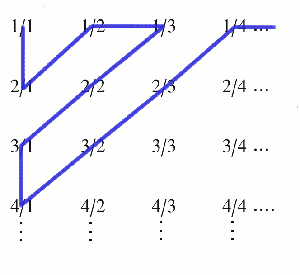
This picture is for natural numbers but it shows you one way to do the mapping:
https://plus.maths.org/issue47/features/macgregor/diagram3.g...
Re:Mathematicians Measure Infinities, Find They’re Equal
by semi-extrinsic on Wednesday September 13, 2017 @12:21PM
(#15239761)
See Cantor's diagonalization argument for exactly how to do this mapping.
Re:Mathematicians Measure Infinities, Find They’re Equal
by protonfish on Wednesday September 13, 2017 @12:24PM
(#15239795)
How? Which real number maps to the natural number 42?
Edit: real -> rational