http://graemebell.net/pubs/taros05-bl-embedded-preprint.pdf
Section 3 has some low dimensional examples with simulated robots and donkeys.
Take a look at Figure 3 with the donkey.
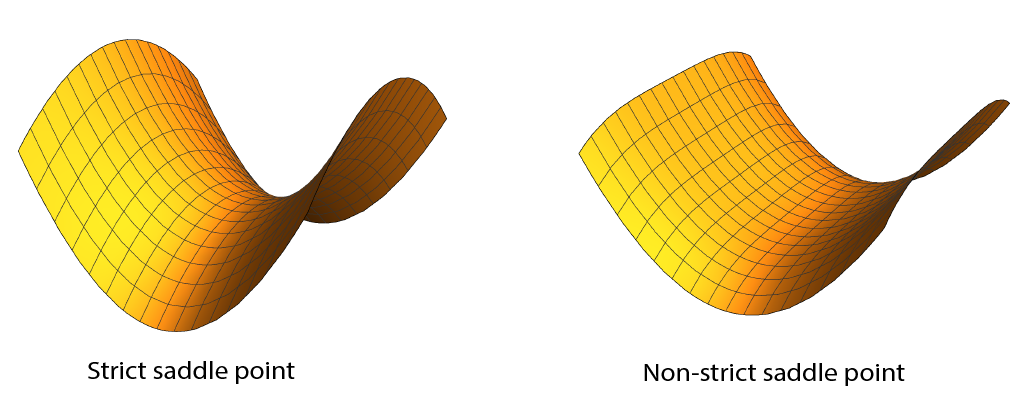
Burridan's Ass is a classic philosophical example where a saddle point prevents success.
Basically, place a donkey between two piles of food in front of it that are equally attractive. The donkey moves in whatever direction will take it towards food.
So at first, it can move forward (reducing its distance to both piles of food) up to a point, but then it gets stuck because both piles are equally attractive. It can't move forward or back either because that moves it away from both piles of food.
There is nothing to 'push' the donkey to the left or the right.
('push'/hunger being analogous to 'following the gradient' for neural net training or robot navigation here)
If you add a bit of a random wobble, it's enough to free the donkey from its indecision and make one of the piles slightly closer.
But things are more complex than that especially as you move into higher-dimensions of space beyond 2D and 3D [as you see when training neural nets, for example].
And a random wobble is not enough to guarantee success. It may have consequences for physical devices (your robot shakes around and falls over), it may have consequences for realism and immersion in games/simulations (the AI monster stops and does a mad shake for a minute to creep its way around a rock to get you, rather than moving smoothly/normally around the rock)
It's funny -- I can imagine a real human (perhaps a particularly anxious one) stall in indecision wondering which similar-looking pile held more value or which was closer. Fear of wasted time would likely force them to make a decision. And once they committed to a pile they would likely continue until/unless they discovered new information.
What if the agent had a list of waypoints and only re-evaluated the list every N ticks or when the horizon reveals something new?
I know very little about AI so I have no idea if this is out of scope or could possibly apply.
I assume you are vaguely familiar with gradient descent. In gradient descent, we are basically trying to find the sweet spot where the value of a function is minimized. We do this by calculating the derivative of the function at a certain point and then use it to take small steps in the direction where we believe the function will have a lower value.
Gradient descent usually suffers from a problem where the algorithm gets stuck in local minimas if the function is not convex in shape.
However, when people use gradient descent to optimize functions with a very large number of parameters (as is the case in Deep Learning), another problem surfaces called saddle points. Imagine a 3 dimensional plot of the function at different values of its parameters (in reality the plot will be multi-dimensional). Now on this plot, there will be many regions where the derivative of the components defining the surface become zero. This messes with our plan to use derivatives to find the direction in which to move. So we need to come up with strategies to escape saddle points during the gradient descent process.
Also, what about the case where the function isn't continuous or where it's not defined everywhere (the surface has holes)?
I'm not sure what you mean. Apart from the linear case (which is weakly convex), most convex functions are non-linear. So yes, it is not only possible, it is the norm (in a colloquial sense). Refer to this for a mathematical definition of convexity: https://en.wikipedia.org/wiki/Convex_function
> Also, what about the case where the function isn't continuous or where it's not defined everywhere (the surface has holes)?
There are two different cases:
1) Discontinuous functions: these are by definition nonconvex e.g. step functions. Gradient-descent methods cannot handle these directly; typically they are modeled as mixed-integer problems.
2) Non-smooth functions: are convex but do not have derivatives defined everywhere. e.g. abs(x). Gradient-descent methods don't work well on these types of functions. These typically require subgradient/bundle methods, or can be modeled as discontinuous functions.
d/dx √(x²) = x/√(x²)
The "volume" (or "area" in the 2D case) above the graph is called an epigraph.
One property of convex functions is that their epigraphs are convex sets (note the word "sets" this time). https://en.wikipedia.org/wiki/Epigraph_(mathematics)
Convex sets are more abstract in meaning, but in general in means can draw a straight-line between any two points in the region without going outside of the region.
Perhaps your notion of convexity comes from a mental idea of the shapes of convex and concave lenses? Those are good visualizations but in mathematics, convexity has a subtler, more rigorous meaning. With this rigorous meaning comes many nice mathematical properties that make optimizing them easier than nonconvex functions.
{ (x, y) : f(x) <= y }
(1 - t) f(x) + t f(y) >= f((1 - t) x + t y) for all 0 <= t <= 1
Convex function must be defined on a convex domain (no holes) and continuous at everywhere except the boundary of the domain.
[1]: http://bair.berkeley.edu/blog/assets/saddle_eff/strictsaddle...